Pre-Writing Word Budget
[INTERNAL PLANNING DOCUMENT — Remove before publication. Submit each content section separately for editorial review.]
Introduction
In December 1997, a structural steel erection contractor in the Sampson Steel case lifted a 200-pound bundle of crossbraces when the crane boom fell — injuring a signalman (broken feet, massive contusions) and an ironworker (facial lacerations). OSHA's accident record identifies the cause as a sprag clutch not maintained per manufacturer specifications. One maintenance failure. Two injured workers.
That record is why OSHA crane inspection requirements for steel erection exist as enforceable standards, not voluntary guidelines.
Cranes used in steel erection are governed by 29 CFR 1926.753 under Subpart R, a standard that supplements (not replaces) the general construction crane rules under Subpart CC. The distinction matters: contractors who rely only on the general crane standard are operating with gaps.
This article covers what Subpart R actually requires — who conducts inspections, what they examine, how failures are handled, and the operational rules specific to steel erection sites.
Key Takeaways
- Pre-shift visual crane inspections under 29 CFR 1926.753(c)(1) must happen before every shift
- A competent person conducts the crane inspection; a separate qualified rigger inspects the rigging
- Any deficiency that creates a hazard requires mandatory crane removal from service
- Steel erection imposes additional requirements — suspended load paths, multiple-lift procedures, and hook latch use — that the general crane standard does not cover
Why Steel Erection Crane Inspections Have Their Own Rules
Steel erection is not typical crane work. Ironworkers make initial connections on structural members while suspended loads hang nearby. Crews sometimes ride personnel platforms to reach elevated connection points. Multiple structural members may be hoisted in a single "Christmas tree" lift. These conditions create hazard exposures that standard crane operations simply don't present.
That reality drove OSHA to publish a supplemental steel erection standard — finalized January 18, 2001, at 66 FR 5196, effective January 18, 2002. In its rulemaking, OSHA estimated that structural metal workers suffered an average of 35 fatalities and 2,279 lost-workday injuries annually from 1994 to 1998, and projected the new standard would prevent 30 deaths and 1,142 serious injuries per year.
How Subpart R Relates to Subpart CC
Those injury numbers explain why OSHA didn't simply expand Subpart CC — steel erection needed its own layer of requirements on top of the general crane standard:
- 29 CFR 1926.753(a) states that all provisions of Subpart CC apply to hoisting and rigging in steel erection — with one exception: § 1926.1431(a)
- Paragraphs (c) through (e) of 1926.753 then layer steel-erection-specific requirements on top of that Subpart CC baseline
Subpart CC is the floor. Subpart R raises it. A contractor who only complies with Subpart CC on a steel erection project is not fully compliant.
Pre-Shift Visual Crane Inspection: 29 CFR 1926.753(c)(1)
Every crane used in steel erection must be visually inspected before each shift by a competent person. The inspection must include observation for deficiencies during operation — not just a static walkaround before the hook goes in the air.
Who Qualifies as a Competent Person?
Under 29 CFR 1926.32(f), a competent person is someone who:
- Can identify existing and predictable hazards in the work environment
- Has the authority to take corrective measures immediately
This is not a certification — it's a demonstrated capability recognized by the employer. Many contractors assume any experienced operator qualifies automatically, but OSHA enforcement holds employers to a specific standard — good intentions don't substitute for demonstrated hazard recognition.
What the Inspection Must Cover
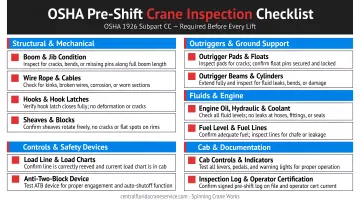
29 CFR 1926.753(c)(1)(i) lists twelve required inspection items at minimum:
Mechanical and Control Systems:
- All control mechanisms for maladjustments
- Control and drive mechanisms for excessive wear or contamination by lubricants, water, or foreign matter
- Safety devices: boom-angle indicators, boom stops, boom kick-out devices, anti-two block devices, and load moment indicators where required
Structural and Fluid Systems:
- Air, hydraulic, and pressurized lines for deterioration or leakage — especially lines that flex during normal operation
- Hooks and latches for deformation, chemical damage, cracks, or wear
- Wire rope reeving for compliance with the manufacturer's specifications
- Hydraulic system fluid levels
Electrical Apparatus:
- Signs of malfunctioning, excessive deterioration, dirt, or moisture accumulation
Ground Conditions and Positioning:
- Conditions around the hoisting equipment for proper support — including ground settling under outriggers and groundwater accumulation
- Crane level position — checked initially and again after each move and setup
In Florida's heat and humidity, electrical and fluid checks carry extra weight. High ambient moisture accelerates corrosion on electrical connectors, and hydraulic contamination has contributed to control failures during lifts — both are recurring factors in OSHA accident investigation records.
The ground condition check is not a one-time item. Every time the crane repositions, it must be re-evaluated. OSHA built the repeat-check requirement directly in response to fatal tip-overs caused by soft or uneven ground under outriggers — those incidents are part of the regulatory record behind this rule.
Rigging Inspection: The Qualified Rigger Requirement
The crane inspection and the rigging inspection are two separate requirements. 29 CFR 1926.753(c)(2) states:
"A qualified rigger (a rigger who is also a qualified person) shall inspect the rigging prior to each shift in accordance with § 1926.251."
A qualified rigger has specific knowledge, training, and demonstrated ability to solve problems related to rigging loads for the specific job and equipment. OSHA's Qualified Rigger fact sheet confirms riggers do not have to be certified by an accredited third-party organization. They must, however, genuinely meet the knowledge and experience standard, not just hold a title.
What the Rigging Inspection Covers Under 29 CFR 1926.251
- Inspect slings each shift; remove any damaged sling from service immediately
- Verify hooks bear legible safe working load markings — unreadable capacity markings render rigging unsafe regardless of physical appearance
- Confirm shackles and attachments meet safe working load ratings before use
- Check all rigging hardware for condition and load rating compliance
At Spinning Crane Works, each steel erection crew includes a certified crane operator and a qualified rigger as separate crew members. That structure ensures both the crane inspection and rigging inspection are completed by appropriately qualified individuals before the shift begins.
When a Deficiency Is Found: The Out-of-Service Protocol
A discovered deficiency triggers a mandatory three-step sequence under 29 CFR 1926.753(c)(1)(ii) and (iii):
- Immediate hazard determination — the competent person must assess whether the deficiency constitutes a hazard. This determination must happen immediately, not at the end of the shift.
- Remove from service — if the deficiency is a hazard, the crane must be taken out of service until the deficiency is corrected. No partial use. No lighter lifts in the meantime.
- Operator authority — under 29 CFR 1926.753(c)(1)(iv), the crane operator has explicit authority to stop and refuse to handle loads whenever there is doubt about safety. Schedule pressure from a GC or steel erector does not override this.
What "Removed from Service" Means on a Live Site
There's sometimes confusion about this on active job sites. A crane removed from service is fully grounded — no exceptions:
- No hoisting of any kind until the deficiency is corrected and a follow-up check is completed
- No "smaller picks" or "low-risk" tasks while the hazard remains unresolved
Documentation best practice: While 29 CFR 1926.753 does not mandate a specific daily log format, broader industry practice — and Subpart CC provisions incorporated through 1926.753(a) — require keeping inspection logs in the crane cab and available to site safety personnel at all times.
Those records are your primary defense if OSHA responds to an incident. Current penalties run up to $16,550 per serious violation and $165,514 per willful or repeat violation — gaps in your inspection log can turn a correctable finding into a willful citation.
Special Operational Rules for Cranes in Steel Erection
Subpart R doesn't stop at equipment inspection — it governs how the crane is operated during steel erection, covering load routing, multi-member lifts, safety latches, and personnel hoisting.
Working Under Suspended Loads
Under 29 CFR 1926.753(d)(1), load routes must be pre-planned so that no worker is required to be directly below a suspended load — with two narrow exceptions:
- Workers making initial steel connections
- Workers necessary for hooking or unhooking the load
When workers must be under suspended loads, three conditions apply:
- Materials must be rigged to prevent unintentional displacement
- Hooks must have self-closing safety latches
- All loads must be rigged by a qualified rigger
Multiple Lift (Christmas Tree) Rigging Procedures
OSHA permits multiple-member lifts under 29 CFR 1926.753(e), but the requirements are specific:
- Maximum of five structural members per lift (beams and similar members only)
- Rigging assembly must be certified with a 5-to-1 safety factor for all components
- Members attached at center of gravity, rigged top-down, spaced at least 7 feet apart
- Members set in position from the bottom up
- Controlled load lowering required whenever the load is over connectors
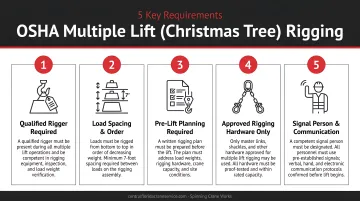
Fewer crane swings mean less exposure time for ironworkers — but multi-member lifts introduce failure modes that single-pick lifts don't, which is why the procedural requirements are non-negotiable.
Safety Latches and Personnel Hoisting
Safety latches on hooks must remain operable unless a qualified rigger determines that hooking purlins or single joists is safer without them, or a site-specific erection plan specifies equivalent protection.
Personnel hoisting rules in steel erection differ from general construction — no infeasibility showing is required. Under 29 CFR 1926.753(c)(4), cranes may hoist employees on a personnel platform provided:
- All provisions of § 1926.1431 (except subsection (a)) are met
- The headache ball, hook, or load itself is never used to transport personnel
Outside those conditions, hoisting personnel on the load or hook is prohibited without exception.
Frequently Asked Questions
How often does OSHA require cranes to be inspected?
Under 29 CFR 1926.753(c)(1), cranes used in steel erection require a visual pre-shift inspection by a competent person before each shift. Subpart CC also mandates monthly inspections (records kept 3 months) and annual comprehensive inspections by a qualified person (records kept 12 months).
What is the OSHA regulation dealing with steel erection?
Steel erection is governed by 29 CFR 1926 Subpart R. Crane-specific hoisting and rigging requirements appear in 29 CFR 1926.753, which supplements the general construction crane standard under Subpart CC. Both apply simultaneously on steel erection sites.
What should be regularly inspected to ensure safety during steel erection?
The pre-shift crane inspection covers control mechanisms, safety devices, pressurized lines, hooks and latches, wire rope reeving, electrical apparatus, hydraulic fluid levels, tires, ground conditions, and crane level. A qualified rigger separately checks all rigging hardware — slings, shackles, and hooks.
Who qualifies as a "competent person" for crane inspection under OSHA?
A competent person is someone capable of identifying existing and predictable hazards and who has employer-granted authority to take corrective action. This is not a certification requirement — it's a demonstrated knowledge and authority standard that the employer must document.
What happens if a deficiency is found during a pre-shift crane inspection?
The competent person must immediately assess whether the deficiency is a hazard. If it is, the crane must be removed from service until corrected. No hoisting is permitted until the deficiency is corrected and the crane re-inspected.
Does the crane operator have the authority to stop work if they feel the lift is unsafe?
Yes. Under 29 CFR 1926.753(c)(1)(iv), the operator is explicitly responsible for operations under their direct control and has the authority to stop and refuse to handle loads whenever there is any doubt about safety — regardless of schedule or site pressure.