
Introduction
Crane incidents rarely trace back to equipment failure alone. Lift teams often struggle with planning gaps: a verbally estimated load weight, an unverified ground condition, or an unmapped power line near the boom path.
In an industry safety analysis of 632 construction crane deaths, the leading fatal event categories were electrocution (25%), struck-by loads (21%), and crane collapse (14%). Each can be addressed through pre-lift planning. That pattern matters.
This article walks through five questions operators, riggers, site supervisors, and contractors can apply before a crane moves a load.
Whether you're placing an HVAC unit on a Tampa rooftop or erecting a cell tower outside Jacksonville, these questions create a practical decision-making framework. The goal is simple: turn planning from paperwork into a real safety control.
Key Takeaways
- A crane lift plan defines the lift objective, hazards, controls, and personnel roles before any load moves.
- The five questions cover: what should happen, what could go wrong, how likely is it, what are the consequences, and how do you control them.
- Overhead power lines account for 25% of crane-related construction deaths — they must be identified and mapped before every lift.
- Florida's sandy soils, high water tables, and afternoon storm patterns create hazards that demand site-specific planning beyond national minimums.
- Lifts exceeding 75% of rated capacity, multi-crane lifts, or lifts over occupied structures require a more detailed critical lift plan.
What Is a Crane Lift Plan and Why Does Every Lift Need One?
A crane lift plan is a formal document, or at minimum a structured verbal process, that defines every relevant aspect of a lifting operation before it begins. Think of it as the answer to one fundamental question: "Has everyone on this site agreed on exactly what's about to happen?"
ASME P30.1 – Planning for Load Handling Activities establishes the planning framework used across the industry, categorizing lifts into standard and critical types and defining what each level of planning must address. OSHA's 29 CFR 1926 Subpart CC adds enforceable requirements, especially for ground conditions, power-line clearances, load-weight verification, and multi-crane operations.
What a Complete Lift Plan Must Cover
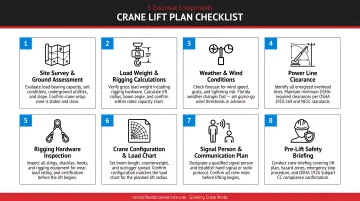
A sound plan addresses all of the following:
- Load data — confirmed weight, dimensions, and center of gravity
- Crane type and configuration — capacity, boom length, radius, counterweight setup
- Rigging details — sling type, angle, hardware ratings, attachment points
- Site diagram — crane setup position, load travel path, landing zone, obstructions
- Personnel assignments — operator, rigger, signal person, lift director
- Communication method — hand signals, radio channel, backup protocol
- Hazard analysis — identified risks with probability and severity ratings
- Approval signatures — from all responsible parties before mobilization
Not Just for Heavy or Complex Lifts
Lift plans aren't reserved for 50-ton picks over occupied buildings. A routine HVAC unit placement or power pole installation involves unique variables (site layout, soil conditions, overhead utilities, crew familiarity) that change with every job. Even a few-hundred-pound load can cause a fatality if the crane setup is wrong.
The plan doesn't need to be elaborate for every job. What it needs to be is complete, communicated, and agreed upon before anyone picks up a rigging hook.
Question 1: What Do You Expect to Happen?
This question forces the team to define the intended outcome in concrete operational terms: where the load starts, the path it travels, where it lands, and who is responsible at each stage.
Confirming Load Data
Under OSHA 1926.1417, the operator must verify that the load is within rated capacity using at least one recognized method: manufacturer data, reliable calculation, or other equally reliable means. A verbal estimate from a contractor is not sufficient.
Before the lift, confirm:
- Exact weight: manufacturer specs, certified scale ticket, or engineered estimate
- Dimensions: overhang, protrusions, or irregular geometry
- Center of gravity: the point that determines where slings attach and how the load hangs
- Tag line or load handler needs: for loads that may rotate or drift
Overloading is a documented cause of fatal crane collapses. Accurate load data is the foundation of every capacity calculation that follows.
Matching Crane Configuration to the Expected Outcome
Once the team confirms the load data, match the crane configuration to the planned lift. Boom length, working radius, and counterweight setup determine the crane's load chart position and the percentage of rated capacity the lift will use.
A lift at 60% of rated capacity leaves meaningful margin. A lift at 88% leaves almost none. That distinction drives everything from the setup position to whether the lift qualifies as critical.
The Site Diagram and Pre-Lift Meeting
A site diagram maps the crane's setup position, the load's travel path, the landing zone, and known obstructions. Build it before crews arrive for the lift so the full team works from the same sequence of events.
The pre-lift meeting (toolbox talk) is where that plan gets communicated. Every person involved, including the operator, riggers, signal person, and supervisor, should leave that meeting knowing exactly what's supposed to happen and what their role is when it does.
Questions 2 & 3: What Could Go Wrong — and How Likely Is It?
Hazard identification (Question 2) and probability assessment (Question 3) are two distinct steps. The first asks the team to identify every condition that could disrupt the planned outcome.
The second asks how likely each one actually is, given current site conditions, not generic assumptions.
Identifying Common Hazards
Ground conditions are one of the most underestimated hazards in Florida crane work. OSHA 1926.1402 requires firm, drained, and graded ground before crane setup, with mats, cribbing, or blocking deployed where needed.
In a 2023 OSHA enforcement case from Orlando, a large mobile crane tipped over after an outrigger gave way on inadequate ground, killing a worker. The contractor was cited for failing to verify that the ground could support the crane.
Overhead power lines are the leading source of crane electrocution deaths. According to industry safety research on crane-related deaths, 157 of 632 crane-related construction fatalities, or 25%, involved power-line contact.
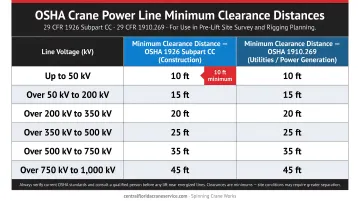
OSHA 1926.1408 requires employers to assess whether any part of the equipment, load line, or load could come within 20 feet of a power line up to 350 kV before work begins. Minimum clearances from OSHA Table A:
| Voltage | Minimum Clearance |
|---|---|
| Up to 50 kV | 10 ft |
| Over 50 to 200 kV | 15 ft |
| Over 200 to 350 kV | 20 ft |
| Over 350 to 500 kV | 25 ft |
| Over 500 to 750 kV | 35 ft |
For Spinning Crane Works' team, which regularly handles cell tower and power pole installations throughout Central and South Florida, this risk is familiar. Experience around energized lines helps planners spot encroachment risk before the boom is already in position.
Weather can change between morning and afternoon on a Florida workday. Go/no-go thresholds should be set before the lift begins, not negotiated mid-operation as conditions deteriorate.
Watch for:
- Wind speed at boom height exceeding ground-level readings
- Rain that reduces visibility and makes load control harder
- Lightning that creates an immediate stop-work condition
Assessing Likelihood in Context
Risk probability depends on the jobsite. A power-line hazard rates higher when the crane's swing radius places the boom within 30 feet of an energized line. A weather hazard rates higher when the afternoon forecast shows a 70% chance of thunderstorms.
A job hazard analysis (JHA) or pre-lift risk matrix documents this step by assigning each identified hazard a probability level: high, medium, or low. The rating should be based on current conditions, so no hazard gets dismissed as "unlikely" unless that call is deliberate and recorded.
Questions 4 & 5: What Are the Consequences — and How Do You Control Them?
Questions 4 & 5: What Are the Consequences and How Do You Control Them?
Question 4 shifts focus from probability to impact. A hazard with a low chance of occurring can still demand the highest level of control if its consequences are catastrophic and irreversible.
A load dropped over an occupied area. A boom contacting an energized line. A stability failure during a pick over an active utility corridor. These events don't offer recovery. The control measures must be proportional to the severity of the outcome, not just the odds of it happening.
When Consequences Escalate to a Critical Lift Plan
This is the mechanism that triggers an escalation from a standard lift plan to a critical lift plan. USACE EM 385-1-1 and NSSGA's industry benchmarks both identify the critical lift threshold at 75% or more of the crane's rated capacity for a given configuration, along with multi-crane lifts, lifts over occupied structures, and lifts over public spaces.
At these thresholds, a small error can carry severe consequences: a slightly higher-than-reported load weight, a wind gust at the wrong moment, or a rigging angle miscalculation. The standard planning process is no longer enough.
Applying the Hierarchy of Controls
Question 5 asks which controls the lift team will use for each identified hazard. Controls should follow the OSHA/NIOSH hierarchy, from most to least effective:
- Elimination or substitution — Can the lift be redesigned to reduce risk? Is there a different approach that avoids the hazard?
- Engineering controls — Outrigger mats, load cells, anti-two-block devices, crane-mounted anemometers
- Administrative controls — Exclusion zones, certified personnel only, defined communication protocols, documented pre-lift meetings
- PPE — Hard hats, high-visibility vests, fall protection where applicable
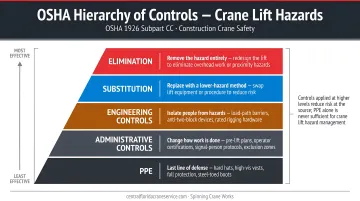
Match each control to a specific hazard. Generic controls that ignore the hazard analysis create paperwork that looks like safety management but does little to reduce risk.
Contingency Planning
The plan must also define what happens when conditions change mid-lift. An unexpected wind gust. Ground movement under an outrigger. A rigging concern noticed after the load is in the air. Every team member needs to know the stop-work protocol before the lift starts, and that protocol must be explicit, not assumed.
Site-Specific Factors for Crane Lift Planning in Florida
Florida's operating environment elevates several hazards above what national-level planning guides typically address.
Ground Conditions
Florida's coastal and inland soils, often sandy, filled, or affected by high water tables, can carry lower bearing capacity than rocky or compacted terrain in other regions.
Subsurface voids, duct banks, and utilities are common near urban job sites. OSHA requires firm, drained, graded ground before crane setup, but in Florida that often means active site preparation: soil investigation, mat sizing, and cribbing placement based on actual outrigger loads.
The 2023 Orlando crane tip-over, which resulted in a worker fatality and a $16,131 OSHA penalty for the contractor, illustrates what happens when that preparation step is treated as a formality.
Weather Volatility
Florida's rainy season runs roughly May through mid-October, with afternoon thunderstorm activity that can develop within 30 to 45 minutes. The National Weather Service Tampa Bay office notes a peak severe-storm phase in late May through June, with damaging winds and frequent lightning, followed by a high-rainfall period through early September.
For Florida lift plans, this means:
- Morning-only forecasts miss fast changes, especially when storms build by midday
- Real-time weather monitoring on-site is a practical necessity during storm season
- Set go/no-go thresholds for wind, lightning proximity, and visibility before mobilization
Congested Setup Areas
Florida job sites often leave little room for error: HVAC rooftop placements on occupied commercial buildings, cell tower erections in suburban corridors, and power pole installations along utility rights-of-way all restrict swing radius and crane positioning options.
In these environments, the site diagram produced during Question 1 becomes more than documentation. It helps prevent a costly crane repositioning mid-job or, worse, a swing-radius encroachment discovered after the boom is already moving.
Standard vs. Critical Lift Plans: Know the Difference
Not every lift requires the same level of documentation. Knowing the threshold, and when to cross it, is a non-negotiable part of the lift director's role.
What Triggers a Critical Lift Plan
Per USACE EM 385-1-1 and NSSGA industry standards, a critical lift plan is required when any of the following conditions apply:
- The lift exceeds 75% of the crane's rated capacity for that configuration
- Two or more cranes share a single load (multi-crane lift)
- The lift occurs over an occupied structure or active utility
- The lift involves personnel hoisting
The OSHA 1926.1432 multiple-crane lift standard adds that multiple-crane or derrick lifts must be planned by a qualified person and directed by someone meeting both competent-person and qualified-person criteria.
Operator Judgment as a Trigger
The 75% threshold isn't the only trigger. A crane operator or lift director should escalate a technically standard lift when site congestion, unusual rigging geometry, visibility limits, or uncertain ground conditions raise the risk.
For example, a rooftop HVAC pick in coastal Florida winds may need critical-lift review even if the load chart shows capacity.
That judgment call shows the lift plan working as intended: identify changing conditions early, then adjust the approval path before the hook goes up.
Practical Differences in Documentation
| Element | Standard Lift Plan | Critical Lift Plan |
|---|---|---|
| Required signatures | Lift director, operator | Adds project manager, safety manager, sometimes a PE |
| Load calculations | Basic capacity check | Detailed engineering calculations |
| Contingency procedures | Recommended | Required and documented |
| Submission timeline | 24–48 hours before lift | 5+ days before crane mobilization (industry benchmark) |
| PE review | Not typically required | May be required depending on owner policy |
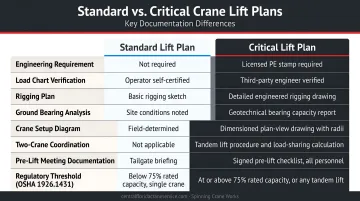
Critical-lift requirements should match the severity of the possible consequences, especially when a failed pick could damage utilities, structures, or occupied work areas.
Frequently Asked Questions
What should a crane lift plan include?
A complete lift plan should cover the load weight, dimensions, center of gravity, crane setup, rigging method, site diagram, crew roles, communication plan, hazard controls, and required approvals.
Does OSHA require a crane lift plan for every lift?
OSHA 29 CFR 1926 Subpart CC does not require a written plan for every standard mobile crane lift. It does require proper planning, qualified-person involvement, and added documentation for higher-risk lifts.
What is a critical lift plan and when is one required?
A critical lift plan is used for higher-risk work, such as multi-crane picks, lifts over occupied areas, or lifts near a site’s rated-capacity threshold. Many owners use 75% capacity as the trigger.
Who is responsible for creating a crane lift plan?
The lift director, working with the crane operator, rigger, and site supervisor, is responsible for making sure the plan is complete. Every crew member should review it before work starts.
How far in advance should a crane lift plan be submitted?
Standard lift plans should be completed 24–48 hours before the load moves. Critical lift plans often need five or more days for review, depending on owner or site policy.
Can a crane operator stop a lift if something doesn't look right?
Yes. The operator and lift director can stop the lift when conditions create a safety concern, and that stop-work authority should be clear in the plan.