Introduction
A single crane lift gone wrong can result in fatalities, structural damage, and project shutdowns that cost far more than the lift itself. According to the Bureau of Labor Statistics, 297 crane-related workplace deaths occurred between 2011 and 2017 — an average of 42 per year — with private construction accounting for 43% of those fatalities. Struck-by events made up more than half of all fatal incidents.
Whether you're managing a factory floor, overseeing a cell tower erection, or coordinating HVAC placements on commercial rooftops, crane operations leave no room for error — one miscalculation can end the job, or someone's life.
This guide covers what contractors, site managers, and industrial operators need to run crane operations correctly: the right equipment for the job, defined team roles, OSHA compliance requirements, pre-operation inspection protocols, and safe operating practices.
TLDR
- Two separate OSHA standards govern crane operations: 29 CFR 1910.179 for general industry and 29 CFR 1926 Subpart CC for construction
- Four defined roles carry distinct legal accountability: Crane Owner, Crane User, Site Supervisor, and Lift Director
- Willful OSHA violations can reach $165,514 per violation — compliance isn't optional
- Pre-operation inspection is a documented, three-tier requirement with legal and safety consequences
- Choosing a crane service requires vetting certifications, equipment specs, and power line experience
Types of Cranes Used in Industrial Settings
The Regulatory Split That Drives Equipment Selection
Which OSHA standard applies to your operation determines operator qualification requirements, inspection protocols, and liability exposure. Get this wrong, and compliance gaps follow before a single lift takes place.
- 29 CFR 1910.179 covers overhead and gantry cranes in general industry settings: factories, warehouses, shipyards, and similar fixed facilities
- 29 CFR 1926 Subpart CC covers mobile, tower, crawler, and other cranes used in construction on active job sites
Businesses that operate in both environments — a manufacturer that also does on-site installation work, for example — need compliance programs that address both standards.
Common Crane Types and Their Industrial Applications
| Crane Type | Regulatory Standard | Typical Use Case |
|---|---|---|
| Overhead/bridge crane | 1910.179 | Factory floor material handling, assembly lines |
| Jib crane | 1910.179 (if wall/overhead-configured) | Workstation lifting, warehouse optimization |
| Mobile crane (truck/rough-terrain) | 1926 Subpart CC | HVAC rooftop placements, utility work |
| Tower crane | 1926 Subpart CC (§1926.1435) | High-rise construction, large infrastructure |
| Crawler crane | 1926 Subpart CC | Heavy lifts on soft or uneven terrain |
Matching Crane Capacity to the Job
Crane selection is a foundational safety decision. Matching the wrong crane to a job creates overload risk before the hook is even attached.
Key selection criteria:
- Heavy lifts or extreme heights require heavy-duty boom cranes with full load rating documentation
- Confined indoor environments call for overhead or jib cranes that operate within fixed runways
- Outdoor industrial sites with variable ground conditions often require rough-terrain or crawler configurations
- Telecom and utility work — erecting cell towers or power poles — demands cranes with both high reach and the ability to operate safely near energized infrastructure
Key Roles and Responsibilities in Crane Operations
Key Roles and Responsibilities in Crane Operations
ASME B30.5 and B30.3 define four roles that carry distinct legal and safety responsibilities on every lift. Gaps in role assignment are a documented contributor to crane incidents — industry safety research on crane-related deaths flagged the absence of jobsite safety plans and clear supervisory accountability as recurring hazards.
Every crane operation involves these four roles:
- Crane Owner — the entity that owns and maintains the equipment
- Crane User — the entity directing use of the crane on a project
- Site Supervisor — responsible for preparing and maintaining the crane area
- Lift Director — on-site oversight of all active lifting operations
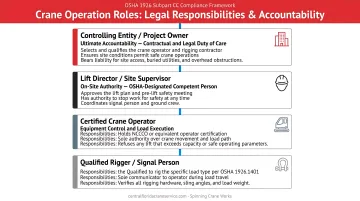
Each role carries non-overlapping duties. Here's what each one is accountable for.
Crane Owner and Crane User Responsibilities
The Crane Owner is responsible for:
- Providing equipment that meets the specified capacity and configuration for the job
- Supplying load rating charts and technical documentation
- Establishing and maintaining inspection and maintenance procedures
- Designating qualified personnel for transport, assembly, disassembly, and repair
The Crane User takes operational responsibility once the equipment is on-site:
- Ensuring only qualified operators run the crane
- Verifying up-to-date inspections and proper operating condition
- Confirming rated capacity is sufficient for the planned lift
- Making sure all lift team members understand their roles before operations begin
Site Supervisor and Lift Director Responsibilities
The Site Supervisor prepares and monitors the crane operating environment:
- Verifying ground stability and load-bearing capacity
- Confirming adequate access roads and assembly/disassembly space
- Assessing proximity to power lines — one of the most frequently overlooked and dangerous site hazards
- Monitoring adverse weather conditions including high winds, fog, and heavy rain
Once the site is ready, the Lift Director manages lift execution on the ground:
- Must be physically present during all lifting operations
- Has authority to halt operations when unsafe conditions arise
- Appoints and verifies qualified signal persons
- Confirms rigging is performed by competent personnel and that every load is properly rigged and balanced before leaving the ground
OSHA Standards and Regulatory Compliance for Crane Operations
Qualified vs. Competent Person: A Critical Distinction
OSHA 29 CFR 1926.1401 draws a clear line between two personnel designations that appear throughout crane regulations:
- Qualified person: Someone with a recognized degree, certificate, professional standing, or demonstrated technical expertise to resolve crane-related problems
- Competent person: Someone capable of identifying existing and predictable hazards and authorized to take prompt corrective action
These aren't interchangeable. For complex multi-crane lifts, OSHA may require a Lift Director who meets both definitions. Assigning the wrong designation, or neither, puts the lift out of compliance before the hook leaves the ground.
Operator Certification Requirements
For construction cranes, OSHA 29 CFR 1926.1427 requires operator certification by equipment type, or type and capacity, through an accredited certification body.
Key points on crane operator certification:
- Credentials are type-specific: a mobile crane certification does not qualify an operator for tower crane work
- Separate certifications exist for mobile cranes (lattice-boom and telescopic-boom), tower cranes (hammerhead, luffer, self-erecting), and overhead cranes
- Most credentials are valid for five years, with periodic renewal required
- General industry (1910.179) certification requirements are less prescriptive but still require demonstrated competency
OSHA Penalty Exposure
Non-compliance carries real financial consequences. Current OSHA penalty tiers are:
- Serious violations: up to $16,550 per violation
- Willful or repeated violations: up to $165,514 per violation
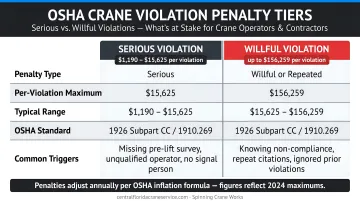
A single incident triggering a willful violation — especially for certification failures or ignored inspection deficiencies — can easily produce six-figure penalties. That's well above the cost of any compliant lift plan.
Power Line Safety Requirements
Power line strikes are one of OSHA's most frequently cited — and most costly — crane violations. OSHA 1926.1408 requires employers to determine whether any part of the equipment, load, or load line could come within 20 feet of a power line. If it can, one of several compliance paths applies:
- Maintain minimum 10-foot clearance for lines up to 50 kV (per Table A)
- Confirm the line is de-energized and visibly grounded
- Implement required encroachment-prevention measures
These requirements demand planning before the crane ever moves on site. Operators with documented experience near energized infrastructure — and a clear pre-lift survey on file — are the baseline for any compliant power line proximity job.
Pre-Operation Safety Checks and Inspection Protocols
Three Tiers of Required Inspection
Every crane operating in a construction or industrial environment is subject to three distinct inspection levels, each with different frequency, scope, and authorized personnel:
| Inspection Level | Frequency | Who Performs It |
|---|---|---|
| Pre-shift/daily | Before or during each shift | Competent person (construction); designated personnel (1910.179) |
| Periodic | Monthly, based on usage | Competent person |
| Comprehensive/annual | Annually | Qualified person (construction) |
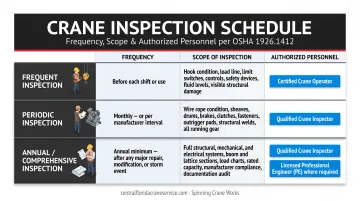
All inspection findings must be documented. Any deficiency identified before a lift must be reported to a designated competent person — and operations must not proceed until the deficiency is corrected. Operating with a known defect puts both the operator and employer at risk of OSHA violations and civil liability.
Pre-Lift Checklist: What to Verify Before Every Lift
Before any lift begins, the operator and lift team must confirm:
- Structural integrity: boom, cables, hooks, and sheaves show no visible damage or wear
- Safety devices: limit switches and anti-two-block devices are functional
- Ground and outrigger conditions: stable, level, and appropriate for rated capacity
- Load chart compliance: planned lift weight and radius fall within rated capacity
- Rigging equipment: all rigging is rated, inspected, and in serviceable condition
Critical Safety Systems to Verify
Beyond the general checklist, four onboard systems demand individual verification before operations begin:
- Load monitoring: Compares rated capacity against actual load in real time, triggering audio-visual warnings before an overload condition occurs
- Anti-two-block devices: Stop the load block or headache ball from striking the boom tip — two-blocking is a documented cause of boom failure and must never be overlooked
- Swing and range limiters: Cap crane rotation in zones where encroachment on power lines or structures is a realistic risk
- Anti-sway systems: Dampen load oscillation during travel, which is especially critical on confined sites or when lifting at height
Safe Crane Operating Practices and Emergency Preparedness
Core Practices During Every Lift
Each of the following reflects OSHA operational requirements and established industry practice:
- Never exceed the rated load capacity for the current configuration and radius
- Use standardized hand signals or two-way radio communication; OSHA requires hand signal charts to be posted on the equipment
- Maintain clear visibility of the load at all times — if the operator can't see the point of operation, a signal person is required
- Avoid sudden starts and stops that generate load swing
- Never move a suspended load over personnel
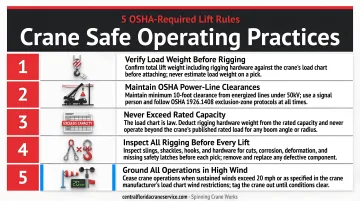
For radio and electronic signal systems, OSHA requires on-site testing before operations, a dedicated channel, and hands-free reception for the operator.
Emergency Action Plan Requirements
OSHA's construction standard mandates a site-specific emergency action plan (EAP) for crane operations. Employers must review the plan with each covered employee when it's developed, when it changes, and at initial assignment.
An effective EAP for crane operations should address:
- Site-specific hazard identification (power lines, underground utilities, traffic)
- Designated emergency contacts and communication channels
- Procedures for equipment malfunction and power line contact scenarios
- Clear evacuation routes accessible to all personnel on site
- Protocols for alerting emergency services
Building a Safety Culture on Crane Sites
Beyond compliance, a strong safety culture is what turns close calls into corrective actions rather than accident reports. Practical steps:
- Conduct daily toolbox talks before lifts — industry safety organizations maintain toolbox talk resources specifically for construction hazards
- Create an open reporting environment where near-misses are document near-misses without fear of retaliation
- Review incident reports regularly to identify patterns and prevent recurrence
Sites that treat near-miss reporting as a learning tool — rather than a liability — consistently show lower incident rates over time.
How to Choose the Right Crane Service for Industrial Projects
Vetting Criteria That Actually Matter
Not every crane company is equipped for every job. When evaluating a crane service for industrial work, ask about:
- Operator certifications: crane operator certification, specific to the crane type being used
- Equipment specs: Confirmed lift capacity and reach for the planned job — not approximations
- Inspection and maintenance records: Current documentation, not verbal assurance
- Industry-specific experience: Has the company completed similar lifts — HVAC placements, cell tower erections, power pole installations, high-tonnage lifts near energized lines?
Why Specialized Experience Matters
Complex industrial lifts — particularly those involving proximity to energized power lines, confined access conditions, or extreme heights — require more than a crane and an operator. They require a team that has done that specific type of work repeatedly and knows where the problems occur.
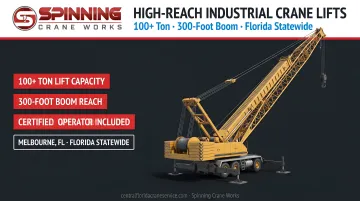
Spinning Crane Works, based in Melbourne, FL, is a specialized crane and rigging company serving Central and South Florida — from Tampa and Miami to Jacksonville and Saint Augustine. Their boom crane handles heavy lifts at significant heights, operated by crews with documented experience working around power lines across telecom, utilities, HVAC, and heavy construction applications. On jobs where line clearance is measured in inches, that combination of certified operators and purpose-built equipment is what keeps a lift on schedule and on the right side of safe.
Confirming Operational Readiness Before Hiring
Beyond credentials and experience, operational readiness is its own category. Before signing with any crane service, confirm:
- Availability: Can they respond to off-hours or emergency situations? Spinning Crane Works operates 24/7.
- Insurance and licensing: Request certificates of insurance covering general liability, workers' compensation, and equipment
- Lift plan: A reputable service should provide site-specific load calculations and a risk assessment before work begins — if a company can't or won't, that's a red flag
Frequently Asked Questions
What is the 3-3-3 rule for cranes?
The 3-3-3 rule is not a codified OSHA or ASME standard — it appears in informal training materials with varying interpretations, such as lifting a load roughly 1 foot, holding for 3 seconds, and maintaining a 10-foot worker exclusion zone. Actual compliance must be based on OSHA Subpart CC, applicable ASME standards, and your site-specific lift plan.
What are the OSHA standards for crane operations?
Two primary standards apply: 29 CFR 1910.179 for overhead and gantry cranes in general industry (factories, warehouses), and 29 CFR 1926 Subpart CC for cranes and derricks used in construction. Both govern operator qualifications, inspection requirements, and operational safety protocols.
What certifications are required for crane operators?
Construction crane operators must hold certification specific to their crane type — a mobile crane credential doesn't cover tower crane work. General industry operators under 1910.179 must demonstrate competency per OSHA training standards, though requirements are less prescriptive than those for construction.
How often should cranes be inspected on industrial job sites?
Three tiers apply: daily pre-shift checks by the operator, periodic inspections (typically monthly) per usage and manufacturer recommendations, and annual inspections by a qualified crane inspector — with all findings documented and deficiencies corrected before operations resume.
What is the difference between a "qualified" and "competent" crane operator under OSHA?
Under 29 CFR 1926.1401, a qualified person has a recognized degree, certificate, or demonstrated technical expertise to solve crane-related problems. A competent person can identify existing or predictable hazards and has authority to take corrective action. Some roles — such as lift directors on multi-crane lifts — require a person who meets both definitions simultaneously.