
Introduction
Crane-related fatalities are rare but catastrophic when they happen. According to the Bureau of Labor Statistics, the construction and manufacturing sectors averaged 42 crane-related deaths per year between 2011 and 2017 — with private construction accounting for 42% of those fatalities. The numbers have improved over decades, but they haven't reached zero, and they won't without consistent discipline on the highest-risk operations.
Critical lifts are where that discipline matters most. Unlike routine picks, a critical lift involves elevated risk factors that cannot be managed through experience alone — they require structured planning, verified equipment data, documented crew assignments, and a clear protocol for stopping when conditions change. When those structures are skipped or shortened, the margin for error disappears.
Managing that risk breaks into two distinct phases — planning and execution. This guide covers both: what goes into a defensible lift plan before the crane moves, and what execution discipline looks like once it does.
Key Takeaways
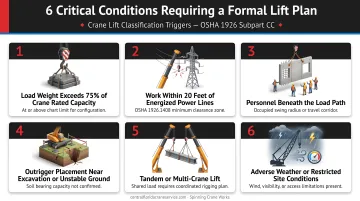
- A lift qualifies as critical when it exceeds 75% of a crane's rated capacity, requires multiple cranes, involves personnel hoisting, or presents other elevated risk conditions
- Every critical lift requires a written lift plan developed by a qualified person and signed by all key personnel before work begins
- Verify load weight, rigging geometry, and site conditions against the load chart at each phase of the lift
- Only one designated person gives signals during execution — any crew member can call a stop
- Florida's afternoon thunderstorms require real-time weather monitoring in every lift plan
What Qualifies as a Critical Lift?
The Regulatory Definition
OSHA's clearest definition appears in 29 CFR 1926.751 (steel erection): a critical lift is any lift exceeding 75% of the crane's rated capacity or requiring more than one crane or derrick. OSHA's Subpart CC doesn't define a universal "critical lift plan" category, but it does mandate qualified-person planning for multiple-crane lifts and imposes strict personnel-hoisting requirements under 1926.1431.
Two other frameworks add practical depth:
- USACE EM 385-1-1 (effective March 2024) — defines critical lifts as non-routine operations requiring detailed planning; triggers include loads above 75% capacity, multiple load-handling equipment, personnel hoisting, and technically difficult rigging
- ASME P30.1 — establishes a formal Standard Lift Plan vs. Critical Lift Plan framework for load handling activities
Together, these standards give you the full picture of what "critical" means in practice — not just a capacity number, but any lift where the margin for error narrows significantly.
Scenarios That Trigger Critical Lift Classification
Beyond the capacity threshold, these conditions typically require critical lift treatment:
- Personnel hoisting (any load-bearing platform with people)
- Loads suspended above workers or in fall zones
- Loads with shifting or uncertain centers of gravity (submerged equipment, wet materials, asymmetric loads)
- Lifts outside the operator's direct line of sight
- Loads involving hazardous materials
- Non-routine or technically complex rigging configurations
Who Declares a Lift Critical?
The lift supervisor, site manager, or qualified person makes the call. When conditions are ambiguous — unusual load geometry, questionable soil under the outriggers, a load approaching 70% capacity — default to critical. A lift plan takes hours to complete. An unplanned incident can shut a job down for days and expose every party on site to liability.
How to Develop a Critical Lift Plan
Who Develops It and Who Signs It
The plan must be developed by a qualified person — someone with the recognized training, experience, and demonstrated ability to solve the technical problems involved. For multiple-crane lifts, OSHA 1926.1432 requires that a lift director meeting both competent-person and qualified-person criteria review the plan in a meeting with all involved workers before the lift begins.
At minimum, the following roles should sign off before work starts:
- Crane operator
- Qualified rigger
- Lift supervisor or lift director
- Signal person
Spinning Crane Works coordinates rigging engineering input and pre-lift site surveys directly with the GC's superintendent, mechanical contractors, and steel erectors — covering lift sequence, logistics, and OSHA 1926 Subpart CC compliance before anyone signs off.
Technical Contents of the Plan
The plan must document the crane's actual capacity — not an approximation. Required inputs include:
- Crane make, model, boom length, and angle
- Lift radius at each phase of the pick
- Manufacturer's rated capacity at every point in the lift arc (not just the start position)
- Exact load weight and dimensions
- Load's center of gravity location
Load chart verification at each phase is not optional. Operating even briefly beyond the load chart removes the crane's engineered safety margin entirely.
Rigging Plan
The rigging section identifies:
- Lift points and attachment hardware
- Sling types, lengths, and rated capacities
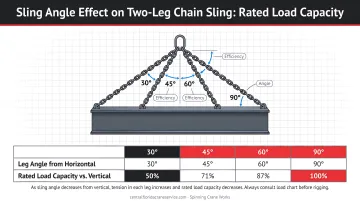
- Sling angles and their effect on leg load
- Rigging sequence
Sling angle deserves particular attention. OSHA's sling tables show that a two-leg alloy chain sling rated for 4,200 lb vertical drops to 2,100 lb at a 30° horizontal angle — exactly half the rated capacity. The Crosby Group warns against rigging alloy chain slings at angles below 30° to horizontal. Do this calculation before selecting any hardware, not on the day of the lift.
Site and Ground Conditions
This section covers:
- Crane positioning and outrigger pad sizing
- Soil bearing capacity beneath each outrigger
- Proximity to overhead power lines (OSHA requires a 20-foot minimum clearance for lines up to 350 kV under 29 CFR 1926.1408)
- A site sketch showing all equipment and personnel positions
For utility and telecom work in Florida, power-line proximity demands extra scrutiny. Spinning Crane Works handles OSHA 1910.269 clearance requirements and coordinates directly with utilities on minimum approach distances — work that must be confirmed and documented before the crane moves on any energized-infrastructure lift.
Communication and Emergency Protocol
Before the crane moves, the plan must define each of these in writing:
- Who gives signals and by what method
- Which radio channels are designated for each crew position
- How a stop-work condition is declared and who has authority to call it
- What the crew does if load instability occurs mid-lift
Crews that improvise these protocols on the day of the lift are operating without a plan. When a load shifts mid-pick, there's no time to hold a discussion about who calls the stop.
Executing a Critical Lift Safely
Pre-Lift Inspection
Every piece of equipment gets physically inspected before a critical lift — no exceptions. Under OSHA 29 CFR 1926.1412 and 1926.251:
- Crane shift inspections are conducted by a competent person
- Wire rope is checked for broken wires, distortion, corrosion, electric-arc damage, and core protrusion
- Slings and rigging hardware are inspected before each shift; damaged or defective gear is removed from service immediately
A failed inspection means the process caught a problem before the load was in the air. That's the point.
Pre-Lift Briefing
All crew members attend a documented meeting before the crane moves. The briefing covers:
- Walk through the lift plan — not just a reference to it, but an actual review of each phase
- Confirm roles — operator, rigger, signal person, lift supervisor each know their specific responsibilities
- Rehearse communication signals — radio channels, hand signals, and the stop-work command are confirmed aloud
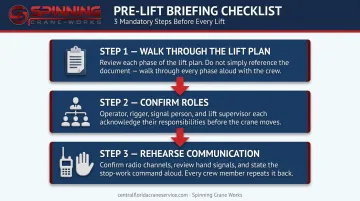
For multiple-crane lifts, OSHA mandates that the lift director conduct this meeting with all involved workers.
Load Control During the Lift
Raise the load slowly before committing to full height. This initial test check reveals:
- Whether the rigging is balanced
- Whether the load is stable and center of gravity is where the plan predicted
- Whether any equipment is showing unexpected stress
The behavioral risks here are real: rushing the lift, skipping the slow-raise protocol, or assuming the load will behave as calculated are among the most common precursors to load incidents. On a critical lift, cutting the slow-raise short doesn't save time — it removes the only early warning you have before the load is at full height.
Signal Discipline
Only one person gives signals. OSHA 1926.1419 is clear on this. The signal person must be qualified per 1926.1428 — meaning they understand crane dynamics including boom deflection, have passed oral, written, and practical tests, and have their qualification documentation on site.
Any crew member should have the standing to call a stop if something looks wrong. That authority needs to be explicitly stated in the pre-lift briefing, not assumed. Knowing who controls the lift — and who can halt it — sets the conditions for the next critical decision: recognizing when to stop.
When to Stop Mid-Lift
Stop immediately when any of the following occur:
- Unexpected load swing or rotation
- Equipment warning indicators or alarms
- Wind speed increases beyond the manufacturer's rated limit
- Reduced visibility or lightning
- Any change in site conditions not accounted for in the plan
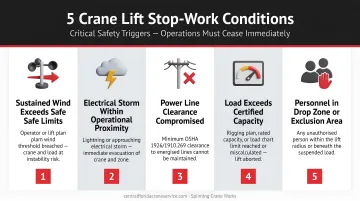
Resuming after a stop requires a full re-evaluation. The conditions that triggered the stop must be assessed and documented before operations continue.
Environmental and Site Conditions That Affect Critical Lifts
Wind
OSHA requires a competent person to adjust operations for wind effects on equipment stability. The often-cited 20 mph threshold applies specifically to personnel platforms under OSHA 1926.1431 — for other lifts, the trigger is the crane manufacturer's load chart limits, which vary by boom configuration and load wind surface area.
The practical rule for any lift:
- Consult the load chart before the lift, not during it
- Know the manufacturer's wind limits for your specific boom configuration
- Have a qualified person make and document the call to proceed or stop
Lightning
Florida holds the highest lightning casualty rate of any U.S. state, with Central Florida identified by the National Weather Service as the "Lightning Capital" of the United States. Stop all crane and hoisting operations the moment lightning is visible. The 30-minute wait after the last sound of thunder is the OSHA/NOAA outdoor-worker standard before returning to operations — no exceptions.
Florida's rainy season runs from mid-May through mid-October across most of the state. For any lift scheduled during this window, real-time weather monitoring is essential.
Ground Conditions
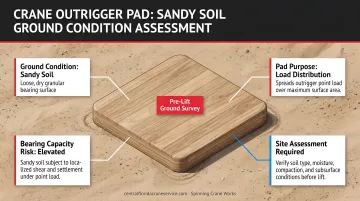
Outrigger stability depends on soil bearing capacity beneath each pad. OSHA 29 CFR 1926.1402 requires ground conditions to be firm, drained, and graded to provide adequate support. The controlling entity must provide known ground hazard information before work begins.
That pre-lift rain monitoring matters here too — saturated ground compounds the risk. On Florida job sites, where sandy soil, drainage features, and buried utilities are common, the ground conditions section of the lift plan deserves extra attention. Soft or saturated ground can shift outrigger stability mid-lift in ways that aren't visible from the operator's cab.
Common Critical Lift Mistakes to Avoid
Skipping the Lift Plan Entirely
Relying on experience instead of a documented, signed plan is among the most common precursors to crane incidents. A missing lift plan also removes any defensible record during an OSHA investigation — and provides no regulatory protection for the operator, rigger, or site supervisor if something goes wrong.
Underestimating Total Load Weight
The load weight in the plan must account for the load itself, all rigging hardware, spreader beams, and any absorbed weight from wet or saturated material. Operating outside the load chart range — even briefly — removes the crane's engineered safety margin and risks structural overload, tipping, or loss of rated capacity certification.
Allowing Multiple Signal Sources
Multiple people giving signals, bystanders inside the lift zone, or improvised hand gestures replace a known protocol with guesswork. The operator can only act on one source of information at a time — and when that source is ambiguous, decision-making slows at precisely the moment speed matters.
Frequently Asked Questions
What does OSHA require for a critical lift plan?
OSHA 29 CFR 1926.1432 requires a qualified person to develop the plan for multiple-crane lifts, with a lift director conducting a documented pre-lift meeting with all workers involved. Personnel hoisting under 1926.1431 adds three more requirements: a pre-lift meeting, an unoccupied trial lift, and a proof test at 125% of platform rated capacity.
What should be included in a critical lift plan?
At minimum, the plan must document:
- Crane make, model, and rated capacity at each lift radius
- Exact load weight including all rigging hardware
- Sling angles, hardware ratings, ground conditions, and crew qualifications
- Communication methods, environmental stop conditions, and an emergency procedure for load instability
What is the difference between a lift plan and a critical lift plan?
A standard lift plan covers routine single-crane operations and is largely governed by employer discretion. A critical lift plan is a formally documented, signed plan triggered by specific risk thresholds: exceeding 75% crane capacity, requiring multiple cranes, or involving personnel hoisting or other elevated-risk conditions defined by OSHA, USACE, or ASME P30.1.
What is the 3-3-3 rule for critical lifts?
The 3-3-3 rule is an informal pre-lift safety mnemonic used in rigging training that checks three items (such as rigging, load balance, and equipment condition) at three stages, involving three parties. It is not codified by OSHA, ASME, or NCCCO; treat it as a training aid rather than a regulatory standard.
Who is responsible for approving a critical lift plan?
A qualified person (typically the lift director) develops and approves the plan. The crane operator, rigger, and lift supervisor must sign off before the lift begins. On USACE projects, the plan follows ENG Form 6213 and requires formal approval through the contractor's safety chain.
When should crane operations stop during a critical lift?
Stop immediately if any of the following occur:
- Wind speeds exceed the manufacturer's rated limit for the current configuration
- Lightning is observed, visibility drops, or site conditions change unexpectedly
- Load becomes unstable, swings unexpectedly, or equipment warning indicators activate
Resuming requires documented re-evaluation of the triggering condition, not just a visual check.