
This article breaks down pricing ranges by crane size, explains what drives costs up or down, clarifies what "renting with an operator" actually includes, and gives you a realistic framework for budgeting before your lift.
Key Takeaways
- Operated crane rental often ranges from about $245/hour for smaller cranes to $1,350+/hour for heavy-lift configurations
- Operator fees are often bundled into an all-in rate, though some providers itemize them separately
- Key cost drivers: crane type, required lift capacity at reach, rental duration, site access, and lead time or after-hours scheduling
- Minimum hour requirements (commonly 4–8 hours) apply to most bookings — budget for the minimum, even for a short pick
- For most contractors in Florida, operated crane service is usually better value than operator-less rental once you factor in qualified labor and liability
How Much Does It Cost to Rent a Crane With an Operator?
There's no single fixed price. Operated crane rental varies by crane class, project requirements, and regional factors. The ranges below are benchmarks based on published rate cards, not firm Florida quotes. Use them to sanity-check budget estimates before you contact a provider.
Three budgeting traps to avoid upfront:
- Underestimating minimum hours: most cranes have a 4–8 hour minimum regardless of actual lift time
- Ignoring mobilization fees: transport from the depot to your site is often billed portal-to-portal and can add hundreds or thousands of dollars to the total
- Missing overtime rules: nights, weekends, emergency calls, or work beyond straight time can raise the hourly rate
Small Cranes With Operator (Under 50 Tons)
Published industry rate data shows small hydraulic cranes running $245–$315/hour at straight time, with 4–8 hour daily minimums depending on the crane class. Rough-terrain units in this class tend to carry 8-hour minimums; smaller hydraulic cranes often require only 4 hours.
These cranes handle rooftop HVAC unit placement, light steel lifts, residential tree removals, and confined urban site work where a full-sized crane can't maneuver.
Mid-Sized Mobile Cranes With Operator
Mid-sized mobile cranes span a wide rate spread. Published industry rate data shows rates roughly in the $320–$460/hr range for cranes in this class at straight time, with larger configurations running somewhat higher.
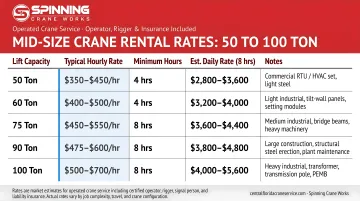
Two-operator configurations within this class can run around $535/hour straight time with an 8-hour minimum, which matters when lift complexity or boom configuration requires a second crew member.
Common jobs at this capacity: commercial construction picks, cell tower erection, utility equipment placement, and larger tree sections in confined residential or commercial corridors. Some crane operators apply a 6-hour minimum to mid-sized cranes in this class.
Large and Heavy-Lift Cranes With Operator
At larger capacities, pricing climbs and quotes typically include more complexity:
- Large all-terrain (one operator): ~$415–$475/hour straight time
- Large all-terrain (two operators): ~$685–$705/hour straight time
- Large crawler crane: rates vary by configuration; contact providers for current quotes
- Heavy-lift all-terrain (two operators): ~$1,350/hour straight time, with emergency rates reaching $1,685/hour
At this capacity, an all-in quote typically reflects engineered lift plans, complex mobilization and setup, and multi-person crews. These are project-specific quotes; published rates are a starting point, not a final number.
Spinning Crane Works operates cranes of all sizes to complete your lifts safely, suited for heavier commercial and industrial lifts where smaller equipment cannot complete the job safely.
Key Factors That Affect the Cost of Renting a Crane With an Operator
Pricing is shaped by a combination of technical, logistical, and scheduling factors. Understanding them helps you compare quotes accurately.
Crane Type and Lifting Capacity
Different crane configurations carry different base rates, even within the same capacity class. An all-terrain hydraulic crane typically runs higher per hour than a rough-terrain unit of comparable capacity. Similarly, a crawler crane in a given class costs more than an all-terrain at the same straight-time rate.
More importantly: capacity selection isn't just about the load's weight. According to the Specialized Carriers & Rigging Association, crane selection depends on the load weight at the required radius and boom length — a 10-ton load at 80 feet of reach may require a larger crane than the same load at 20 feet. Over-specifying to avoid that calculation adds unnecessary cost.
Rental Duration and Minimum Hour Requirements
Most operated crane rentals bill against a minimum time block:
- 4-hour minimums: Common for smaller hydraulic cranes and all-terrain units
- 6-hour minimums: Typical for mid-to-large crane classes
- 8-hour minimums: Standard for rough-terrain, crawler, and larger configurations
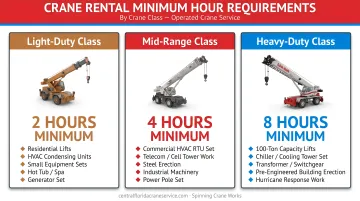
If your lift realistically takes 2 hours, you're still paying for 4–8. Hourly pricing works well for fast, well-planned single picks. For complex jobs with multiple picks, site transitions, or unpredictable delays, a daily block rate is often more predictable and cost-efficient.
Project Location and Mobilization Distance
Most operated crane providers bill portal-to-portal: the clock starts when the crane leaves the depot and stops when it returns. Travel time, fuel surcharges, and setup/breakdown fees stack on top of the hourly rate.
Remote or hard-to-access sites add cost. So do congested urban environments. In Florida, coastal project sites can carry additional access restrictions. Post-storm conditions such as debris, unstable ground, or blocked routes also affect logistics and setup time. For jobs across Central and South Florida, a Melbourne-based provider such as Spinning Crane Works may price travel to Miami, Tampa, or Fort Lauderdale into the total project cost.
Florida state road permits are managed through the state transportation authority's permit office, and municipalities like Fort Lauderdale require separate crane placement permits for work in public rights-of-way.
After-Hours, Weekend, and Emergency Scheduling
Standard crane rates apply during regular business hours on weekdays. Outside those windows, expect surcharges. One published crane rental rate sheet shows how quickly surcharges can add up:
- Overtime (after 8 hrs/day, before 6 AM, after 5 PM, or Saturday): +$74/hr (one operator), +$144/hr (two operators)
- Double time: +$144/hr (one operator), +$284/hr (two operators)
- Holiday rates: +$224/hr (one operator), +$347/hr (two operators)
Emergency or last-minute scheduling carries similar premiums. In one published rate example, a heavy-lift crane configuration runs $1,350/hour at straight time and $1,685/hour as an emergency rate. For time-sensitive lifts, 24/7 availability matters, but it needs to be priced into the budget.
Permits, Rigging Equipment, and Additional Crew
Many base quotes don't include:
- Road or lift permits: State transportation permits start at $15, but overweight fees can increase based on vehicle weight and mileage
- Riggers and signal persons: published rates range from $88–$160/hour with 4-hour minimums
- Rigging hardware: modular rigging, spreader bars, and personnel baskets are typically billed separately
- Fuel/environmental surcharges: some providers apply 8–10% on the total invoice
- Setup and breakdown fees: common for larger crane classes requiring outrigger mat placement
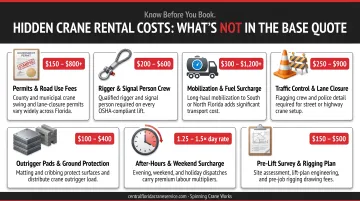
Always confirm what's included in the quoted rate before comparing providers.
What's Included When You Rent a Crane With an Operator?
Renting "with an operator" means the crane company supplies a certified crane operator. Their labor, credentials, and jobsite compliance are managed by the rental company, not the client.
OSHA's Subpart CC regulations require crane operators on construction sites to be certified or qualified. Certification requires both a written exam and a practical test, and certificates from accredited testing organizations are valid for 5 years.
In an operated rental, the crane company is responsible for confirming the operator meets those requirements. That burden does not fall on the client.
Typically included in an operated rental:
- Crane equipment and fuel
- Certified operator labor
- Operator certification and jobsite compliance documentation
- Basic operational oversight and load chart compliance
Typically excluded (confirm with your provider):
- Road and lift permits
- Rigging hardware (slings, shackles, spreader bars)
- Signal person or rigging crew
- Site preparation or cleanup
- After-hours or weekend premiums
For Florida jobs, especially HVAC rooftop picks, utility work, and commercial lifts, confirming who manages operator certification is a practical safety step. Providers such as Spinning Crane Works handle operated crane and rigging work across Central and South Florida, so those responsibilities should be clear before the lift begins.
Bare Rental vs. Operated Crane Rental: What's the Difference?
A bare rental provides the crane only. The client sources the operator, manages insurance and OSHA compliance, and coordinates all logistics. The hourly rate may look lower, but the total cost can change quickly.
| Factor | Bare Rental | Operated Rental |
|---|---|---|
| Upfront cost | Lower equipment rate | Higher all-in rate |
| Operator responsibility | Client sources and manages | Crane company provides |
| OSHA/certification compliance | Client's responsibility | Crane company's responsibility |
| Insurance/liability | Client bears operator risk | Managed by crane company |
| Scheduling simplicity | Higher coordination burden | Single point of contact |
| Best use case | Firms with in-house certified operators | Most contractors, HVAC companies, tree services |
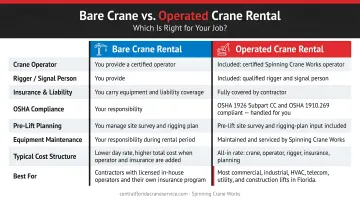
For most HVAC contractors, tree services, utility crews, and commercial contractors in Florida, an operated rental is the more practical choice. Sourcing a certified crane operator independently, verifying their credentials, and arranging appropriate insurance coverage adds friction and cost that typically exceeds the rate difference. For Florida lifting jobs, Spinning Crane Works provides the crane, trained operator, and rigging support as one coordinated service.
How to Budget for Your Crane Rental With an Operator
The base hourly rate is one line item. A realistic budget includes these line items:
- Base rate × minimum hours: never assume you'll beat the minimum
- Mobilization and portal-to-portal travel: especially when the crane is dispatched from Melbourne to Tampa, Miami, or Jacksonville
- Setup and breakdown: relevant for larger configurations requiring outrigger mats or boom assembly
- Permits: include state road permits and local right-of-way permits when applicable
- Crew and rigging hardware: confirm whether riggers, signal persons, spreader bars, slings, or other gear are included
- Fuel, surcharges, and premiums: ask about 8–10% fuel charges, early morning work, weekends, or emergency response
The most common budgeting mistake is underestimating job duration. Before booking, review the lift plan, the number of picks, site layout, and crew coordination requirements with your crane provider. What looks like a 2-hour job often runs 4–6 hours once setup, rigging, repositioning, and breakdown are factored in.
According to the AGC's 2025 Florida construction data, Florida's construction sector employed 657,000 workers in 2025, a 14% increase from pre-pandemic levels. That demand affects crane calendars during active building and storm-recovery seasons. Booking several weeks ahead helps reserve the right equipment; last-minute requests often carry premium pricing or limited options.
Request a written all-in quote, not just an hourly rate, from any provider you're comparing. Use the same checklist for each bid so the final invoice does not hinge on missing travel, rigging, or overtime charges.
Conclusion
Operated crane rental costs vary widely, from under $300/hour for a small hydraulic crane on a straightforward lift to over $1,350/hour for a heavy-lift configuration on a complex industrial project. The base rate is just the starting point. Minimum hours, mobilization, permits, rigging, and scheduling timing all shape the final number.
The clearest path to an accurate budget is a direct conversation with your crane provider before the lift . Walk through the scope, the site conditions, and the timeline together.
If you're planning a lift in Central or South Florida, contact Spinning Crane Works at 321-759-2263 for a clear quote. The team operates cranes of all sizes to complete your lifts safely, serving Tampa, Miami, Fort Lauderdale, Jacksonville, and nearby Central and South Florida job sites, with 24-hour availability.
Frequently Asked Questions
How much does crane rental with an operator cost per hour?
Expect about $245–$315/hour for smaller cranes, $320–$535/hour for mid-sized cranes, and $415–$1,350+/hour for large and heavy-lift cranes. Operator labor is often bundled, and most bookings carry a 4–8 hour minimum.
How much does crane rental with an operator cost per day?
Most providers bill hourly against a minimum block rather than publishing a fixed day rate. An 8-hour straight-time day typically runs about $2,000–$2,500 for smaller cranes and $11,000+ for large heavy-lift configurations. Day pricing is most useful on multi-pick jobs with long setup windows.
How much does it cost to rent a heavy-lift crane with an operator?
A published heavy-lift all-terrain crane rate can run about $1,350/hour at straight time for two operators, with emergency rates near $1,685/hour and an 8-hour minimum. At this capacity class, expect engineered lift plans, complex mobilization, and a project-specific quote.
Is it cheaper to rent a crane with or without an operator?
Bare rental has a lower equipment rate, but you must supply a certified operator, confirm credentials, and handle OSHA compliance and insurance. For most contractors, operated rental is the better value because it reduces coordination risk.
What does a crane rental with an operator typically include?
It usually includes the operator's labor, credentials, and crane-company liability for the lift. Permits, rigging hardware, signal persons, and cleanup are often excluded, so confirm each line item before approval.
How far in advance should I book a crane with an operator?
Booking several weeks ahead is advisable during Florida's active construction season. Last-minute availability may be limited or priced at a premium. For time-sensitive or emergency lifts, confirm the provider's 24/7 availability before committing to a project schedule.