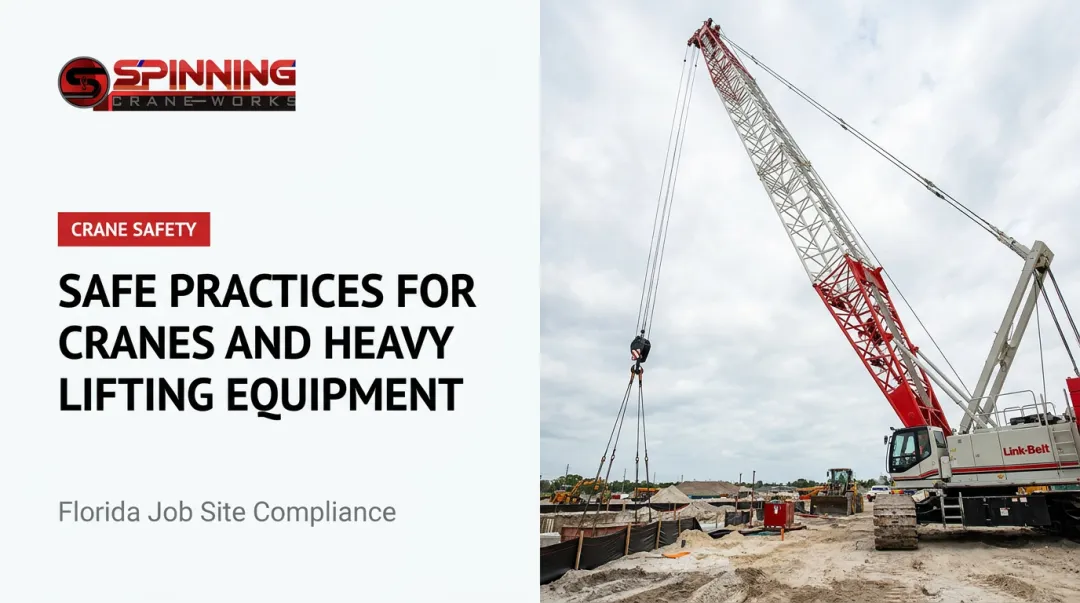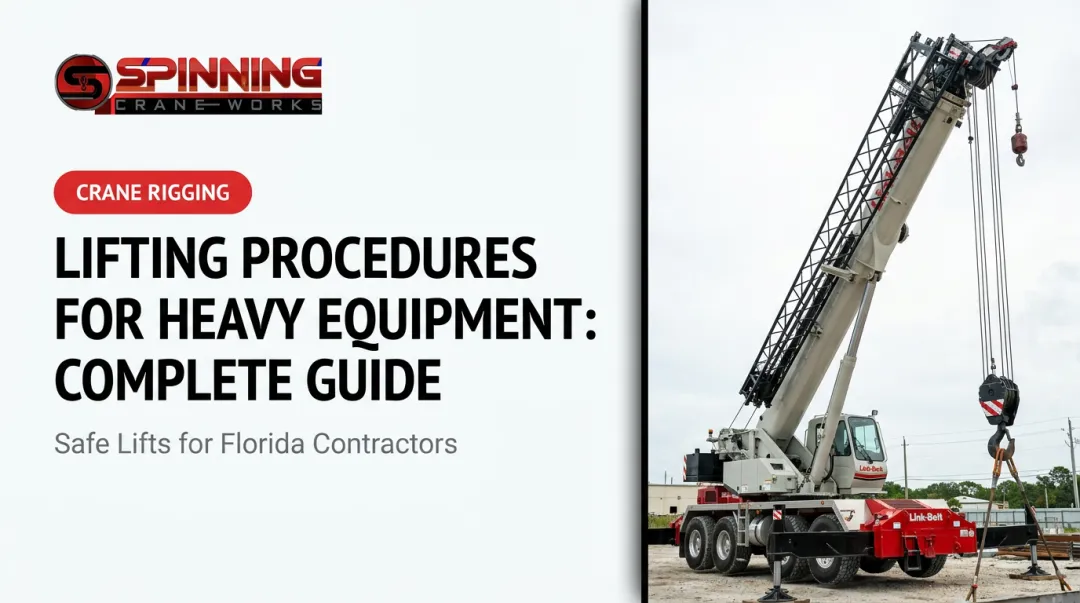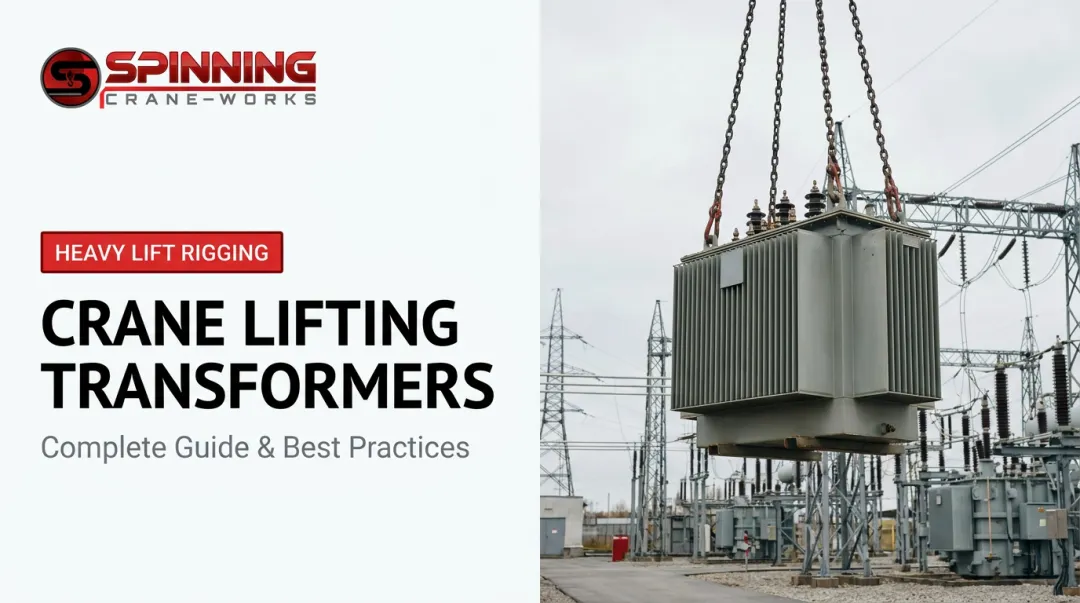
Crane lifts are routine in construction, HVAC placement, telecom, utility work, and tree removal. But "routine" doesn't mean forgiving. According to BLS data covering 2011–2017, 297 workers died in crane-related incidents over that period — averaging 42 fatalities per year — with 154 of those deaths involving workers struck by objects or equipment. Florida alone accounted for 16 of those fatalities.
This guide covers what every contractor, project manager, and site supervisor needs to know: lift classifications, rigging fundamentals, OSHA compliance, pre-lift checklists, and environmental hazards. Whether you're managing a lift in-house or working with a professional crane service like Spinning Crane Works, these principles apply.
Key Takeaways
- Plan every lift with qualified personnel and equipment matched to the load, radius, and site conditions
- Classify lifts as ordinary, pre-engineered, or critical; each requires different documentation and oversight
- Watch sling angle: at 30°, each sling leg carries tension equal to the full load weight
- OSHA 29 CFR 1926 Subpart CC governs construction crane work; violations can trigger citations, shutdowns, and liability
- Check wind, ground conditions, lightning, and power line proximity before and during every lift
What Is Crane Lifting and Why Does It Matter?
Crane lifting is the coordinated use of a crane, rigging hardware, a qualified operator, and a documented lift plan to move heavy loads to positions that can't be reached safely any other way. The crane itself is only one part of the system.
Several industries depend on this capability daily:
- Tree removal: extracting storm-damaged trees over structures without secondary damage
- HVAC contractors: placing rooftop units on commercial buildings
- Telecom: erecting cell towers and antenna structures
- Utilities: installing power poles, often near energized lines
- Heavy construction: placing structural steel, precast concrete, and heavy machinery
The variety of industries means the risks are just as broad. Load shapes, site access constraints, and proximity hazards differ completely between a tree removal in a suburban backyard and a cell tower erection in an industrial corridor.
Because those job sites differ so much, the lift plan has to account for the load, access path, ground conditions, overhead hazards, and communication roles. OSHA’s crane and derrick guidance treats these hazards as formal safety requirements, not optional preferences.
Types of Crane Lifts: Ordinary, Critical, and Engineered
Lift Classification
Many lift-planning programs, including those based on DOE-STD-1090, classify lifts into three categories. OSHA Subpart CC governs crane operations separately, but it doesn't define these categories as one unified taxonomy. Understand the distinction:
| Lift Type | Characteristics | Documentation Level |
|---|---|---|
| Ordinary | Routine loads, well-understood parameters, no unusual hazards | Standard lift plan |
| Pre-Engineered | Defined parameters exceed ordinary thresholds; uses established templates | Enhanced planning and supervision |
| Critical | Complex loads, tight clearances, or proximity to hazards | Written plan, supervisory sign-off, may require PE stamp |
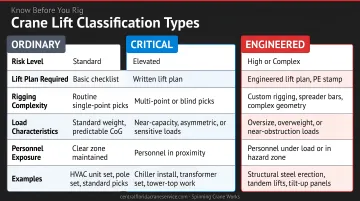
The classification determines who signs off, which documents are required, and what level of supervision is present. Treating a critical lift as ordinary is how incidents happen.
The Four Rigging Hitch Types
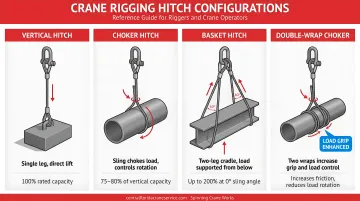
Once the lift category sets the planning requirements, the rigging method controls how the load behaves under the hook. The four standard hitch configurations are:
- Vertical (straight lift): Uses one attachment point directly above the load's center of gravity; simplest when the load has a designed lift point
- Choker: Wraps the sling around the load so friction holds it; useful for cylindrical or bundled items
- Basket: Passes the sling under both ends of the load; spreads weight across two contact points for beams, pipe, or similar materials
- Double-wrap basket: Adds an extra wrap for friction and load control when a standard basket hitch would be unstable
Load Charts and Rated Capacity
A crane rated at 100 tons does not lift 100 tons in every configuration. Rated capacity changes with boom length, boom angle, and operating radius. As the boom extends farther from the crane's center or drops to a lower angle, lifting capacity can fall sharply.
Operators must consult the manufacturer's load chart before configuring every lift. Spinning Crane Works' crane can handle heavy lifts at significant heights, but that capacity applies only at specific boom configurations. Matching the crane's chart to the job's radius, load weight, and height keeps heavy or high-reach lifts within safe limits.
Essential Crane Rigging: Equipment and Techniques
Rigging is the mechanical connection between the crane and the load. When that connection fails through a slipped hitch, overloaded sling, or undersized shackle, the load can drop.
These failures are a common cause of crane-related struck-by injuries and fatalities, which is why rigging checks need the same attention as crane setup.
Core Rigging Components
- Slings: Choose wire rope for abrasion resistance, chain for rough loads, or synthetic slings when the load surface needs protection.
- Shackles: Use bow shackles for multi-directional loading and D-shackles for inline pulls only; verify the working load limit.
- Hooks with safety latches: Confirm the latch closes fully before the lift so the sling cannot jump the hook during movement.
- Spreader bars and lifting beams: Keep sling legs from collapsing inward on long, fragile, or off-center loads.
Why Sling Angle Changes Everything
OSHA's sling-angle data shows how dramatically leg tension increases as slings move away from vertical:
| Sling Angle from Horizontal | Load Factor |
|---|---|
| 90° (vertical) | 1.000 |
| 60° | 1.155 |
| 45° | 1.414 |
| 30° | 2.000 |
At 30°, each sling leg in a two-leg bridle can carry tension equal to the full load weight. For example, a 10,000 lb load with 30° slings puts 10,000 lb of tension on each leg, not 5,000 lb.
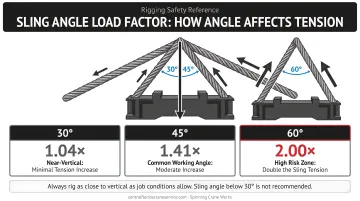
A sling rated only for its share of the load will be underrated for the forces actually applied.
Rigging to the Center of Gravity
If attachment points are not directly above the load's center of gravity, the load can tilt or swing as it leaves the ground. That risk shows up often with rooftop HVAC units, power pole sections, and storm-damaged tree material.
For irregular or asymmetric loads, use a test lift: raise the load a few inches, pause, and check for tilt or instability before committing to the full lift.
Pre-Use Inspection Requirements
Every piece of rigging hardware must be inspected before use. Under ASME B30.9, slings must be checked for:
- Deformation, cuts, or kinking
- Broken or worn wire rope strands
- Corrosion or heat damage
- Missing or illegible capacity tags
Any hardware showing damage comes out of service immediately. No exceptions.
Crane Lifting Safety: OSHA Compliance and Best Practices
OSHA Subpart CC Requirements
OSHA 29 CFR 1926 Subpart CC sets the minimum legal requirements for crane safety in construction. The key requirements every operator and supervisor must know:
- 1926.1427: Operators must be trained, certified, and evaluated; operator certification is portable and valid for 5 years
- 1926.1412: A competent person must conduct a visual inspection before each shift; annual inspections by a qualified person every 12 months, with records kept for 12 months
- 1926.1408: If equipment or load could come within 20 feet of a power line, the employer must deenergize and ground the line, maintain 20-foot clearance, or comply with Table A minimum distances
OSHA Table A Power Line Clearances:
| Nominal Voltage | Minimum Clearance |
|---|---|
| Up to 50 kV | 10 ft |
| Over 50 to 200 kV | 15 ft |
| Over 200 to 350 kV | 20 ft |
| Over 350 to 500 kV | 25 ft |
| Over 500 to 750 kV | 35 ft |
For contractors working in Florida, where utility infrastructure often sits close to active work zones, these clearances are practical job-site rules. Spinning Crane Works' experience around energized power lines is especially relevant for power pole and cell tower lifts across Central and South Florida.
The Lift Team
A safe lift requires defined roles with clear authority:
- Qualified crane operator: Certified per OSHA 1926.1427; the only person controlling crane movement
- Signal person: The single voice or hand signal source directing the operator; no conflicting commands
- Rigger: Secures the load and confirms rigging integrity before lift-off
- Lift supervisor: Has authority to stop work at any time and signs off on the lift plan
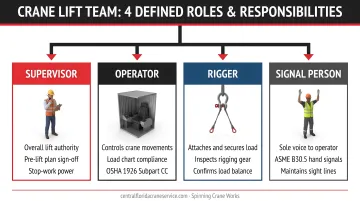
One critical rule: only the designated signal person directs crane movement during a lift. Emergency stops are the exception: any worker on site can and must call them.
Stop-Work Authority
Every worker on site has both the right and the obligation to halt operations if they spot an unsafe condition. No role, schedule pressure, or client relationship overrides that duty.
Stop-work authority is one of the clearest signs of a genuine safety culture. It catches the job-site risks that checklists can miss.
The Pre-Lift Checklist: What to Verify Before Every Crane Operation
A pre-lift inspection is required under OSHA 29 CFR 1926.1412, not a courtesy. A competent person must inspect the equipment and confirm site conditions before the load leaves the ground.
Crane Mechanical Inspection
- Wire rope: inspect per OSHA 29 CFR 1926.1413 for broken strands, kinking, and corrosion
- Hooks and latches: check for deformation, cracks, and excessive wear
- Brakes, hydraulics, and controls: verify proper function
- Limit switches and safety devices: confirm they operate correctly
- Outriggers and stabilizers: check condition and full extension capability
Site Setup Verification
- Ground is level, stable, and capable of supporting the crane's load
- Outriggers deployed to full width with properly sized blocking/pads
- Crane configuration matches load chart for the planned lift
- No overhead obstructions (power lines, tree canopy, structures) within boom path
- Exclusion zone established and physically marked with barriers
Rigging and Load Verification
- All rigging hardware is inspected and rated for the working load
- Load weight confirmed from drawings, tags, or scale data; not guessed
- Load hook centered over the load's center of gravity before tensioning
- Sling angles checked against rated capacity
- Landing zone clear and prepared
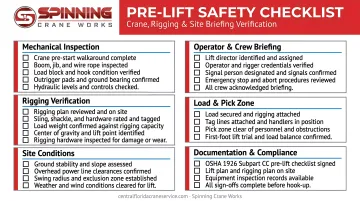
Pre-Lift Briefing
The final step before any lift begins is a team briefing. The lift supervisor reviews the plan with all personnel and confirms:
- Role assignments for the operator, rigger, signal person, and spotter
- Communication method, including hand signals or radio channel
- Emergency procedures and stop-work authority
- Exclusion zone boundaries
If anyone raises a concern, stop and resolve it before the pick.
How Environmental and Site Conditions Affect Crane Operations
Wind
Wind is the most variable and unforgiving environmental hazard in crane work.
Under OSHA 1926.1417, a competent person must assess whether wind affects equipment stability or rated capacity. There is no universal shutdown speed for material lifts; limits depend on the manufacturer's load chart, boom configuration, and load surface area.
For personnel hoisting, OSHA 1926.1431 sets 20 mph as the point where a qualified person must decide whether conditions are safe. For material lifts, use the crane manufacturer's wind and load chart for that exact setup.
Gusts matter more than average speed. A sustained 15 mph wind with 25 mph gusts can swing a large-surface load unpredictably.
Ground Conditions
Florida's sandy and coastal soils create outrigger stability challenges that differ from inland construction sites. Before setup, verify:
- Check soil bearing capacity, especially on sandy or recently saturated ground
- Call 811 before setup to identify underground utilities or hidden voids
- Reassess the site after rainfall, since saturated soil loses strength quickly
- Size outrigger pads to spread the imposed load and prevent sinking
OSHA 1926.1402 defines ground conditions as the ground's ability to support equipment, accounting for slope, compaction, and firmness.
Florida-Specific Hazards
Three site conditions deserve extra attention in Florida:
- Suspend lifts when June-through-September storms approach; do not wait for lightning to strike nearby.
- Plan for heat exposure with hydration, shade breaks, and monitoring, following NIOSH heat stress guidance.
- Treat power line clearance as a lift-planning issue, especially on power pole, cell tower, and utility-adjacent jobs.
- For Spinning Crane Works crews, that planning starts before arrival with boom path, setup location, and clearance review.
Frequently Asked Questions
What is crane lifting?
Crane lifting uses a crane, rigging hardware, and a trained crew to move heavy loads that manual handling cannot safely reach. The system includes the crane, operator, rigging setup, and lift plan for jobs such as HVAC rooftop placement, utility poles, tree removal, and equipment moves.
What is the 3-3-3 rule for lifting?
The 3-3-3 rule appears in some manual lifting guidance, but OSHA and NIOSH do not define it as a crane standard. For crane work, use a written lift plan, a qualified lift team, and a pre-lift inspection every time.
What are the four types of lifting hitches?
The four common rigging hitches are vertical, choker, basket, and double-wrap basket. The right choice depends on the load’s shape, weight, center of gravity, sling angle, and how much load control the lift requires.
What inspections are required before a crane lift?
OSHA 1926.1412 requires a competent person to visually inspect the crane before each shift, including wire rope, hooks, brakes, hydraulics, outriggers, and safety devices. Rigging hardware also needs inspection before each use; damaged gear should be tagged and removed from service.
How do weather conditions affect crane operations?
Weather can stop a lift when wind, lightning, rain, poor visibility, or extreme heat affects control, visibility, or ground conditions. Crews should follow the manufacturer’s load chart and monitor gusts, not just average wind speed, throughout the lift.
When should you hire a professional crane service instead of renting?
Hire a professional crane service when your team lacks a certified operator, trained riggers, or a qualified lift supervisor. In Central and South Florida, service-based providers like Spinning Crane Works handle lift planning, rigging, and crane operation instead of offering operator-less rentals.