Introduction
Crane work kills people. From 2011 to 2017, the Bureau of Labor Statistics recorded 297 fatal occupational injuries involving cranes, roughly 42 deaths per year.
Many serious crane incidents do not start with equipment failure. Common causes include skipped inspections, ignored load charts, damaged rigging, and lifts too close to energized power lines.
ASME B30 gives crane teams a practical safety framework for those decisions. This guide explains what ASME B30 is, which volumes matter most for crane and rigging work, what day-to-day compliance looks like, and how the standard connects to enforceable OSHA law.
Key Takeaways
- ASME B30 sets voluntary safety standards for crane design, inspection, operation, maintenance, rigging, and hoisting.
- Key jobsite volumes include B30.5, B30.9, B30.26, B30.10, and B30.30.
- OSHA often cites ASME B30, so compliance gaps can create legal exposure, fines, shutdowns, and delays.
- Compliance depends on documented pre-shift, monthly, and annual inspections, plus qualified operators and rigging checks.
- For Florida lifts, hire crane crews that align daily work with ASME B30 and OSHA safety requirements.
What Is the ASME B30 Safety Standard?
ASME (the American Society of Mechanical Engineers) publishes the B30 series under its formal title: Safety Standard for Cableways, Cranes, Derricks, Hoists, Hooks, Jacks, and Slings. The series covers most equipment used to lift and move heavy loads in commercial work.
Each volume addresses a specific equipment type or component, such as:
- B30.5 for mobile and locomotive cranes
- B30.9 for slings
- B30.10 for hooks
The provisions within each volume cover construction standards, installation, operation, inspection, testing, maintenance, and in some cases repair or replacement. Not every volume applies to every lift; a contractor running mobile cranes needs B30.5, not B30.17, which covers overhead and gantry cranes.
Who B30 Is Written For
ASME B30 is intended for a wide audience:
- Equipment manufacturers
- Employers and crane owners
- Crane operators and riggers
- General contractors and project owners
B30 carries no direct legal mandate. It is a voluntary consensus standard, not a federal regulation.
In practice, courts, insurers, and OSHA investigators often treat B30 compliance as evidence that an employer met its duty of care. Non-compliance can be treated as evidence of negligence, and the Federal Register notice for OSHA’s Subpart CC crane rule confirms that ASME B30 standards helped inform the rule.
Key ASME B30 Volumes for Crane and Rigging Operations
ASME B30.5 — Mobile and Locomotive Cranes
The current edition is ASME B30.5-2025. It governs the construction, inspection, testing, maintenance, and operation of crawler cranes, wheel-mounted cranes, locomotive cranes, and similar equipment.
For contractors working in Florida, overhead power lines are a routine planning concern on utility, telecom, HVAC, and commercial lifting jobs. One update worth knowing: the 2018 edition revised the section on crane operation near electric power lines and added a section covering rigger responsibilities.
Both changes affect how lifts must be planned, briefed, and executed before the crane ever sets up on site.
ASME B30.9 — Slings
ASME B30.9-2025 covers the fabrication, attachment, use, inspection, testing, and maintenance of slings made from:
- Alloy steel chain
- Wire rope
- Metal mesh
- Synthetic fiber rope
- Synthetic webbing
- Polyester fiber yarns
Sling angle and rated capacity are defined here. As the angle between a sling leg and the horizontal decreases, tension in each sling leg increases, and capacity de-rates accordingly. Ignoring this is one of the most common field rigging errors.
B30.9 also defines removal-from-service criteria for each sling type. OSHA's 1926.251 rigging equipment standard reinforces those requirements with its own marking and inspection rules.
ASME B30.26 — Rigging Hardware
ASME B30.26-2026 applies to detachable rigging hardware, including:
- Shackles, links, rings, and swivels
- Turnbuckles and eyebolts
- Hoist rings and wire rope clips
- Wedge sockets, rigging blocks, and load indication devices
Each component has defined selection, use, and inspection criteria. Hardware must be removed from service when it shows deformation, corrosion, cracking, or wear beyond acceptable limits. The standard draws a clear line between hardware that looks questionable and hardware that must come off the job.
ASME B30.10 — Hooks
ASME B30.10-2024 governs hook fabrication, inspection, and maintenance for hooks used in load handling. OSHA's 1910.179 overhead and gantry crane standard provides a useful reference point for removal thresholds: hooks with cracks, more than 15% excess throat opening, or more than 10 degrees of twist must be taken out of service.
A failed hook under load can cause an immediate, unrecoverable drop. There is no safe margin once the hook has already failed.
ASME B30.30 — Ropes
ASME B30.30-2023 covers wire rope, hybrid rope, and synthetic fiber rope used with crane equipment. Wire rope is one of the most common failure points in crane operations. OSHA 1926.1413 requires shift observation of running and standing ropes and identifies specific discard triggers, including:
- Kinking, crushing, or birdcaging
- Six randomly distributed broken wires in one rope lay, or three broken wires in one strand in one rope lay
- Diameter reduction exceeding 5%
- Prior contact with an energized power line
B30.30 and OSHA 1926.1413 overlap on rope inspection and replacement. Treat them as complementary requirements, not competing rulebooks.
ASME B30 Safety Requirements: What Compliance Looks Like in Practice
B30 compliance isn't a one-time checklist. It requires consistent discipline across pre-lift planning, daily operations, and a structured inspection program.
General Safety Precautions Before Every Lift
B30.5 requires a pre-lift plan for every operation. That plan must confirm:
- Verified load weight (not an estimate)
- Lift radius and crane configuration
- Ground conditions and outrigger placement
- Exclusion zones and personnel positioning
- Signal person placement with clear sightlines to both operator and load
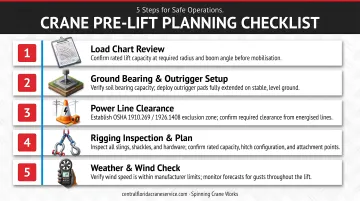
Ground conditions deserve special attention in Florida. Sandy, soft, or recently disturbed soil, common at construction and utility sites across the state, can shift under outrigger pads mid-lift. Skipping ground assessment before positioning is a leading contributor to crane tip-overs.
Safe Crane Operation Under ASME B30
Load chart compliance is non-negotiable. Cranes must operate within rated capacity at every combination of boom angle and working radius shown on the load chart.
Capacity drops sharply as reach extends. A crane that handles 40 tons at a short radius may only be rated for 8-10 tons at maximum reach, so “close enough” load assumptions can lead to serious incidents.
Power line proximity is among the highest-risk hazards in Florida crane work. Under OSHA 1926.1408, equipment that could come within 20 feet of an energized line must follow one of three controls: deenergize and ground the line, maintain 20 feet of clearance, or follow Table A minimum clearances:
| Voltage | Minimum Clearance |
|---|---|
| Up to 50 kV | 10 ft |
| Over 50 to 200 kV | 15 ft |
| Over 200 to 350 kV | 20 ft |
| Over 350 to 500 kV | 25 ft |
| Over 500 to 750 kV | 35 ft |
| Over 750 to 1,000 kV | 45 ft |
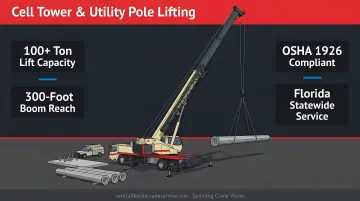
Spinning Crane Works applies power-line experience on Central and South Florida lifts such as cell tower erections, power pole installations, and utility-adjacent HVAC placements.
Signal persons must be qualified through documented testing whenever the operator doesn't have a direct, unobstructed view of the load. That qualification must match the signaling method used. Hand signals and radio communication are not interchangeable without separate qualification.
Inspection and Maintenance Requirements
ASME B30 establishes a three-tier inspection structure that aligns with OSHA's requirements under 1926.1412:
- Pre-shift/frequent inspections — performed by a competent person before each use, covering controls, safety devices, wire ropes, hooks, and ground conditions
- Periodic inspections — performed by a qualified person at least monthly, with documentation retained for a minimum of 3 months
- Annual comprehensive inspections — performed by a qualified person, with documentation retained for a minimum of 12 months
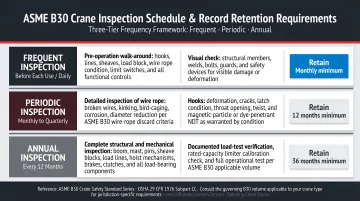
Crews must document, report, and correct any deficiency before the crane returns to service. Records must remain on site and available for OSHA review during the applicable retention period.
How ASME B30 and OSHA Work Together
The legal distinction is simple: OSHA regulations are enforceable federal law. ASME B30 is voluntary unless adopted by regulation, contract, or employer policy.
The primary OSHA rules for crane operations are:
- 29 CFR 1926 Subpart CC: Cranes and Derricks in Construction, the standard that governs most commercial crane work
- 29 CFR 1910.179: Overhead and Gantry Cranes, which applies to general industry rather than mobile construction cranes
OSHA's construction crane standard does not spell out every technical detail for safe crane design, inspection, and operation. ASME B30 fills much of that technical gap.
The Federal Register final rule for Subpart CC shows OSHA used ASME B30 voluntary consensus standards as part of its technical foundation. OSHA selected specific B30 requirements and made those provisions legally enforceable.
The practical implication is direct: meeting OSHA's minimum floor without B30's technical guidance can leave safety and liability gaps. A daily inspection may satisfy a basic checklist, for example, while still missing hook, wire-rope, or rigging details covered in B30.
Courts and OSHA investigators may treat B30 compliance as evidence that an employer met its general duty to provide a workplace free from recognized hazards. B30 non-compliance can also support negligence claims, even when no specific OSHA rule was technically violated.
For Florida project owners and general contractors hiring a crane service such as Spinning Crane Works, compliance means more than a valid operator license. The crew should document how the lift plan, rigging, inspections, and site hazards meet OSHA duties and B30 guidance.
That matters on jobs such as HVAC rooftop placements, cell tower work, storm-damage tree removal, and power pole installation. In those lifts, load control and power line exposure can change quickly, so alignment with both standards separates a controlled crane operation from a liability exposure.
Common ASME B30 Compliance Mistakes to Avoid
Skipping or Rushing Pre-Shift Inspections
Treating the daily inspection as a formality means real defects go undetected. A wire rope that fails a proper B30.30 inspection because of broken wires, diameter reduction, or prior power line contact may still look acceptable on a quick visual walk-around. That rope won't announce itself before it fails under load.
Exceeding Rated Capacity at Extended Radius
Most crane overloads don't happen at short, obvious radius points. They happen at extended reach, where operators or supervisors misjudge how quickly capacity drops on the load chart.
B30.5 requires compliance with rated capacity at every working radius: no exceptions, no judgment calls. On Florida utility and telecom sites, that matters because boom extension is often necessary to reach structures without repositioning.
Reusing Rigging Hardware That Should Be Removed from Service
Damaged shackles, kinked wire rope, and worn synthetic slings get reused because the damage looks minor. B30.9 and B30.26 define specific discard criteria for a reason. A sling or shackle failure mid-lift can cause:
- Dropped loads over an active work zone
- Serious injuries or fatalities below the lift
- Damaged equipment, project shutdowns, and OSHA exposure
"It looked okay" is not a defense.
Frequently Asked Questions
What are the OSHA standards for cranes in construction?
The primary federal regulation is 29 CFR 1926 Subpart CC: Cranes and Derricks in Construction. It covers operator certification, assembly/disassembly, inspections, power line safety, signal person qualifications, and related construction crane requirements.
What is the ASME B30.17 standard?
ASME B30.17 covers cranes and monorails with underhung trolleys or bridge systems, meaning fixed overhead material handling equipment, not mobile cranes. It addresses construction, installation, operation, inspection, and maintenance.
Is ASME B30 compliance legally required?
ASME B30 is a voluntary consensus standard, not federal law. OSHA uses B30 as a technical foundation, and courts may treat non-compliance as evidence of negligence, so responsible crane operations should follow it.
Which ASME B30 volume applies to mobile cranes?
ASME B30.5: Mobile and Locomotive Cranes is the applicable volume. It covers crawler cranes, wheel-mounted cranes, power line work, rigger responsibilities, inspections, and maintenance.
How often must cranes be inspected under ASME B30?
Pre-shift checks occur before use by a competent person. Qualified personnel handle monthly periodic inspections and annual comprehensive inspections, with records kept for 3 and 12 months, respectively.
What is the difference between ASME B30 and OSHA crane regulations?
OSHA regulations, especially 29 CFR 1926 Subpart CC, are enforceable federal law. ASME B30 supplies technical guidance for safe design, operation, and maintenance, so many contractors use it to meet or exceed OSHA’s legal baseline.