For employers in construction, HVAC, utilities, and other physically demanding industries, that translates directly into workers' comp claims, OSHA citations under the General Duty Clause, reduced crew capacity, and real long-term disability risk for workers.
The encouraging part: most manual lifting injuries are preventable. Following structured, OSHA-aligned techniques — combined with knowing when to stop lifting manually altogether — can dramatically reduce that risk. This guide covers both.
Key Takeaways
- Overexertion costs employers $13.7B annually, according to a 2024 workplace safety industry report
- OSHA has no single lifting limit, but it can cite unsafe manual handling under the General Duty Clause
- Safe lifting requires pre-lift planning, correct body mechanics, and the right equipment for the load
- Use team lifts or mechanical aids above 50 lbs; NIOSH treats 51 lbs as the ideal-condition lifting limit
- For oversized, awkward, or elevated loads, qualified crane and rigging services are the safer compliance path
OSHA's Framework for Safe Heavy Lifting
OSHA does not publish a specific ergonomic lifting standard with numeric weight limits. What it does have is the General Duty Clause (Section 5(a)(1)), which requires employers to protect workers from recognized, serious hazards , including those caused by improper manual lifting.
In 1997, the Occupational Safety and Health Review Commission confirmed that ergonomics hazards involving lifting and repetitive motions are citable under the General Duty Clause. OSHA's ergonomics guidance reinforces this: the agency may inspect ergonomic hazards and issue citations or hazard alert letters when appropriate.
The Hierarchy of Controls for Lifting
OSHA and NIOSH both apply the standard hierarchy of controls to manual handling risks. In order of preference:
- Eliminate or reduce the load: redesign the task or break loads into smaller units
- Engineering controls: mechanical devices that lift, reposition, or transport loads (forklifts, hoists, conveyors)
- Administrative controls: team lifts, job rotation, scheduled rest breaks
- Work-practice controls: trained body mechanics, including keeping the load close and avoiding twists
- Personal protective equipment (PPE): gloves, safety-toe boots, and other task-specific gear (last line of defense, not a substitute)
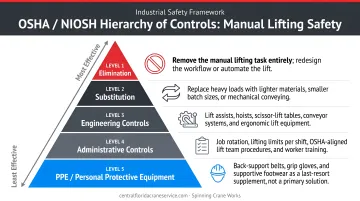
The practical implication: proper lifting form matters, but OSHA expects employers to evaluate feasible mechanical and engineering options before relying on a worker's technique alone. For oversized loads, such as rooftop HVAC units, power poles, or storm-damaged trees, that usually means planning the lift around equipment, rigging, and controlled placement instead of manual handling.
Pre-Lift Planning and Risk Assessment
Many acute lifting injuries happen when workers skip the assessment and pick up the load cold. A few seconds of planning can prevent strains, dropped loads, and blocked-visibility hazards.
Evaluate the Load First
Before touching any object, assess:
- Weight — if unknown, test with a small push or tilt before committing
- Size and shape — bulky or irregular objects shift center of gravity unpredictably
- Grip points — if there are no secure handholds, stop and find an alternative
- Line of sight — carrying a load that blocks your view creates a secondary hazard
If any of these factors raise doubt, the right move is to plan differently, not push through.
Know the Power Zone
OSHA defines the "power zone" as the area close to the front of the body, between mid-thigh and mid-chest height. NIOSH describes it as above the knees, below the shoulders, and close to the body, where the arms and back exert the least mechanical stress.
Anything lifted below knee level or above shoulder height falls outside this zone and raises injury risk.
When to Call for Help
The NIOSH Revised Lifting Equation sets the ideal-condition maximum at 51 pounds for a single-person two-handed lift, adjusted downward for frequency, twisting, distance from the body, and grip quality. In general industry practice, 50 pounds is the accepted single-person threshold; above that, a team lift or mechanical aid is expected.
For team lifts:
- Designate one person to call the lift ("lift on three")
- Confirm grip and footing before anyone moves
- Move together at the same pace, with communication throughout
When loads are too heavy, too bulky, or must travel significant distance, use a mechanical aid: hand trucks, dollies, pallet jacks, or forklifts depending on the load scale.
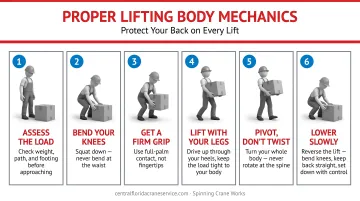
Proper Body Mechanics During the Lift
OSHA-aligned lifting technique comes down to a short set of practical principles. Each one has a biomechanical reason behind it.
Setup and Foot Position
- Stand close to the load, feet shoulder-width apart
- Place one foot slightly forward to create a stable, balanced base
- This distributes force evenly and gives you a recovery step if the load shifts
The Lift Itself
- Bend at the hips and knees, not the waist
- Keep the back straight or slightly arched (a slight natural curve, not a slump)
- Tighten core muscles before the load leaves the ground
- Push through the legs to rise. That is what "lift with your legs" actually means
- Avoid both deep squatting and full stooping; a controlled, partial bend is the target
Carrying and Setting Down
Once the load is in hand:
- Hold it close to the body at waist height; keeping it at arm's length multiplies spinal load
- Keep shoulders aligned with hips
- Move your feet to change direction instead of twisting the torso while holding weight
- Take smooth, deliberate steps; never jerk or snatch
Setting down carries as much injury risk as picking up. Reverse the lifting motion: bend at the knees and hips, keep the back straight, lower the load under control, and don't release until it's stable.
Absolute Prohibitions
These are non-negotiable during any lift:
- Avoid torso twisting while the back is loaded
- Keep loads below shoulder level
- Do not carry anything that blocks your vision
- Exhale on exertion instead of holding your breath
Environmental Considerations: Florida Worksites
Florida's climate introduces specific risks that raise lifting risk, especially on outdoor construction, utility, HVAC, and tree-removal jobs.
Heat and Humidity
OSHA heat exposure guidance and NIOSH heat stress guidance both identify heavy physical activity in hot environments as a primary heat illness risk factor. Heat fatigue impairs skilled manual work, so a heat-stressed worker may lift with worse form, slower reaction time, and reduced grip strength.
Practical adjustments:
- Schedule the heaviest lifts for early morning, before peak heat
- Enforce hydration breaks before workers feel thirsty
- Watch for early heat stress signs: slowed reaction, poor coordination, irritability
Surface and Terrain Conditions
Construction sites rarely offer ideal footing. Wet concrete, uneven ground, gravel, and confined spaces all change the mechanics of a lift:
- Slow down on unstable surfaces instead of matching indoor lifting pace
- Widen your base stance on uneven terrain
- On slippery surfaces, consider whether the task requires a mechanical alternative
OSHA's construction housekeeping standard (29 CFR 1926.25) requires work areas and passageways to be kept clear of debris. That baseline helps, but crews still need to assess footing, load path, and weather conditions before each lift.
Cold Environments
Refrigerated spaces or early-morning outdoor work in cooler months can reduce muscle flexibility and grip strength. In those conditions, a brief warm-up or stretching routine before heavy lifts is basic injury prevention.
Common Lifting Safety Mistakes to Avoid
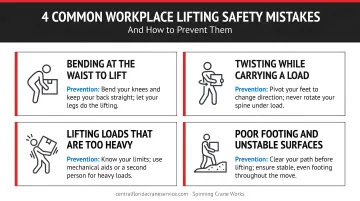
These four mistakes show up repeatedly across construction, rigging, and industrial worksites:
Skipping the pre-lift assessment: Workers who lift without checking weight, path, or grip can lose control fast. A few seconds of planning prevents many acute lifting injuries.
Twisting while lifting or carrying: Rotational force on a loaded spine is a common driver of disc injuries. Set the load down or step to turn instead of pivoting under weight.
Trusting lighter-looking objects: Dense materials, uneven weight, and awkward shapes can make a load harder to control than it appears. Test the load before committing.
Ignoring fatigue: Lifting technique breaks down as workers tire. BLS data shows overexertion and repetitive motion account for nearly 946,290 DART (Days Away, Restricted, or Transferred) cases annually, so rest breaks should be treated as a safety control.
When the Load Exceeds Manual Limits: Mechanical and Crane-Assisted Lifting
At a certain point, manual handling stops being a technique problem and becomes an equipment problem. For loads that exceed safe manual capacity, particularly in construction, HVAC installation, utility work, and tree removal — mechanical equipment isn't optional. It's required.
Mechanical Solutions by Scale
| Load Type | Typical Equipment |
|---|---|
| Up to ~1,000 lbs | Hand trucks, dollies, pallet jacks |
| 1,000 – 20,000 lbs | Forklifts, rough terrain lifts |
| Tons / precision placement at height | Professional crane and rigging services |
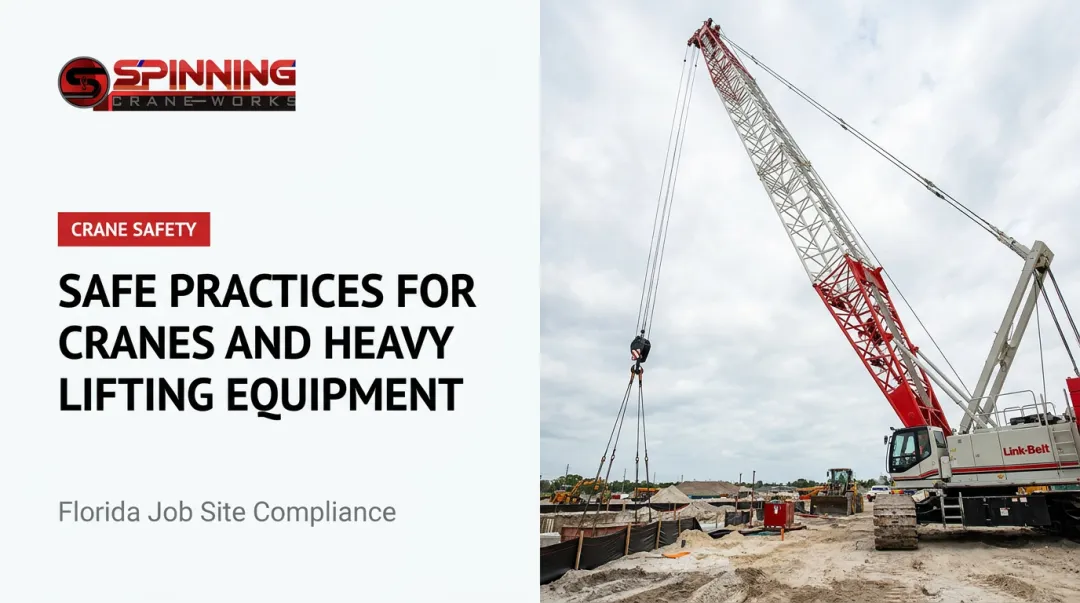
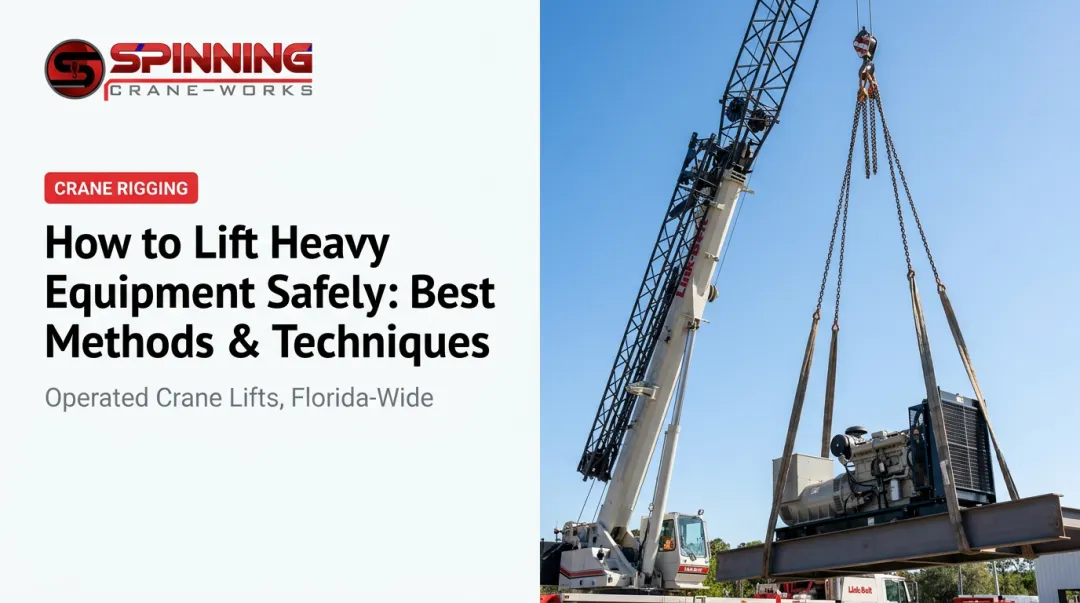
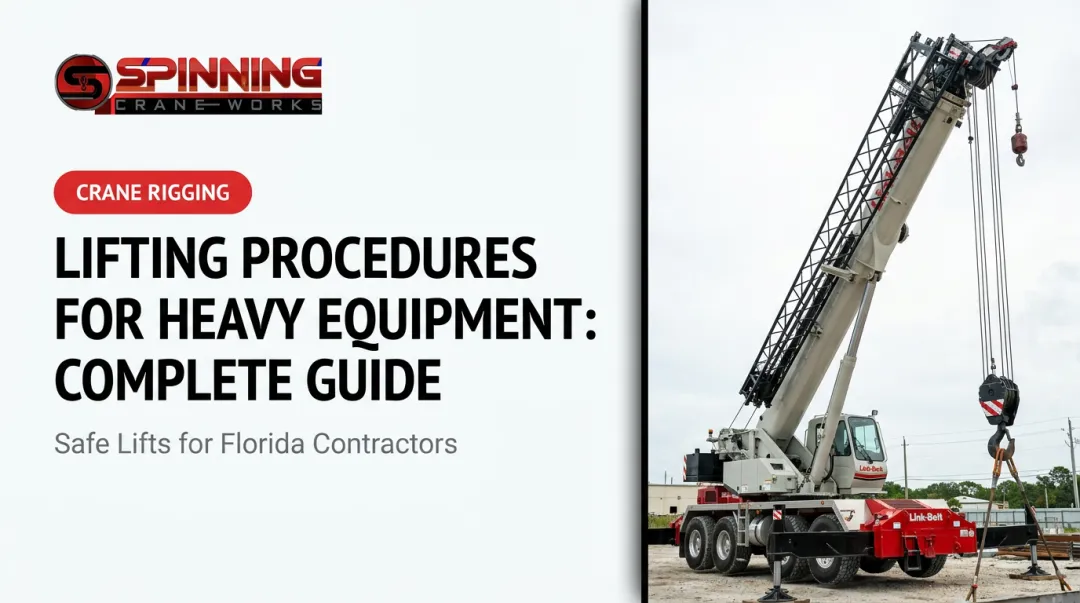
For lifts measured in tons, such as HVAC rooftop units, power poles, cell tower components, or storm-felled trees near structures, crane-assisted lifting is the safe, compliant option.
What Crane Work Actually Requires
OSHA treats construction crane work as a separate regulatory category under OSHA 29 CFR 1926 Subpart CC. Requirements often include:
- Certified operators under 29 CFR 1926.1427
- Rigging and sling checks before use and during each shift when conditions require it, including inspection duties under 29 CFR 1926.251
- Power line clearance planning under 29 CFR 1926.1408, including a 20-foot minimum distance for lines up to 350 kV unless protective measures are used
- Pre-lift assessment of load weight, center of gravity, and swing path
Spinning Crane Works handles these lifting scenarios across Central and South Florida. From its Melbourne base, the team serves Miami, Fort Lauderdale, Tampa, Jacksonville, Saint Augustine, and nearby service areas, using cranes of all sizes to complete your lifts safely.
Common work includes HVAC rooftop placements, cell tower and power pole erection, heavy equipment lifting, and crane-assisted tree removal after storms. In those cases, the job depends on trained operators, rigging plans, and controlled placement rather than manual handling.
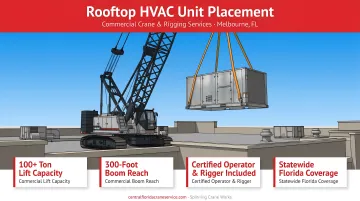
Experience working around power lines is especially useful for utility and telecommunications jobs, where clearance planning affects both field safety and OSHA compliance.
Conclusion
Safe lifting doesn't happen automatically. It requires deliberate planning before each lift, consistent technique during the lift, and the discipline to stop when the load or conditions exceed what's safe to handle manually. Both employers and workers share that responsibility — OSHA's General Duty Clause makes it a legal one.
For loads that no amount of technique can safely address, the answer is mechanical. Working with a trained crane and rigging crew helps ensure the lift is planned, controlled, and completed in line with OSHA requirements.
For crane and rigging support in Central or South Florida, contact Spinning Crane Works at 321-759-2263.
Frequently Asked Questions
What are the control measures for lifting heavy objects?
Start by eliminating or reducing the load. If that is not possible, use mechanical aids such as hand trucks, forklifts, cranes, or workstation changes; training and PPE only support those controls.
Does OSHA have a specific weight limit for manual lifting?
No. OSHA does not set a maximum manual lifting weight. NIOSH uses 51 pounds as an ideal-condition benchmark, but many job sites treat 50 lbs as the point to consider team lifting or mechanical aids.
What is the safest way to lift a heavy object from the floor?
Stand close to the load with feet shoulder-width apart. Bend at the hips and knees, keep your back straight, push through your legs, hold the load close, and avoid twisting.
What are the most common injuries caused by improper lifting at work?
Lower back strains and herniated discs are most common. Shoulder sprains, muscle pulls, and wrist injuries also occur, especially when workers lift through early pain instead of stopping.
When should you use crane or mechanical lifting equipment instead of manual lifting?
Use crane or mechanical lifting when loads exceed safe manual limits, placement must be precise at height, or the area is confined, overhead, or hazardous. HVAC rooftop units, power poles, cell towers, and heavy equipment placement are common examples.
What PPE is required for heavy lifting tasks?
Common PPE includes steel-toed boots, work gloves, and high-visibility gear where traffic or equipment is present. PPE is the last layer of protection; it does not replace proper technique or needed mechanical aids.