What makes this particularly frustrating is that most crane accidents aren't freak events. Overloaded booms, skipped inspections, power line contact, rigging failures — these are preventable failures with known causes and documented solutions.
This guide covers the specific safety practices that keep crane operations off the fatality report: from pre-lift planning and rigging inspection to environmental hazards and the behavioral mistakes that end careers and lives.
Key Takeaways
- Inspect equipment before every shift — mechanical failures rarely announce themselves in advance
- Never lift beyond the rated capacity for the crane's current configuration and radius
- Maintain at least 10 feet of clearance from power lines up to 50kV — more for higher voltages
- Only OSHA-certified operators and qualified riggers should handle crane operations
- Environmental conditions must be reassessed before every lift, not just at job start
Safety Guidelines for Cranes and Heavy Lifting Equipment
Crane safety doesn't rest on any single person or procedure. It depends on the combined discipline of qualified personnel, well-maintained equipment, and deliberate planning executed consistently across every phase of the job.
Understanding where accidents originate helps explain why every phase matters. CPWR's analysis of 1992–2006 fatality data identified the leading causes of crane-related construction deaths:
- 25% — electrocution from overhead power lines
- 21% — struck by crane load
- 20% — struck by crane or crane parts
- 14% — crane collapse
- 9% — falls
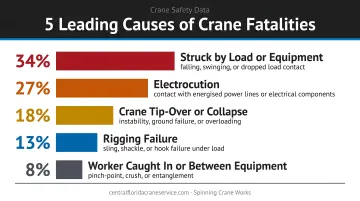
Mobile and truck cranes were involved in 78% of fatal incidents where crane type was identified. These aren't tower crane statistics from high-profile collapses. They're the everyday mobile crane work happening on job sites across the country.
Safety must be maintained across every phase: inspection, setup, rigging, active lift, and load landing. A single gap anywhere in that sequence can be fatal.
General Safety Precautions
Personal Protective Equipment is the baseline, not the complete solution. All personnel on a crane lift site must wear:
- Hard hats (required under OSHA 29 CFR 1926.100 where head injury risk exists)
- High-visibility vests
- Steel-toed boots
- Gloves appropriate to the task
When working near energized power lines (as Spinning Crane Works frequently does on utility pole and telecom tower jobs) additional electrical-rated PPE may be required based on minimum approach distance (MAD) requirements and site conditions.
Workspace readiness matters just as much as personal gear. Before any lift:
- Establish and enforce exclusion zones around the crane's full swing radius
- Remove all non-essential personnel from the lift area
- Confirm the landing zone is clear and unobstructed
- Post control lines, warning lines, or barriers to mark hazard boundaries, per OSHA 29 CFR 1926.1424
Under OSHA 29 CFR 1926.1425, workers are prohibited from the fall zone except for specific permitted tasks : hooking, unhooking, guiding a load, or initial connection work.
Personnel qualifications are non-negotiable. OSHA 29 CFR 1926 Subpart CC governs crane and derrick operations in construction. Only trained, certified crane operators (per 29 CFR 1926.1427) and qualified riggers (per 29 CFR 1926.1404) should perform any operational role on a crane lift.
Safety During Crane Setup and Rigging
The ground beneath a crane is either its foundation or its failure point. OSHA 29 CFR 1926.1402 requires that equipment only be assembled and operated on ground that is firm, drained, and graded to manufacturer specifications. In Florida specifically, where sandy fill, reclaimed land, and recently backfilled construction sites are common , this requirement demands genuine assessment, not assumption.
Key ground and outrigger requirements:
- Assess bearing capacity before positioning the crane
- Outriggers must be fully extended per the load chart (29 CFR 1926.1404) — partially deployed outriggers are not an acceptable compromise
- Never position outrigger pads over voids, underground utilities, tanks, or recently backfilled soil
- Controlling entities must disclose known underground hazards before setup begins
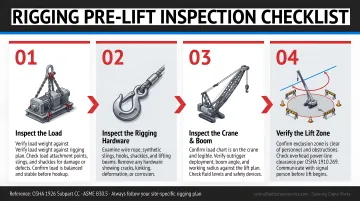
Rigging inspection before every lift is required under OSHA 29 CFR 1926.251 and ASME B30.9. Before hoisting:
- Inspect slings, hooks, and shackles for wear, deformation, or damage
- Select the correct hitch type (basket, choker, or vertical) based on load shape and weight distribution
- Verify the load's center of gravity before the hook goes up
- Remove any defective hardware from service immediately
Do not proceed with setup when:
- Ground conditions are unstable and cannot be corrected on site
- Any rigging hardware shows visible damage
- Load weight or pick points have not been confirmed
Safety While Operating Cranes and Heavy Lifting Equipment
Active lifts are where most mistakes become irreversible. Operators must understand and stay within the crane's rated load chart for the specific configuration in use.
Critical operating limits:
- Load charts specify capacity based on boom length, radius, and configuration ; all three must match actual conditions
- As load radius increases (boom extends outward), rated capacity drops sharply
- Never bypass anti-two-block devices or rated capacity limiters; OSHA 29 CFR 1926.1416 mandates these systems on modern cranes for a reason
Behavioral risks during active lifts:
- Avoid sudden boom or load movements that create dynamic loading
- Never side-load the boom ; it's not engineered for lateral force
- Use tag lines to control load swing; free-swinging loads become struck-by hazards
- No worker should be positioned under a suspended load, period
For complex or high-stakes lifts, working with a qualified crane and rigging service that brings certified operators, a qualified rigger, signal person, and pre-lift site survey to every job reduces the margin for error considerably. Spinning Crane Works operates this full-service model on every lift across Florida, including the pre-lift rigging engineering input that helps confirm load weights and pick points before the crane ever moves.
Environmental and Site Safety Considerations
Environmental conditions affect crane safety decisions as directly as any equipment factor — and Florida's specific hazards demand extra attention before every lift.
Weather and wind: No other U.S. region sees more thunderstorm activity than Florida, with the western peninsula averaging more than 80 thunder days per year according to the Florida Climate Center. The rainy season runs from mid-May through mid-October, with late May and June posing the highest severe storm risk : hail, damaging winds, waterspouts, and frequent lightning.
OSHA doesn't set a universal wind speed cutoff for construction cranes; limits are manufacturer and configuration-specific. For personnel platforms specifically, OSHA 29 CFR 1926.1431 requires a qualified-person safety determination when sustained winds or gusts exceed 20 mph at the platform level. When in doubt, operations stop ; that's the only safe protocol.
Heat is a separate hazard. Crane operators and ground crews working in Florida's summer conditions face heat stroke risk when sustained physical activity combines with high heat and humidity. Confusion, disorientation, and loss of coordination (all documented heat stroke symptoms per OSHA) are incompatible with safe crane operation.
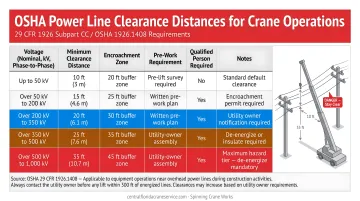
Power line clearance: OSHA 29 CFR 1926.1408 Table A establishes minimum clearance distances:
| Voltage | Minimum Clearance |
|---|---|
| Up to 50 kV | 10 feet |
| 50–200 kV | 15 feet |
| 200–350 kV | 20 feet |
| 350–500 kV | 25 feet |
| 500–750 kV | 35 feet |
| 750–1,000 kV | 45 feet |
Power line electrocution was the single leading cause of crane fatalities in construction (25% of all deaths) in the CPWR dataset. Spinning Crane Works coordinates with utilities on minimum approach distances, outage windows, and OSHA 1910.269 power-line clearance compliance for every utility and telecom job involving energized infrastructure.
Common Safety Mistakes to Avoid
Understanding what kills people matters as much as knowing what to do correctly. Three mistakes account for most preventable crane accidents.
Skipping or rushing the pre-shift inspection. OSHA 29 CFR 1926.1412 requires a visual inspection by a competent person before or during each shift. When this gets skipped, whether because the job is running late or because "nothing was wrong yesterday," worn wire rope, hydraulic leaks, or improperly seated outriggers go undetected. Category III wire rope deficiencies (broken strands, core protrusion) require immediate replacement under 29 CFR 1926.1413. A pre-shift find is an inconvenient delay. A mid-lift find is a fatality.
Overloading or misreading the load chart. NIOSH data shows that nearly 80% of mobile crane upsets result from exceeding rated capacity. Operators who assume a crane "can handle it", without verifying actual load weight, current radius, and configuration against the load chart, create tip-over and structural failure risk on every lift.
OSHA 29 CFR 1926.1417 requires the rated capacity chart in the cab for exactly this reason: it must be consulted before every lift, not filed away as reference material.
Ignoring warning signs during a lift. Under OSHA 29 CFR 1926.1418, operators have the explicit authority and responsibility to stop and refuse to handle loads whenever a safety concern exists. These aren't problems to work around:
- Unusual boom flex or deflection
- Warning alarm activation
- Ground settlement under outriggers
- Unexpected load swing or drift
Each is a signal to stop the lift, reassess, and get a qualified determination before proceeding.
Conclusion
Safe crane operations don't result from good intentions. They result from trained judgment applied consistently across every phase — setup, rigging, active lift, environmental monitoring, and immediate response to warning signs. Getting that judgment right means understanding not just what the rules are, but why each one exists.
For any lift in Florida, the fastest way to reduce that risk is putting a trained, properly insured crew in charge from the start. Working with a qualified crane service eliminates a significant share of the variables that cause incidents. Spinning Crane Works provides certified operators, qualified riggers, full liability and equipment insurance, pre-lift site surveys, and rigging engineering input on every job — from Melbourne and Orlando to Miami, Tampa, and Jacksonville. Call 321-759-2263 or reach out through centralfloridacraneservice.com to discuss your lift.
Frequently Asked Questions
What are the safe practices and procedures for lifting heavy objects?
Safe crane lifting requires a pre-operation inspection, load weight verification against the crane's rated chart, proper rigging selection and inspection, and clear crew communication throughout the lift. Only certified operators and qualified riggers should fill operational roles.
What PPE is required when working around cranes?
The standard PPE on a crane lift site includes a hard hat, high-visibility vest, steel-toed boots, and gloves. Additional protective equipment — including electrical-rated gear — is required when working near energized power lines or other site-specific hazards.
How far must a crane stay from power lines?
OSHA requires a minimum of 10 feet of clearance from power lines up to 50kV, increasing to 45 feet for lines between 750 and 1,000kV. A qualified spotter and documented pre-lift plan are required any time equipment could come within 20 feet of an energized line.
What causes most crane accidents on job sites?
The most common root causes are overloading beyond rated capacity, improper outrigger setup on unstable ground, contact with overhead power lines, rigging failure, and workers entering the exclusion zone beneath or near a suspended load.
When should a crane lift be stopped or postponed?
Stop the lift when wind speeds exceed manufacturer thresholds, ground conditions become unstable, equipment warning systems activate, visibility is insufficient, or load weight cannot be confirmed. OSHA authorizes operators to halt work whenever a safety concern arises.
Do crane operators need to be certified?
Yes. OSHA 29 CFR 1926.1427 requires operators to be trained, certified through an accredited program, and evaluated for the specific equipment they operate. Certification is valid for five years, and employers must document evaluations before putting any operator in service.