Introduction
Between 2011 and 2017, the Bureau of Labor Statistics recorded 297 crane-related occupational fatalities in the United States, an average of 42 deaths per year. During that same period, 79 fatalities involved an object falling from or put in motion by a crane.
These numbers point to a practical jobsite problem: lifts fail when crews treat a rated capacity as flexible. For HVAC contractors, utility crews, and rigging teams, that mistake can mean a dropped load, OSHA citations, civil liability, criminal exposure after a fatality, or a complete project shutdown.
Crane lift weight limits are legally binding thresholds. OSHA regulations under 29 CFR 1910.179, 1926.1417, and 1917.45 prohibit operating any crane above its manufacturer-rated load capacity. This guide explains what those limits mean, what changes them, and how to plan lifts without crossing the line from controlled work into failure.
Key Takeaways
- A crane's rated capacity changes with boom angle, load radius, and site conditions — it's never a single fixed number
- OSHA regulations prohibit exceeding manufacturer-rated load capacity under any circumstances
- Total suspended load must include all rigging hardware, not just the object being lifted
- Wind, soft ground, and power line proximity can all reduce safe working capacity
- Pre-lift load verification and load chart consultation are legally required steps, not optional practices
What Determines a Crane's Rated Lift Capacity
Rated Capacity and the Load Chart
OSHA defines "rated capacity" as the maximum working load permitted by the manufacturer under specified working conditions. That last phrase matters: the rating is always tied to a specific configuration. Change the configuration, and the capacity changes too.
Every crane has a load chart, a document specifying safe lifting capacity across different boom lengths, angles, and radii. OSHA requires that this chart, along with the operator manual, be readily available in the cab or operator station at all times. If the chart is inaccessible or an electronic display fails, operations must stop until it's available again. That rule is a safety stop point, not just paperwork.
How Boom Angle and Radius Affect Capacity
As a boom extends further outward and the load radius increases, the crane must counteract a greater overturning moment. The mechanical leverage working against the crane grows, and the safe working capacity can drop fast.
A crane's nominal capacity at minimum radius can drop sharply as the boom extends and the operating radius increases. That same crane, at a longer boom extension and greater radius, will support a fraction of its close-range rating. The specific numbers depend on the exact configuration in the load chart. That's why operators must consult the chart for every lift, not rely on memory or a general capacity figure.
Rigging Weight Counts
One of the most consistently overlooked variables is rigging. our crane's own load chart documentation states explicitly: "A deduction must be made from these capacities for weight of hook block, hook ball, sling, grapple, load weighing device, etc."
Spreader bars, shackles, lifting frames, and rigging slings can add hundreds or even thousands of pounds to the suspended load. The net allowable payload for any lift is the chart capacity minus the total weight of all rigging and below-the-hook hardware. Operators who skip this calculation may believe they're within limits when they're already over.
OSHA Regulations Governing Crane Lift Weight Limits
The Three Key Standards
Three OSHA standards govern crane weight limits across different settings:
| Standard | Applies To | Core Requirement |
|---|---|---|
| 29 CFR 1910.179 | General industry overhead/gantry cranes | Rated load must be visibly marked on each side of the crane; no operation above rated load except for testing |
| 29 CFR 1926.1417 | Construction cranes | Load charts must be in the cab; operations must stop if electronic capacities become unavailable; no operation above rated capacity |
| 29 CFR 1917.45 | Marine terminal cranes | Durable rating chart must be visible to the operator; manufacturer's rated loads must not be exceeded under any condition of use |
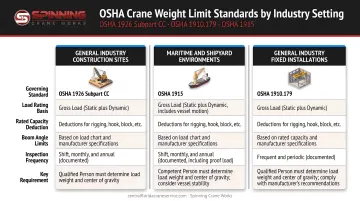
All three share the same core prohibition: do not exceed manufacturer-rated capacity.
Operator Certification Requirements
Under 29 CFR 1926.1427, effective December 2018, construction crane operators must hold certification from an accredited testing organization. Employers must also conduct and document their own training evaluations.
Certified operators learn to read load charts, calculate total suspended loads, and spot overloading risks before they become structural failures.
Inspection Requirements
Under 29 CFR 1926.1412, a competent person must conduct a visual inspection before each shift. Monthly inspections must be documented and retained.
At least every 12 months, a qualified person must perform a formal inspection. Any defect that affects safe load-bearing capacity must be corrected before the crane is used again.
Penalty Exposure
OSHA's current penalty schedule (effective January 15, 2025) sets maximums at:
- $16,550 per serious violation
- $165,514 per willful or repeated violation
Beyond fines, employers face work stoppages, civil liability, and, after a fatality, potential criminal exposure. An OSHA accident record (case 170184238) describes an incident where load-chart specifications confirmed the crane was overloaded at the time of the accident.
Safety Guidelines: Operating Within Crane Lift Weight Limits
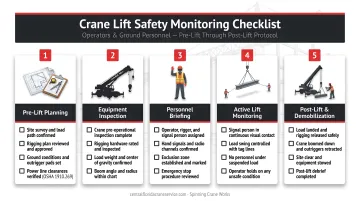
Staying within weight limits requires active discipline before, during, and after every lift, not just knowing a number.
General Safety Precautions
Before any lift begins:
- All personnel in the lift zone must wear required PPE, including hard hats, high-visibility vests, and steel-toed boots
- A designated lift director or signal person must be present and clearly identified
- The swing radius of the crane must be physically barricaded against unauthorized entry
- Ground beneath the crane and load path must be assessed for load-bearing capacity
- Outriggers must be fully deployed on stable, level, adequately prepared ground before any movement begins
Pre-Lift Load Verification
Crews must confirm the actual weight of every load before the lift. Estimates are not enough. Acceptable verification methods include manufacturer documentation, certified weight tickets, and load cells. Guessing the weight of a load is one of the most common paths to an unintentional overload.
Once the crew confirms the weight, the operator must cross-reference the total against the crane's load chart for the specific boom configuration, radius, and outrigger status planned for that lift. If the confirmed load weight, including all rigging, approaches or exceeds the chart value for those conditions, the lift must be reconfigured or stopped.
During the Lift
Smooth, controlled movements are a safety requirement, not a comfort preference. Sudden starts, abrupt stops, and rapid swings create dynamic load amplification, meaning the moving load can act heavier than its measured weight. The effective load on the crane's structure during a jerky swing can exceed the static weight by enough to push past the rated capacity, even when the scale weight was acceptable.
Monitoring requirements during a live lift:
- Operator continuously watches load indicators, boom angle, and wire rope condition
- Ground personnel watch for crane tilt, outrigger settling, or any instability
- Communication between operator and signal person remains continuous and unambiguous throughout
Environmental and Site Conditions That Reduce Safe Lift Capacity
Wind
Wind adds lateral forces to both the load and boom, increasing the effective load on the crane's structure. OSHA requires a competent person to assess and address wind, ice, and snow effects on stability and rated capacity.
OSHA does not set one universal mph shutdown threshold. Wind limits are crane-specific and found in the manufacturer's load chart or operations manual.
Some manufacturers publish separate wind-speed load charts with capacity tables by maximum wind speed. Operators should follow the manufacturer's specifications for their exact equipment.
When wind picks up mid-job, treat it as a reassessment event, not a minor inconvenience to push through.
Ground Conditions
OSHA requires that equipment only be assembled and used where ground is firm, drained, and graded enough to meet manufacturer support requirements. The controlling entity must disclose known subsurface hazards, such as voids, buried tanks, or utilities, before setup begins.
Soft soil, slopes, or uneven terrain can cause outriggers to shift or sink, changing the crane's center of gravity and making the rated capacity on the load chart unreliable. Steel plates, crane mats, and cribbing are often required to stabilize outrigger footprints, particularly on Florida job sites where soft soil and buried infrastructure are common variables.
Power Line Proximity
OSHA's Table A under 29 CFR 1926.1408 establishes minimum clearances from energized lines:
- 10 feet for lines up to 50 kV
- 15 feet for lines over 50 kV to 200 kV
- 20 feet for lines over 200 kV to 350 kV
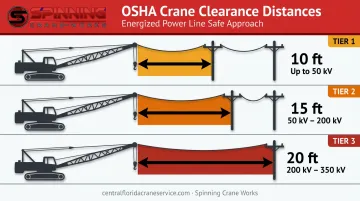
Operating near power lines can force the crane farther from the load. That larger working radius directly reduces safe lifting capacity. Before selecting a crane position on any utility-adjacent site, verify the line voltage with the utility operator.
For Florida utility, telecommunications, and construction work, that planning often means coordinating lift radius, boom angle, utility verification, and ground setup before the crane arrives. Spinning Crane Works applies that approach on power-line-adjacent lifts across Central and South Florida.
Common Safety Mistakes Around Crane Weight Limits
Common mistakes that push a lift outside its planned limit include:
Treating rated capacity as fixed. A high-capacity rating applies only at a specific radius and boom configuration. At full extension, the same crane may safely handle only a fraction of that load, making a tip-over or structural failure more likely.
Leaving rigging out of the load calculation. Slings, shackles, spreader bars, and lifting frames can add hundreds or thousands of pounds. Cargo weight alone may look compliant while the total pick is already over capacity, which OSHA treats as an overload whether intentional or not.
Skipping a fresh load-chart check after changes. A job-start chart check does not cover every lift that follows. If the crane repositions, boom angle changes, or radius shifts, check the chart again before the next pick.
Working through deteriorating conditions. Rising wind, rain-softened ground, or a discovered subsurface void should trigger a stop-work decision. Schedule pressure is real, but those changes can invalidate the rated capacity used in the lift plan.
When any of these factors changes, treat the lift as unplanned until the load chart, rigging weight, and site conditions are verified again.
Conclusion
Crane lift weight limits come from engineering analysis, OSHA requirements, and hard operational experience. The margin between a crane's rated capacity and failure is narrower than many crews assume, especially when boom angle, wind, or ground conditions shift from ideal.
Treat every lift as a documented safety check:
- Confirm the load weight and include all rigging in the total
- Consult the load chart for the exact crane configuration
- Assess wind, ground bearing, overhead lines, and site access before hoisting
For crane lifts in Central or South Florida, Spinning Crane Works provides trained operators, cranes of all sizes to complete your lifts safely, and lift planning experience for utility, construction, HVAC, telecom, and tree removal work.
Call 321-759-2263 to discuss the safest approach for your project.
Frequently Asked Questions
When using a crane, how do you ensure the weight to be lifted does not exceed the crane's rated capacity?
Obtain verified load weight documentation, add all rigging and below-the-hook hardware, then check the total against the crane's load chart for the planned boom length, radius, and outrigger setup. Never estimate the load weight.
What should be done if a crane's load exceeds its maximum capacity?
The lift must not proceed. Options include repositioning the crane to reduce the load radius, substituting a crane with a higher rated capacity for that configuration, or planning a tandem lift using two cranes with a qualified lift director overseeing the operation.
How many people can a crane lift in a personnel basket?
OSHA personnel hoisting rules under 29 CFR 1926.1431 require approved platforms or baskets with rated load markings. The total load, including the basket, people, hook, line, and rigging, must not exceed 50% of rated capacity.
What OSHA standard specifically governs crane lift weight limits?
29 CFR 1910.179 covers general industry overhead cranes, 29 CFR 1926.1417 covers construction cranes, and 29 CFR 1917.45 covers marine terminal cranes. All prohibit exceeding manufacturer-rated loads.
How does boom angle or extension affect how much a crane can safely lift?
As the boom extends outward and load radius increases, safe lifting capacity decreases. The crane's load chart gives the exact capacity for each boom length, angle, and radius combination.
What is the difference between a crane's rated capacity and its actual safe working load?
Rated capacity is the manufacturer's maximum under specified conditions. Actual safe working load may be lower because of rigging weight, wind, ground conditions, boom angle, and outrigger setup.