Introduction
Most crane and rigging incidents start with missed steps: an unverified load weight, incomplete setup, or a rushed signal plan.
According to NIOSH Publication No. 2006-142, nearly 80% of all crane upsets are attributed to operators exceeding the operational capacity of the machine; 54% are linked to improper setup, such as failure to fully extend outriggers. The pattern points to preventable planning gaps, from outrigger setup to load-capacity checks.
This guide covers the complete lifting procedure framework for mechanical lifts in commercial and industrial construction, from pre-lift planning through final load placement. It's written for construction managers, contractors, rigging crews, and project owners in industries like utilities, HVAC, telecom, and heavy construction across Florida.
Whether you're coordinating a rooftop HVAC placement, a power pole erection, or a complex multi-point lift, the fundamentals don't change. The difference is whether the crew verifies each step before the load leaves the ground.
Key Takeaways
- Heavy equipment lifting procedures should be documented, pre-engineered plans with assigned roles and clear lift steps
- Every lift requires verified load weight, center of gravity assessment, and crane capacity confirmation before rigging begins
- OSHA 29 CFR 1926 Subpart CC governs crane and derrick operations in construction
- Signal persons must be formally qualified under 29 CFR 1926.1428 before giving signals
- Skipped planning steps are a common factor in preventable crane incidents, especially during complex or high-risk lifts
What Are Heavy Equipment Lifting Procedures?
A heavy equipment lifting procedure is a documented, pre-engineered plan that specifies exactly how a specific load will be lifted, moved, and placed using mechanical equipment. This is distinct from ergonomic or manual lifting guidelines: we're talking about cranes, rigging hardware, and loads that cannot be moved any other way.
The goal is simple: controlled movement of a load from Point A to Point B without injury, equipment failure, or property damage.
What separates a proper lifting procedure from informal rigging practice is scope. A written procedure accounts for:
- Load geometry and center of gravity
- Site constraints and ground conditions
- Crane geometry and capacity at the required radius
- Multi-point coordination between operators, signal persons, and spotters
- Regulatory compliance under OSHA 29 CFR 1926 Subpart CC
Informal approaches handle none of that systematically. They rely on experience and assumptions, which is exactly where many incidents originate.
Pre-Lift Planning: The Foundation of Every Safe Heavy Lift
No crane or rigging operation should begin without a formal lift plan. The plan sets the load data, equipment limits, personnel roles, and site controls before anyone signals the first pick.
What a Lift Plan Includes
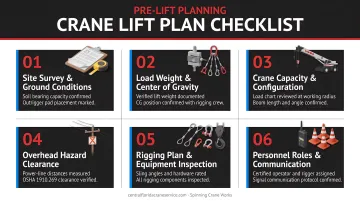
A complete lift plan documents:
- Verified load weight and dimensions
- Center of gravity estimate with attachment point identification
- Rigging configuration and hardware selection
- Crane model, rated capacity, and capacity at the required operating radius
- Personnel assignments and communication protocol
- Site conditions including ground bearing capacity and hazard mitigation
Load Assessment
Teams must determine the exact weight of the load before rigging begins. Under 29 CFR 1926.1417(o)(3), if a trial hoist indicates the load exceeds 75% of maximum rated capacity, the operator must not proceed until weight is verified through recognized sources or calculation methods.
Unverified load weights are among the most common contributors to crane overload incidents. Crews must also identify the center of gravity. An off-center CoG can cause the load to tip or shift mid-lift even when rated capacity is not exceeded.
Site Survey
Ground conditions can make a safe lift unsafe before the boom moves. The site survey must cover:
- Soil bearing capacity at outrigger pad locations
- Ground slope and surface stability
- Underground utilities beneath the crane's travel path
- Overhead obstructions, particularly energized power lines
- Planned crane travel path and swing radius clearances
Personnel Roles
Every mechanical lift requires clearly assigned roles:
- Crane operator: certified and qualified for the equipment
- Signal person: formally qualified under 29 CFR 1926.1428, with documentation on-site
- Lift supervisor: competent person with authority to halt the lift
- Spotters: positioned to monitor swing radius and load clearance
OSHA 1926.1428 requires signal persons to pass both an oral or written test and a practical test before giving signals. Qualification documentation must be available at the job site and must specify the signal types, such as hand signals or radio, for which the person is qualified.
Critical Lift Requirements
For steel erection, 29 CFR 1926.751 (Subpart R) defines a critical lift as any lift exceeding 75% of rated crane capacity or requiring more than one crane. Subpart CC contains separate requirements for high-risk operations:
- Multi-crane lifts require a plan developed by a qualified person (1926.1432)
- Personnel hoisting requires a 50% rated-capacity limit for the loaded platform, trial lifts, and proof testing (1926.1431)
Selecting the Right Crane and Rigging for the Job
Crane selection depends on load weight, lift height, required boom radius, and site access. The critical factor most teams underestimate: rated capacity drops sharply as operating radius increases.
A crane rated for heavy loads at a short radius may only safely lift a fraction of that at a longer radius. That capacity change comes from physics, and every crane's load chart documents it. Load chart interpretation is a mandatory skill, not an optional one.
Reading the Load Chart
The operating radius is the horizontal distance from the crane's axis of rotation to the center of the vertical hoist line under load. As that distance increases for a given boom length, rated capacity decreases. Industry certification programs identify load chart interpretation as core content in the mobile crane operator certification exam.
Always read capacity at the actual operating radius — not the maximum capacity printed at the top of the chart.
Rigging Hardware Categories
| Hardware Type | Common Use Cases | Key Consideration |
|---|---|---|
| Wire rope slings | General heavy lifts | Inspect for broken wires, kinks |
| Synthetic slings | Delicate or finished loads | Vulnerable to heat and abrasion |
| Chain slings | High-temp or rough loads | Check links for stretch or damage |
| Spreader bars | Wide or multiple lift points | Reduces sling angle stress on load |
| Shackles | Connection points throughout rig | Must match rated load of sling |
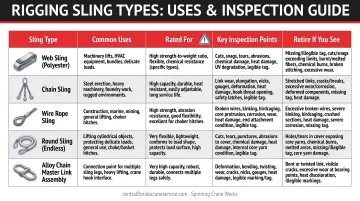
Each hardware type has rated capacities, inspection requirements, and specific use cases under ASME B30.9. Using the wrong type for a given load shape or weight creates rigging failure risk.
How a Heavy Equipment Lift Works: Step-by-Step
A properly executed mechanical lift follows a set sequence. Shortcuts at any stage compound risk.
The sequence is: pre-lift inspection → crane setup → rigging the load → test lift → executing the lift → placement → rigging removal.
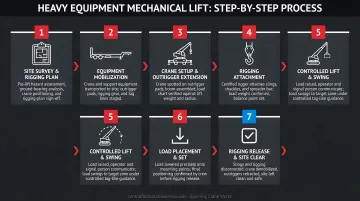
Before any movement begins, the crew confirms three controls:
- Signal person and operator agree on hand signals or radio calls
- Non-essential personnel clear the swing radius
- Lift supervisor gives formal authorization to proceed
Step 1: Pre-Lift Inspection and Setup
Inspect before every lift, without exception:
- Crane condition: boom, wire rope, load line, and all structural components
- Outriggers: fully extended and bearing on appropriately sized pads for ground conditions
- Rigging hardware: check every sling, shackle, and hook for wear, deformation, or damage
Improperly set outriggers are a leading cause of crane tip-over. A NIOSH mobile crane safety alert identifies setup errors as a major factor in crane upsets. Pad size matters: soft or saturated ground requires a larger bearing area to distribute outrigger load.
Step 2: Rigging the Load and Test Lift
Attach rigging hardware to designated lift points only. Verify:
- Sling angles stay within rated limits; lower angles reduce rated capacity
- Rigging configuration will keep the load level throughout the lift
- All connections are properly seated and secured
Next, raise the load a few inches, pause, and hold. The test lift confirms balance, rigging tension, and brake holding capacity.
If the load is not level or a sling appears overstressed, set it back down and reassess. The lift supervisor authorizes proceeding past this point.
Step 3: Executing the Lift, Travel, and Placement
The crane operator lifts at a controlled, consistent speed. Sudden acceleration or braking creates dynamic load: forces that exceed the load's static weight and can push the crane past rated capacity.
During travel and placement:
- Signal person guides every movement
- Tag lines control load swing and rotation; they are required on free-hanging loads
- No one places hands or body under a suspended load during placement
- Set the load down fully before removing rigging
Key Factors That Affect Lifting Safety and Outcomes
Even well-planned lifts can go wrong when these factors aren't accounted for:
Load Characteristics
Weight accuracy and center of gravity are two of the most important factors. Loads with shifting internal contents, such as partially filled tanks or loose components, can redistribute weight mid-lift and change the center of gravity (CoG).
Treat loads with uncertain internal contents as requiring conservative capacity margins.
Ground and Environmental Conditions
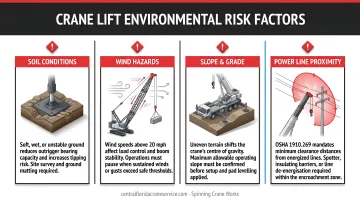
- Soil bearing pressure: Florida's coastal and sandy soils can have lower bearing capacity than the lift plan assumes. Verify with a geotechnical reference or competent person assessment.
- Slope: Even minor grade affects crane stability and load swing.
- Wind: OSHA does not set one universal wind cutoff for all crane operations.
- Wind controls: Under 29 CFR 1926.1417(n), the competent person must adjust operations for wind effects on stability.
- Personnel hoisting: Under 1926.1431(k)(8)(i), operations must stop if sustained or gust wind exceeds 20 mph unless a qualified person determines it is safe.
Crane and Rigging Capacity Margins
Operating at or near 100% of rated capacity leaves little room for field changes. Deduct from rated capacity for:
- Rigging hardware weight
- Hook block weight
- Any dynamic forces from travel or acceleration
The rated capacity includes a built-in safety factor, but that factor disappears quickly when operational deductions aren't applied.
Power Line Proximity
OSHA 1926.1408 applies to power line safety up to 350 kV. If any part of the equipment, load line, or load could come within 20 feet of a power line, the employer must choose one of three controls:
Deenergize and ground the line
Maintain a 20-foot clearance
Determine line voltage and follow Table A minimums
Up to 50 kV: 10 ft minimum
Over 50 to 200 kV: 15 ft minimum
Over 200 to 350 kV: 20 ft minimum
For lines over 350 kV, 1926.1409 increases the baseline to 50 feet. Utilities must provide voltage information within two working days upon request.
This is where project experience matters. Spinning Crane Works handles crane and rigging work around power lines for cell tower erection and power pole installation, where energized lines are routinely present.
Common Mistakes in Heavy Equipment Lifting
Skipping or Shortcutting the Lift Plan
Many crews treat the lift plan as a paperwork exercise. That creates risk before the crane ever sets up.
Unverified assumptions about load weight, ground conditions, or crane capacity are where many preventable incidents start. The lift plan should be the operational document every on-site decision refers back to.
Misreading the Load Chart
The most common error is reading only the crane's maximum rated capacity without accounting for boom length, radius, counterweight, and configuration. A crane's maximum rated capacity does not apply at every radius — the actual safe limit drops as the working radius increases.
The actual capacity at the operating radius for your specific setup is the only number that matters. Read the chart for the right column, right row, and configuration every time.
Getting Sling Angles Wrong
A sling rigged at a low angle from horizontal carries more force per leg than the same sling rigged closer to vertical. As that horizontal angle gets smaller, sling tension rises and the working load limit drops.
ASME B30.9 governs sling fabrication, use, and inspection, while OSHA's sling standard lists rated loads by configuration. Never assume a sling rated for a vertical pull handles the same load at a 30-degree angle.
Letting Experience Replace Written Procedure
Experienced crews sometimes skip written lift plans and inspections because "we've done this a hundred times." That confidence becomes a risk when assumed conditions turn out to be wrong.
OSHA requirements do not include an exemption for familiarity, and neither does physics.
Frequently Asked Questions
What is the correct procedure for lifting heavy objects with mechanical equipment?
Use a documented lift plan, inspect the site and equipment, select proper rigging, assign roles, confirm communication, perform a test lift, and place the load under control. For construction crane work, OSHA 29 CFR 1926 Subpart CC sets the baseline requirements.
What are the 5 P's of lifting?
The 5 P's (Planning, Preparation, Positioning, Performing, and Post-lift review) help crews structure each phase of a lift. They reduce the chance of missing a critical step before, during, or after the load moves.
What's the difference between LOLER and PUWER?
LOLER and PUWER are UK regulations. LOLER covers lifting equipment and lifting operations; PUWER covers broader work equipment safety. In the US, refer to OSHA 29 CFR 1926 Subpart CC for construction crane operations.
What is a critical lift in crane operations?
Under 29 CFR 1926.751 (Subpart R), a critical lift exceeds 75% of the crane's rated capacity or requires more than one crane. These lifts need additional planning, qualified oversight, and often engineering review before work begins.
When is a formal lift plan required by OSHA?
OSHA requires qualified-person plans for multiple-crane lifts under 1926.1432 and strict personnel-hoisting procedures under 1926.1431. For most job sites, document any mechanical lift because access, ground conditions, and nearby power lines can change the risk profile fast.
What PPE is required for crane and rigging operations?
Typical PPE includes a hard hat under 29 CFR 1926.100, protective footwear under 1926.96, rigging gloves, and eye protection. Add hi-vis, fall protection, electrical PPE, or respiratory protection when the site safety plan requires it.