Introduction
Crane and rigging accidents don't happen because equipment suddenly fails out of nowhere. Most happen because someone skipped a step.
According to the Bureau of Labor Statistics, crane-related injuries killed 297 workers between 2011 and 2017 — averaging 42 deaths per year. Private construction accounted for 43% of those fatalities. Of the deaths involving struck-by incidents, 79 involved an object falling from or put in motion by a crane — meaning the load itself became the hazard.
The cost of a single rigging failure goes well beyond the incident itself. OSHA investigations, project shutdowns, equipment damage, and penalties reaching $165,514 per willful violation follow close behind.
In 2024, a Fort Lauderdale crane collapse sent a rigger falling 30 stories. The proposed $61,299 penalty traced back to inadequate pre-inspections and corroded hardware — preventable failures both.
This guide covers what safe rigging actually looks like: hardware selection, load calculations, inspection protocols, and the personnel requirements OSHA mandates before any lift begins.
Key Takeaways
- Accurate load weight and center of gravity identification must happen before any hardware is selected
- Every component — slings, shackles, crane — must be rated above the actual load weight, with no exceptions
- A single designated signal person using standardized ASME/OSHA signals is required on every lift
- Wind speed, ground stability, and power line proximity must be evaluated before setup begins
- Skipping inspections, ignoring sling angle effects, and placing workers under suspended loads are the leading causes of preventable rigging accidents
Safety Guidelines for Rigging Heavy Equipment
Rigging involves three distinct phases: securing the load with slings, shackles, and hardware; connecting that assembly to a crane or hoist; and moving the load to its destination. Risk exists across all three phases — not just during the lift itself.
The failure modes are also categorized into three types:
- Mechanical — hardware fails under load due to wear, overloading, or defects
- Structural — the load becomes unstable or tips due to poor balance or rigging geometry
- Operational — human decisions before or during the lift create conditions for failure
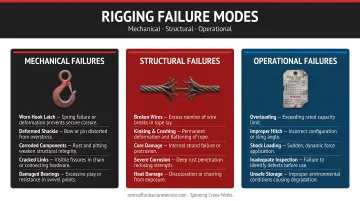
All three must be controlled simultaneously. Advanced hardware cannot compensate for poor planning.
General Safety Precautions
Every person on a rigging site needs the following PPE before work begins:
- Hard hat — protection from overhead objects, especially near suspended loads
- Steel-toed boots — crush protection if hardware or a load contacts the ground near your feet
- High-visibility vest so crane operators and ground crew can see each other at all times
- Cut-resistant gloves — wire rope and chain edges cause severe lacerations during handling
- Safety glasses to guard against flying debris, dust, and metal fragments
PPE covers individual protection. Worksite discipline covers everyone else:
- Define exclusion zones along the entire load path before the crane hook is loaded
- Confirm no personnel are beneath or in the swing radius of the load
- Keep all bystanders clear of the area — not just nearby, but at a genuinely safe distance
Only trained personnel should handle rigging hardware or give crane signals. For complex lifts, loads approaching equipment limits, or operations near energized power lines, bringing in a professional crew with certified operators is the right call. Spinning Crane Works operates throughout Central and South Florida with experienced operators trained to handle exactly these conditions.
Pre-Lift Planning and Setup Safety
Load Weight and Center of Gravity
Load weight must be confirmed, not estimated. Use equipment nameplates, shipping documents, or engineering drawings. If documentation is unavailable on-site, OSHA 1926.1417(o)(3) requires operators to verify the load is within rated capacity using recognized sources, calculations, or load-weighing devices. Guessing the weight — and then selecting rigging based on that guess — is how underrated slings end up under full load.
Once you have the weight, locate the center of gravity. An off-center CoG causes the load to tilt or rotate the moment it leaves the ground. A test lift of 6–12 inches reveals balance issues before the load is in the air. If the load tilts, it must be lowered, the rigging reconfigured, and the test repeated.
Hardware Selection and Inspection
Match rigging hardware to the specific load's weight, shape, surface sensitivity, and temperature environment:
- Chain slings — suited for abrasive, high-temperature, or irregularly shaped loads
- Wire rope slings — strong and flexible; good for heavy industrial lifts
- Synthetic web slings — used where surface protection matters; not for high-heat environments
- Shackles and hooks — must be matched to load weight with proper pins secured; never substitute with unrated hardware, even temporarily
Under OSHA 29 CFR 1926.251, rigging equipment must be inspected before use on each shift and removed from service if defective. Inspect each component before it's attached:
- Wire rope slings: remove if 10+ randomly distributed broken wires in one rope lay, kinking, crushing, birdcaging, or corrosion
- Synthetic web slings: remove for acid burns, melting, charring, cuts, holes, or broken stitching in load-bearing splices
- Alloy chain slings: remove for stretched links, cracks, excessive wear, heat damage, or illegible ID tags
- Shackles and hooks: remove for deformation, cracks, missing or bent pins
Any compromised component leaves service immediately.
Sling Angle and Load Chart
Once hardware passes inspection, sling angle becomes the next critical variable — and one that catches riggers off guard. As the angle from horizontal decreases, tension on each sling leg multiplies sharply:
| Angle from Horizontal | Tension Multiplier |
|---|---|
| 90° (vertical) | 1.0× |
| 60° | 1.155× |
| 45° | 1.414× |
| 30° | 2.0× |
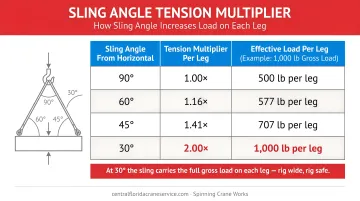
A load rigged at a 30° horizontal sling angle places twice the tension on each leg compared to a 60° angle. That multiplier has caused sling failures on loads well within rated capacity — which is why angle selection isn't optional math.
Before rigging begins, verify the planned lift against the crane's load chart. Rated capacity changes with boom radius and lift height — not just total weight. A crane's capacity at minimum radius can drop sharply at extended radius with the same configuration. Always check the actual chart for the exact planned configuration — not a neighboring column.
During-Lift Safety
Test Lift Protocol
Raise the load 6–12 inches, stop, and verify:
- All sling connections are seated and undistorted
- The load is balanced and not tilting
- Nothing is snagging, dragging, or under unexpected tension
If anything looks wrong, lower the load and correct it before continuing. This brief pause prevents mid-air failures that are far harder to recover from.
Movement and Signal Control
Sudden starts and stops generate swing, which destabilizes the lift and puts ground crew at risk. All crane movements should begin and end gradually, with the operator and signal person in constant coordination.
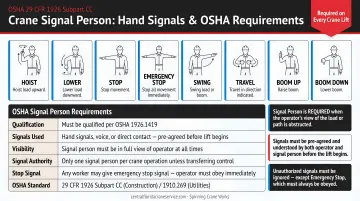
OSHA requires a designated signal person whenever the point of operation is not fully visible to the operator, when travel direction is obstructed, or when the operator or load handler determines it necessary. Under OSHA 1926.1428, that signal person must be qualified through written, oral, and practical testing. Key rules:
- One signal person only. Conflicting signals from multiple people have caused fatal accidents.
- Use standardized ASME B30.2 / OSHA hand signals in normal conditions
- In high-noise environments, switch to radio communication (OSHA 1926.1419 accepts voice/audible signals when appropriate)
- If communication is interrupted, the operator must stop operations safely until it's reestablished
Suspended Load Rules
OSHA 1926.1417(e) prohibits operators from leaving the controls while a load is suspended unless specific conditions are met, including remaining adjacent to the equipment and barricading the fall zone. The practical rule: if work pauses, lower the load to a stable surface.
Tag lines must be used to control swing and rotation, particularly on congested sites. Never wrap them around a worker's hands or body. A shifting load can apply hundreds of pounds of force in an instant.
Site and Environmental Considerations
Wind and Florida Weather
OSHA does not publish a single numeric wind threshold for construction crane operations, but load chart guidance recommends reducing rated loads when wind exceeds 20 mph, and some crane manufacturers include wind speed indicators as standard features.
Florida's outdoor environment makes wind assessment non-negotiable. The Florida Climate Center reports that no U.S. region experiences more thunderstorm activity — central Florida averages approximately 85 thunderstorms per year, and the western peninsula logs over 80 thunder-and-lightning days annually. Weather conditions can deteriorate faster than a lift can be safely aborted. Before any lift begins:
- Monitor forecasts for the full shift window, not just the start of day
- Check on-site conditions at the beginning of each shift
- Set a clear wind or weather threshold for pausing or canceling operations
Ground Conditions
Under OSHA 1926.1402, ground supporting crane equipment must be firm, drained, and graded enough to bear the equipment and load. Soft, saturated, or uneven terrain — common after Florida's heavy rains — requires:
- Outrigger matting or cribbing to distribute load
- Confirmed bearing capacity before setting up
- Repositioning if ground conditions change during operation
A crane tip-over on compromised ground happens fast and without warning. Assess terrain thoroughly before the first outrigger pad is set — not after.
Power Line Clearance
OSHA requires minimum clearance distances from energized power lines:
| Voltage | Minimum Clearance |
|---|---|
| Up to 50 kV | 10 ft |
| Over 50 to 200 kV | 15 ft |
| Over 200 to 350 kV | 20 ft |
| Over 350 to 500 kV | 25 ft |
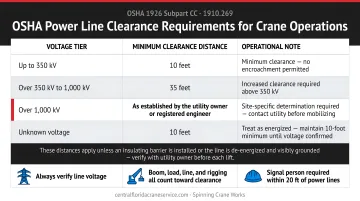
These minimums apply to all equipment, load lines, rigging, and lifting accessories — not just the crane boom. Contact with an energized line can cause immediate electrocution of anyone touching the equipment or suspended load. Lifts near active power infrastructure require pre-lift coordination with utility companies, independent clearance verification, and a site-specific plan before equipment moves. Spinning Crane Works regularly executes these lifts across Central and South Florida and manages the full coordination process on behalf of clients.
Common Safety Mistakes to Avoid When Rigging Heavy Equipment
1. Skipping pre-lift inspections Rigging gear that worked last week is not automatically safe today. Frayed slings, cracked shackles, and bent hooks don't announce themselves — they fail under load. OSHA's enforcement record includes a 2024 Fort Lauderdale fatality linked directly to inadequate pre-inspections and corroded hardware that was never pulled from service.
2. Overloading rigging components Exceeding rated capacity doesn't cause visible strain before failure. Hardware can fail at or just above its working load limit with no advance signal — no creaking, no visible deformation. Always verify the combined load weight against each component's rated capacity before the lift.
3. Ignoring sling angle effects The tension multiplier table above isn't theoretical. At a 30° horizontal angle, each sling leg bears twice the load compared to 60°. Rigging a load well within the sling's stated capacity at a steep angle can still exceed the sling's working load limit. Always calculate actual leg tension, not just total load weight.
4. Positioning workers under or near a suspended load OSHA 1926.1425 restricts fall zone access when a load is suspended. BLS data from 2011–2017 recorded 79 deaths involving objects falling from or set in motion by a crane. No task justifies standing beneath a suspended load.
5. Failing to establish communication protocols before the lift When no one has owned signal responsibility, operators receive conflicting inputs and make reactive movements. A NIOSH fatality record documents an untrained operator disabling an anti-two-block system — the auxiliary hook fell and struck a rigger. Before the crane hook is loaded, every lift crew must confirm signal assignments, communication method, and emergency stop procedures.
Conclusion
Safe rigging isn't the result of any single action. It's what happens when accurate load assessment, correctly matched hardware, thorough pre-lift inspection, controlled execution, and site hazard management all work together — on every job, without shortcuts.
Experience matters, but it doesn't make any lift routine. Every configuration, load, and site condition deserves independent evaluation.
For contractors and project managers across Central and South Florida, Spinning Crane Works operates 24/7 with certified operators and cranes of all sizes to complete your lifts safely. Whether you're placing rooftop HVAC units, erecting cell towers, or working near active power lines, the team has the equipment and site experience to get it done safely. Call 321-759-2263 to discuss your lift.
Frequently Asked Questions
What is heavy equipment rigging?
Heavy equipment rigging is the process of securing and moving heavy loads using specialized hardware: slings, shackles, hooks, and cranes. It requires trained professionals who understand load dynamics, center of gravity, and the mechanical forces involved at every phase of the lift.
What are the four basic rules of rigging?
Know the weight of the load, identify the center of gravity, select hardware rated for the actual load, and inspect all equipment before every lift. Each rule addresses a distinct failure point — together, they form the foundation of every safe rigging operation.
What is the 3-3-3 rule in heavy material lifting by crane?
No single OSHA, ASME B30, or recognized industry certification body definition of a crane-specific "3-3-3 rule" has been verified in authoritative industry sources. If you've encountered this phrase in training materials, confirm its specific meaning with the issuing organization before applying it on-site.
What is the 10 ft rule in rigging?
OSHA requires crane equipment to maintain at least a 10-foot minimum clearance from energized power lines up to 50 kV. Contact with an energized line poses immediate electrocution risk to anyone touching the equipment or load. Larger clearances apply at higher voltages — up to 45 feet for lines over 750 kV.
What PPE is required for rigging operations?
Standard PPE includes a hard hat, steel-toed boots, high-visibility vest, cut-resistant gloves, and safety glasses. Fall protection and face shields may also be required depending on site conditions, work height, and the specific tasks being performed.
When should you hire a professional rigging company instead of rigging in-house?
Engage a professional crew when loads exceed your in-house equipment ratings, lifts involve complex configurations or tight clearances, work is near energized power lines, or the job requires certified crane operators. Attempting these lifts with underrated equipment compounds risk at every stage. Companies like Spinning Crane Works specialize in exactly these scenarios, including lifts around active power infrastructure throughout Central and South Florida.