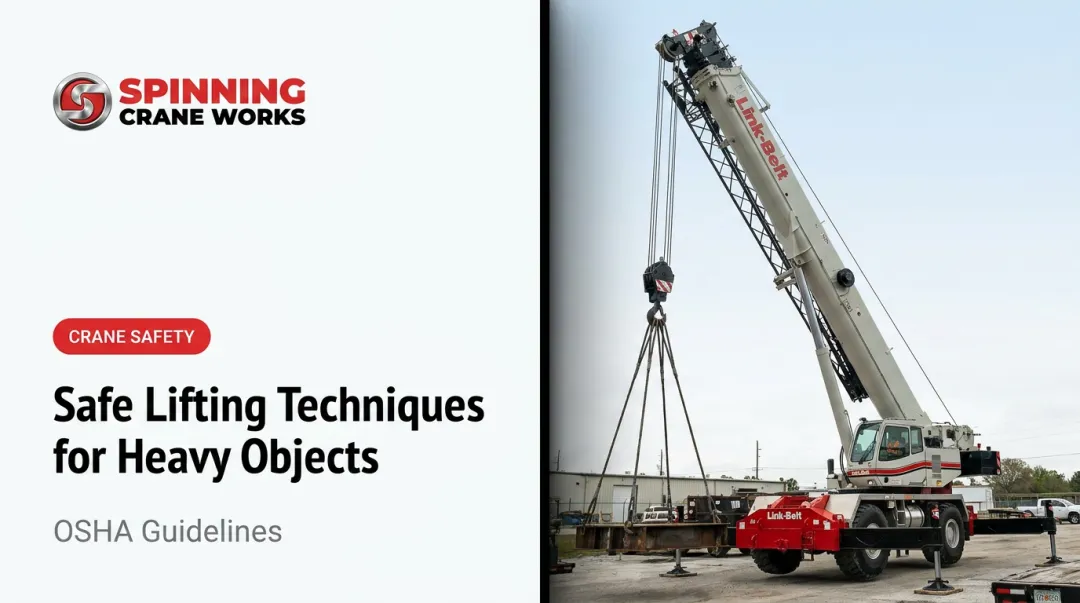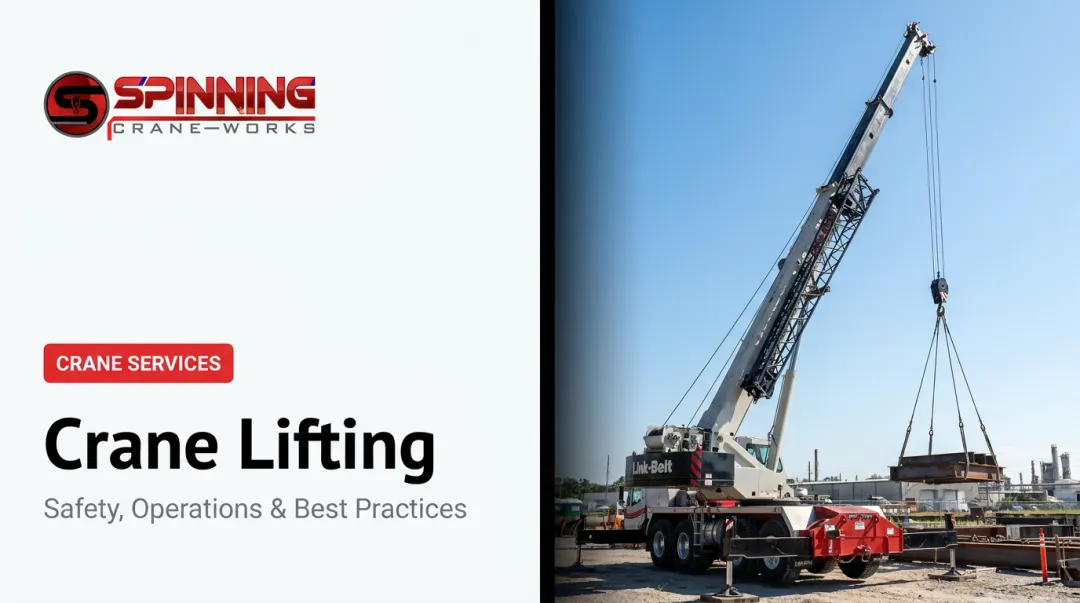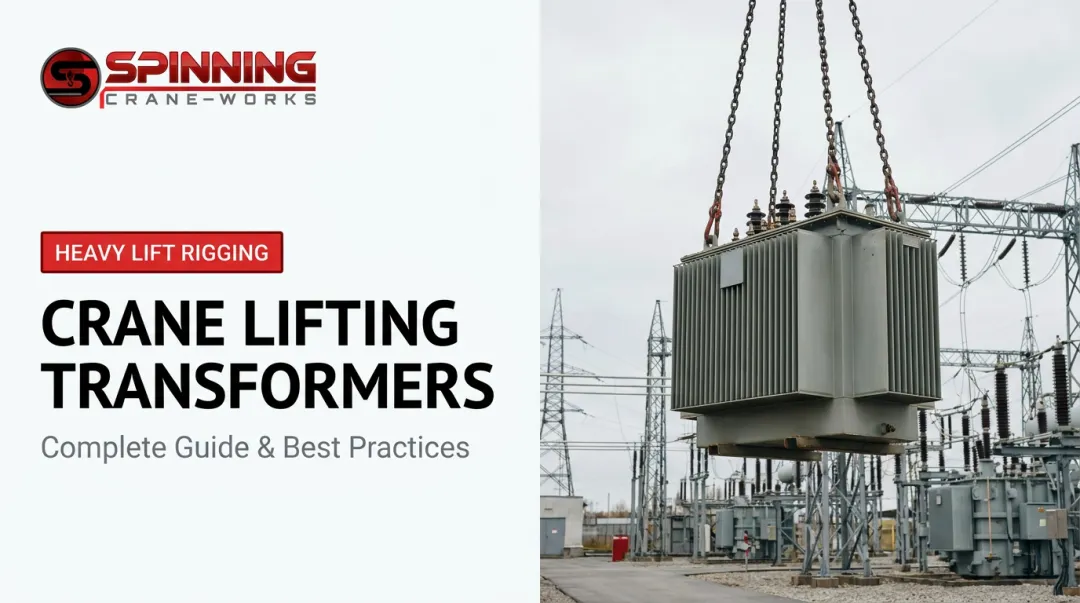
Heavy equipment lifting is one of the highest-risk tasks in construction, utilities, and industrial work. The margin between a controlled lift and a catastrophic failure is thinner than most people assume — and it's almost always determined before the hook is ever attached.
This guide covers what safe lifting actually requires: disciplined pre-planning, proper technique during the lift, and the situational awareness to know when conditions have changed enough to stop.
Key Takeaways
- Never estimate load weight — verify it against spec sheets, load charts, or scales before the lift begins.
- Inspect every sling, shackle, hook, and rigging component before each shift; damaged gear comes out of service immediately.
- Rated load capacity is a hard ceiling, not a guideline — exceeding it even briefly can cause catastrophic failure.
- OSHA mandates specific minimum clearance distances from energized power lines — know them before any lift near electrical infrastructure.
- Lifts near power lines, in confined spaces, or beyond your equipment's rated capacity require a certified crane and rigging contractor.
Pre-Lift Planning: The Foundation of Safe Heavy Equipment Lifts
Every lift that goes wrong can usually be traced to something that wasn't planned for. A documented lift plan converts variables into decisions made before the hook goes on — not during a problem.
What a Lift Plan Must Cover
A thorough lift plan addresses:
- Load weight and dimensions — verified, not estimated
- Center of gravity — especially critical for irregular or asymmetric loads
- Equipment selection — crane type, capacity class, and boom configuration matched to the specific job
- Rigging configuration — sling angles, attachment points, and hardware ratings
- Designated lift zones — where the load travels, what's below it, and who's excluded
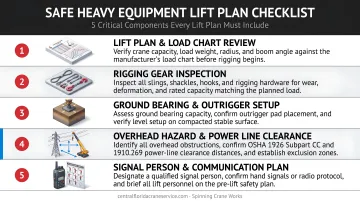
OSHA requires planning for multiple-crane lifts, power-line encroachment prevention, and assembly/disassembly operations. For complex lifts, a qualified person must direct the planning process.
Determining Load Weight Accurately
Guessing load weight is one of the most common shortcuts in the field — and one of the fastest ways to overload a crane. Equipment that "probably weighs around" a certain amount creates real risk the moment that estimate runs low. Verify weight using manufacturer spec sheets, stamped equipment plates, or certified scales.
Operators then cross-reference verified weight against the crane's load chart at the planned radius and boom angle. The two numbers must align before rigging begins.
OSHA 1926.1417 requires that operators determine load weight and operate within rated capacity — no approximations permitted.
Site Inspection Requirements
Before equipment is positioned:
- Ground stability — assess for soft soil, recent excavation, or saturated conditions that could shift under outrigger load
- Overhead clearances — identify power lines, structures, and any obstruction within the lift path
- Underground utilities — contact 811 and verify utility locations before setting outriggers
- Bystander exclusion zones — define and mark the area; no unauthorized personnel inside during the lift
Selecting the Right Equipment
Load type, environment, and required lift height all drive equipment selection. A hydraulic jack works for ground-level repositioning. A chain hoist handles vertical picks in confined spaces. A crane is necessary when height, reach, or load weight exceeds what portable equipment can handle safely.
Matching the wrong equipment class to a job is itself a safety failure: undersized equipment gets overloaded, and oversized equipment may not fit the site. Once the right equipment is confirmed, the team needs to be just as deliberate about roles and communication.
Pre-Lift Team Briefing
Before any hook is attached:
- Assign a lift supervisor — one person accountable for the entire operation
- Designate a sole signal person — only one person gives signals to the operator; OSHA requires a qualified signal person when the operator cannot fully view the point of operation
- Establish communication protocols — whether hand signals or radio, every team member confirms understanding before the lift starts
- Confirm roles — every person on site knows their position, their responsibilities, and where they must not be
Safety Guidelines for Lifting Heavy Equipment
Safe lifting demands layered safeguards. No single precaution compensates for skipping another.
General Safety Precautions
PPE requirements for heavy equipment lifting:
- Hard hat — mandatory where falling or swinging objects are possible; required under OSHA 1926.100
- Steel-toed boots — protect against foot injuries from dropped equipment or shifting loads
- High-visibility vest — keeps personnel visible to operators and spotters, particularly in active lift zones
- Rigging gloves — cut and abrasion resistance for handling wire rope, chain, and synthetic slings
- Eye protection — guards against debris, dust, and fragments dislodged during rigging
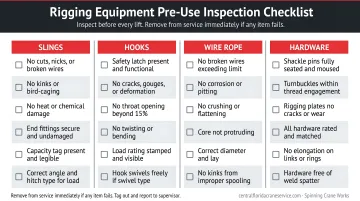
Pre-use inspection requirements:
OSHA 1926.251 requires rigging equipment inspection before every shift and immediate removal if defective. Specifically, check:
- Slings for cuts, abrasion, kinking, heat damage, or discoloration
- Hooks and shackles for deformation, cracks, or missing pins/safety latches
- Load ratings stamped on all components — they must meet or exceed the planned load
- Wire rope for broken wires, kinking, or corrosion
ASME B30.9 (slings) and B30.26 (rigging hardware) set the detailed inspection and retirement criteria. Worn rigging that passes a visual check under poor lighting can fail silently under load — inspect in adequate lighting, every time.
Exclusion zone rules:
- No personnel under a suspended load. No exceptions.
- Establish a defined drop zone before the lift begins and enforce it through physical barriers, not just verbal instruction
- OSHA 1926.1425 requires hoisting routes that minimize personnel exposure and restricts when workers may be in the fall zone
Safety During Lifting Operations
Slow and controlled movement matters. Sudden starts, fast lowering, and abrupt stops create dynamic loading — forces that exceed the static rated capacity. The NCCCO Rigger Reference Manual specifically warns that shock loading from uncontrolled movement can overload rigging and crane components beyond their ratings.
Monitoring load stability:
- Watch for load rotation or swing immediately after pick-up
- Avoid side-loading cranes or hoists — these are designed for vertical loads, and lateral force degrades capacity fast
- Use tag lines — not hands — to guide load positioning; near power lines, OSHA 1926.1408 requires nonconductive tag lines specifically
Stop the lift immediately when:
- The load shifts unexpectedly or begins rotating without control
- Equipment makes unusual noises, shows hydraulic leaks, or responds sluggishly
- Wind gusts increase load swing beyond what tag lines can manage
- Any personnel enter the exclusion zone
Operations near power lines or complex rigging configurations require crews with documented training for those specific environments — not just general lift experience. Spinning Crane Works operates under OSHA 1910.269 compliance for power-line clearance and regularly works around live distribution and transmission lines throughout Florida.
Power Line and Electrical Safety
Power line contact accounted for 25 crane-related deaths between 2011 and 2017 — and in a historical construction-crane analysis, overhead electrocutions represented 25% of all crane fatalities from 1992 to 2006.
OSHA 1926.1408 minimum clearance distances:
| Line Voltage (kV) | Minimum Clearance |
|---|---|
| Up to 50 kV | 10 ft |
| Over 50 to 200 kV | 15 ft |
| Over 200 to 350 kV | 20 ft |
| Over 350 to 500 kV | 25 ft |
| Over 500 to 750 kV | 35 ft |
| Over 750 to 1,000 kV | 45 ft |
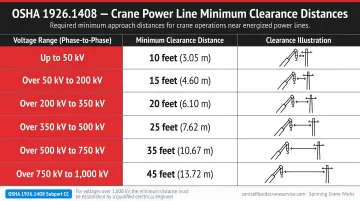
Required steps before any lift near power lines:
- Identify whether any part of the crane, load line, or load could come within 20 feet of a power line
- If yes — contact the utility to confirm voltage and request de-energization or insulating sleeves where possible
- Choose an encroachment prevention option: de-energize and ground, maintain 20-foot clearance, or maintain Table A clearance distances
- Assign a dedicated spotter — positioned solely to monitor line clearance with continuous contact with the operator
If standard clearances cannot be maintained, the lift path crosses under or near lines, or visibility is limited, the lift must not proceed without a crew with documented power line safety experience. This is a hard stop, not a judgment call.
A 2024 OSHA investigation in Palm Bay, Florida found a crane operator was electrocuted when wire rope and chain rigging contacted 13,200-volt lines. The employer was cited for operating within the restricted zone with an uncertified operator — and faced $26,585 in proposed penalties. That citation checklist — voltage confirmed, clearance maintained, certified operator on site — exists precisely to prevent this outcome.
Environmental and Site Conditions That Affect Lift Safety
Ground Stability
OSHA 1926.1402 requires that cranes not be assembled or used unless ground conditions are firm, drained, and graded adequately to support the equipment. Soft, wet, or recently disturbed soil — common in Florida after heavy rain or storm activity — can cause outriggers to sink mid-lift, shifting the load radius and increasing tip-over risk.
Standard protective measures include:
- Outrigger pads or timber cribbing to distribute load across a larger area
- Ground bearing pressure calculations based on crane weight, load, and outrigger footprint
- Post-storm site assessment before any lift where soil saturation is possible
Wind Conditions
Most cranes have manufacturer-specified wind speed limits. As a reference point, Tadano GR-800XL-4 manufacturer data states: stop operation when wind speed reaches 31 mph; reduce load when speed exceeds 20 mph during jib operations. OSHA 1926.1417 requires compliance with manufacturer procedures. The specific threshold depends on the crane model and configuration, not a universal industry number.
Gusts create unpredictable load swing that tag lines cannot fully control. When forecasted or actual wind conditions approach manufacturer limits, delay the lift.
Visibility and Temperature
- Fog, heavy rain, and nighttime operations reduce situational awareness for operators, spotters, and signal persons, increasing the chance of missed signals or undetected hazards
- Extreme heat affects operator focus and can degrade hydraulic fluid performance during extended operations
- Cold temperatures stiffen synthetic slings and reduce ductility in steel hardware; check manufacturer temperature ratings before using rigging in cold conditions
Common Safety Mistakes to Avoid When Lifting Heavy Equipment
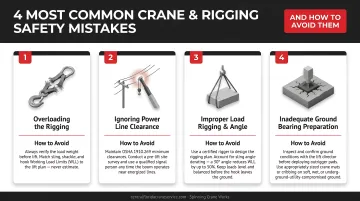
Four mistakes show up repeatedly in post-incident investigations — and each one is avoidable before the crane ever leaves the ground.
Overloading the equipment. OSHA 1926.1417 is unambiguous: equipment must not be operated in excess of rated capacity. Exceeding that limit — even briefly, even slightly — is one of the leading causes of rigging failure and crane collapse. There is no grace margin, and there is no "just this once."
Skipping pre-lift inspections. OSHA 1926.1412 requires a competent-person inspection before each shift; OSHA 1926.251 requires rigging inspection before every use. That gap between policy and practice has consequences: a NIOSH FACE investigation documented a laborer killed when an overhead crane's rigging failed, crushing him between steel frames. A cracked hook or worn sling won't announce itself before it goes under load.
Poor or absent communication. Missed signals, ambiguous hand gestures, or radio failures during a lift lead to workers stepping into exclusion zones or operators releasing loads at the wrong moment. OSHA requires a qualified signal person when the point of operation is not fully visible — one person, clearly designated, not a general expectation that someone will handle it.
Underestimating site and environmental risks. Unverified ground conditions, unmonitored wind speeds, unconfirmed utility line status — each unchecked assumption creates the conditions for an accident that the post-incident report will describe as preventable. Verify all three before mobilization, not after something shifts.
Frequently Asked Questions
What are the best methods for lifting heavy equipment?
The primary methods are crane lifts, rigging with slings and hoists, and hydraulic jacks for ground-level positioning. Method selection depends on load weight, required height, site access, and the precision the placement demands — no single method fits every job.
What is the 3-3-3 rule for lifting heavy equipment?
The "3-3-3 rule" circulates in training contexts but has no verified standard from OSHA, ASME, NCCCO, or NIOSH. Treat any reference to it as an informal training mnemonic, not a regulatory requirement, and verify the specific definition with whichever training provider uses the term.
What are the 5 P's of lifting heavy equipment?
Like the 3-3-3 rule, the "5 P's" (commonly: Plan, Prepare, Position, Perform, Post-lift) are an informal training mnemonic with no verified OSHA or ASME backing. They're useful as a memory aid for pre-lift sequencing, but not a regulatory standard.
What PPE is required when operating a crane or lifting heavy equipment?
Standard PPE includes a hard hat, high-visibility vest, steel-toed boots, rigging gloves, and eye protection. Work near energized power lines may require additional protection — consult OSHA 1910.269 and coordinate with the utility company for site-specific requirements.
When should you hire a professional crane service instead of lifting equipment yourself?
Hire a certified contractor when loads exceed your equipment's rated capacity, lifts occur near power lines, rigging complexity exceeds your team's qualifications, or the site presents confined access challenges. Any one of those conditions is enough.
What are the most common causes of crane and rigging accidents?
Overloading, rigging hardware failure, power line contact, poor ground conditions, and communication breakdowns cause the majority of crane incidents. BLS data shows 154 crane deaths between 2011 and 2017 were tied to load control failures or rigging issues — nearly all preventable with proper planning and inspection.
Safe heavy equipment lifting comes down to consistent execution: planning before the hook moves, situational awareness during the lift, and treating every protocol as non-negotiable. PPE, load limits, inspection requirements, and exclusion zones aren't bureaucratic checkboxes — skipping them produces failures that can't be undone.
For lifts that exceed your in-house capabilities — particularly those near power lines, in confined spaces, or requiring specialized rigging — the right move is partnering with a certified crane and rigging contractor. Spinning Crane Works operates throughout Florida with a 100+ ton Link-Belt crane, certified operators, qualified rigging and signal personnel, and documented experience working around energized electrical infrastructure. Reach the team at 321-759-2263 or visit centralfloridacraneservice.com to discuss your project.