Introduction
Most hot tub deliveries are straightforward: a spa dolly, a clear pathway, and a ground-level pad. But when a fence gate is too narrow, the backyard sits behind a retaining wall, or the tub needs to clear a two-story roofline, a crane becomes the only viable solution.
Crane-assisted hot tub installation requires certified operators, rated rigging equipment, and pre-lift planning that accounts for ground conditions, power line clearances, and structural loads. The wrong crew or a skipped step can bring a crane down onto a neighbor's roof.
In October 2025, a 30-ton crane truck toppled while moving a hot tub into a New Jersey backyard, collapsing onto the roof of an adjacent home. No injuries were reported, but the property damage was significant.
This guide covers the complete process: when a crane is actually necessary, how to choose the right service type, what the lift sequence looks like step by step, and what to verify before you fill the tub and flip the breaker.
Key Takeaways
- A crane is needed when ground access is blocked by narrow gates, retaining walls, stairs, or elevated deck placements
- Always choose a Contract Lift over Crane Hire for residential work: liability stays with the crane company, not you
- Crane size is determined by reach radius and lift height, not the tub's weight alone
- A load-rated, level pad must be cured and in place before scheduling any crane lift
- Document shell condition, pad condition, and surrounding property before and after the lift
When You Actually Need a Crane for Hot Tub Installation
Standard Delivery vs. Crane Requirement
Most residential hot tubs arrive via spa dolly. The delivery crew needs a clear, relatively level path at least as wide as the tub's side-standing dimension, with no more than six consecutive stairs. If those conditions exist, no crane is needed.
A crane becomes necessary when the site physically prevents ground-level delivery. Common scenarios:
- Narrow gates or fences — Most hot tubs require 36–40 inches of clearance; many residential gates fall short
- Retaining walls or steep grade changes with no practical path to roll the tub to level
- Interior-only access — corridors are rarely wide or clear enough to pass a full-size spa
- Elevated deck or balcony placement — the tub must be lifted to height, not rolled up
- Over-the-roof delivery, where the only viable path clears a one- or two-story structure
According to Hot Spring's pre-delivery guide, approximately 10% of hot tub installations require crane delivery.
Weight and Reach Determine Crane Size
Dry weight alone doesn't tell the full story. Filled weights from manufacturer specs show why crane sizing matters:
| Unit Type | Dry Weight | Filled Weight |
|---|---|---|
| Standard hot tub (e.g., Hot Spring Grandee) | ~790 lb | ~5,810 lb |
| Jacuzzi J-285 | ~778 lb | ~5,166 lb |
| Jacuzzi J-13 swim spa | ~1,860 lb | ~13,083 lb |
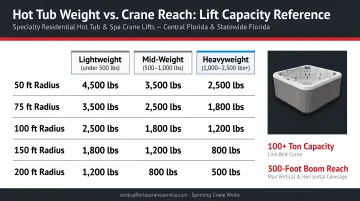
The tub's empty weight is almost irrelevant for crane sizing. What matters is horizontal reach radius—the distance from the crane's rotation pin to where the tub lands. A crane rated at 40 tons can lift thousands of pounds at short radius, but load charts show capacity can drop to as little as 900 lb at 100 feet of horizontal reach. Over-the-roof lifts at 60–100+ feet of radius regularly require 40- to 100-ton equipment—not because the tub is heavy, but because the geometry demands it.
Prerequisites and Safety Considerations
The Pad Must Be Ready Before You Book the Crane
A crane lift cannot proceed if the foundation isn't complete and cured. Key requirements:
- Concrete pads must be at least 4 inches thick, reinforced with rebar or wire mesh, and fully cured (typically 28 days for full strength)
- Deck placements require a structural engineer or qualified contractor to confirm load capacity. Standard deck design assumes 40 psf live load — well below a filled spa's concentrated weight
- The pad must be level — even minor deviation stresses the shell and jets over time
If you're placing a swim spa outdoors, Endless Pools specifies a minimum 6-inch reinforced concrete pad capable of withstanding loads exceeding 250 lb/sf.
Power Lines, Permits, and Ground Conditions
Three non-negotiables before scheduling any residential crane lift:
Power line clearance — OSHA 1926.1408 Table A sets minimum approach distances:
- 10 feet from lines up to 50 kV
- 15 feet for 50–200 kV, increasing beyond that
- If the lift path crosses a service drop or distribution line, the crane company confirms clearance or coordinates with the utility to insulate or de-energize
Ground conditions — OSHA 1926.1402 requires operation only on firm, drained, graded ground capable of supporting outrigger loads. Soft Florida soil after rain may require crane mats. The crane operator assesses this on arrival.
Florida-specific permits — Street-parked cranes blocking a lane typically require a right-of-way permit:
- Orange County: $128 for a Maintenance of Traffic plan
- Hillsborough County: ROW management permits start at $50
- Miami Beach: specific crane-in-right-of-way procedure applies
- HOA restrictions on commercial vehicles may add another approval layer
Contract Lift vs. Crane Hire: The Distinction That Matters
What Each Service Model Actually Means
Crane Hire — The crane company provides the machine and operator. The homeowner (or their representative) directs the lift and bears liability for planning, execution, and any damage that results.
Contract Lift — The crane company assumes full operational and legal responsibility. This includes risk assessment, lift planning, rigging, signal personnel, and insurance coverage for the load and any property damage caused by the lift.
OSHA 1926 Subpart CC — the federal standard governing construction crane operations — makes the stakes clear: lift planning and supervision must be performed by qualified personnel. If a homeowner hires a crane without that expertise on their side, they inherit that responsibility themselves.
Always Choose Contract Lift for Residential Work
The October 2025 Hamilton Township crane collapse shows exactly what inadequate oversight costs. A 30-ton crane toppled while moving a hot tub into a backyard, bringing the boom down through a neighboring roof.
Under a Crane Hire arrangement, a homeowner who directed that lift would carry real liability exposure: property damage claims, legal costs, and a voided hot tub warranty if the shell was damaged in the process.
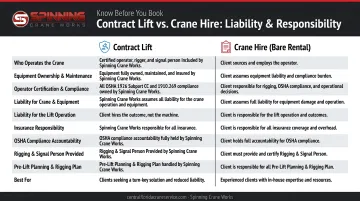
Spinning Crane Works operates exclusively as a Contract Lift provider — no bare-crane rental, no exceptions. Every residential hot tub job includes a certified crane operator, qualified rigger, signal person, and full liability and equipment insurance. Operational responsibility stays with the crane company, not the homeowner.
Before signing any agreement with any crane company, confirm these specific points in writing:
- Is this a Contract Lift or Crane Hire?
- Does the policy cover property damage to the home, driveway, and landscaping?
- Who is responsible if the hot tub shell is damaged during the lift?
How to Install a Hot Tub with a Crane: Step-by-Step
Crane-assisted hot tub installation follows a defined sequence. Skipping or compressing any stage introduces compounding risk.
Pre-Lift Planning
The crane company conducts a site survey—either in person or via photos and satellite imagery—to measure:
- Horizontal reach radius from the crane's rotation pin to the pad
- Roofline height and clearance requirements
- Ground conditions and outrigger placement zones
- Overhead obstacles along the lift path
This survey determines crane size and final pricing. For complex lifts (over a roof, near power lines, or on tight urban lots), an in-person survey is worth requiring.
Coordination with the hot tub dealer is critical. The delivery truck should arrive 30 minutes before the crane. If the tub isn't on-site when the boom extends, idle crane time runs at the full hourly rate. Ask the crane company and dealer to confirm a joint arrival window in a single call — not separate conversations.
Setup and Rigging
On lift day, the crane positions on the driveway or street with outriggers deployed on protective mats. The operator checks terrain slope and soil conditions; uneven terrain requires cribbing to level the crane before any lift begins.
Rigging is where shell damage is either prevented or caused. Per ALLMI/BISHTA guidance, hot tub and swim spa lifts should use a lifting beam, spreader frame, or lifting stillage to prevent lateral compression forces from cracking the acrylic shell.
Straps attached directly to the shell sides without a spreader bar create inward pressure during the lift: the most common cause of post-lift shell deformation.
Ground crew attach taglines at each corner to control rotation during the swing.
The Lift and Placement
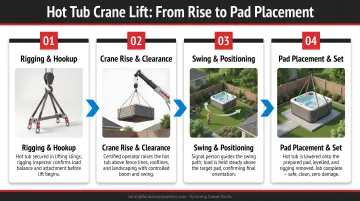
The lift sequence:
- Hot tub rises vertically from street or delivery position
- Swings horizontally over the structure at a height clearing the roof's highest peak
- Descends into the backyard with tagline handlers guiding final positioning
- Lowered onto the prepared pad with ground crew verifying alignment before rigging detaches
The crane operator maintains radio communication with ground crew throughout. The descent should be slow and controlled. If the tub contacts the home's structure at any point during transit, stop and reassess before continuing.
Post-Placement Validation
Do not fill the tub before completing these checks:
- Shell inspection — Look for cracking, stress marks, or deformation on the acrylic, particularly along the sides where straps contacted the shell
- Level verification — A hot tub that's even slightly out of level stresses the shell and jets over time; confirm with a level across multiple points
- Pad condition — Check for cracking or settling from outrigger loads during setup
- Electrical readiness — A licensed electrician must complete connections before commissioning
Take timestamped photos of the tub, pad, and surrounding property immediately after placement. Once water is added, structural problems become far more expensive to address.
Common Problems During Crane-Assisted Hot Tub Installation
Even well-planned lifts run into trouble. Here are three problems that come up regularly — and how to prevent each one.
Crane Cannot Set Up in the Planned Position
The crane arrives and finds power lines overhead, soft ground, or insufficient outrigger clearance where it was supposed to set up. Remote site surveys using satellite imagery miss low-voltage service drops and can't assess actual ground conditions.
Fix: Require an in-person site survey before booking. If utility coordination is needed to insulate or temporarily drop lines, build in several days of lead time.
Hot Tub Shell Damaged During the Lift
Cracking or deformation on the acrylic shell after the crane sets the tub usually traces back to rigging straps attached directly to the shell without spreader bars — lateral compression during the lift causes the damage.
Fix: Confirm in writing before lift day that the crew will use spreader bars and appropriately rated lifting straps. Inspect the shell before rigging attaches and again immediately after the tub is set.
Scheduling Mismatch Between Delivery Truck and Crane
The crane arrives on time, but the hot tub delivery truck is delayed. Because the dealer and crane dispatcher scheduled independently without confirming a joint arrival window, the homeowner ends up paying full hourly crane idle time.
Fix: Require a single coordination call between the dealer and crane company. The delivery truck should be on-site 30 minutes before the crane arrives.
Pro Tips for a Smooth Crane-Assisted Hot Tub Installation
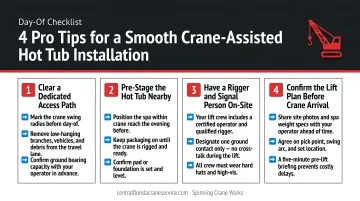
A little preparation goes a long way on crane day. These four tips address the issues Florida homeowners run into most often.
Compare quotes by service type, not price alone. A Contract Lift quote is higher than a Crane Hire quote because they're not the same service. Confirm which type is being quoted and what property damage coverage is included before signing anything.
Plan for Florida afternoon weather. From spring through fall, afternoon thunderstorms roll through Central and South Florida regularly. Crane operators will stand down if sustained winds or lightning are in the area. Schedule morning lifts when possible and build a buffer day into the timeline.
Clear the drop zone before the crane arrives. Remove all patio furniture, grills, plants, and decorative items from the lift path and landing area. Every minute the ground crew spends clearing obstacles is billed crane time.
Document pre-existing conditions. Photograph your driveway, curbs, sidewalks, and landscaping before the crane shows up—even with a Contract Lift. Ground damage waivers are standard practice, and timestamped photos protect you if a dispute comes up after the job.
Conclusion
Crane-assisted hot tub installation is a controlled, repeatable operation — when it's planned correctly. Skip the site survey, hire the wrong service type, or bring in an inexperienced crew, and you're looking at equipment damage, a collapsed crane, and a disputed insurance claim that costs far more than the job itself.
The steps that protect you are straightforward:
- Choose a Contract Lift over bare Crane Hire
- Require an in-person site survey before committing to a schedule
- Confirm your pad is fully cured and load-rated
- Validate shell integrity and levelness before the first drop of water
These aren't bureaucratic checkboxes. They're what separates a clean, on-schedule backyard installation from a costly problem-call two days later.
If you're in Florida and need a crane crew that handles specialty residential lifts with the same rigor as commercial jobs, Spinning Crane Works serves the entire state — from Melbourne and Orlando to Tampa, Miami, and Jacksonville. Call (321) 759-2263 to schedule your site survey.
Frequently Asked Questions
How much does it cost to hire a crane to lift a hot tub?
Pricing varies based on reach radius, crane size, and portal-to-portal travel time from the crane yard to your property. Crane companies with dispatch yards close to your location will have lower mobilization costs. Request itemized quotes from multiple local providers.
Do you need a crane to install a hot tub?
Most installations use a spa dolly and require no crane. A crane becomes necessary when access is blocked by narrow fence gates (typically under 36–40 inches), retaining walls, steep stairs, elevated deck placements, or when the tub must be lifted over a home or garage structure.
What size crane is needed to lift a hot tub?
Crane size is determined by reach radius and lift height, not the tub's weight alone. A 40-ton crane may handle short-radius backyard drops, but over-the-roof lifts at 60–100+ feet of horizontal reach can require 75- to 100-ton equipment. The crane company sizes the equipment from your specific site geometry, not the spec sheet.
What is the difference between a contract lift and crane hire for hot tub installation?
Crane hire provides the machine and operator while liability stays with the homeowner. A contract lift transfers full operational control, lift planning, and legal responsibility to the crane company—including insurance coverage for any damage caused during the lift. For residential hot tub placements, a contract lift is the appropriate choice.
How long does a crane-assisted hot tub installation take?
The actual lift often completes in under an hour, but full site setup, rigging, placement, and crane breakdown typically runs two to three hours on-site. Most crane companies bill a minimum regardless of how quickly the lift itself completes, so have your site ready when the crane arrives.
Can a crane safely lift a hot tub over a two-story house?
Yes—when performed by certified operators with the correct crane sized for the required radius and roofline clearance, over-the-roof lifts are a routine operation. They do require a Contract Lift agreement, an in-person site survey, and confirmed power line clearance along the lift path before proceeding.