This guide breaks down what hot tub crane delivery actually costs in the US market, what drives that price up or down, and how to build an accurate budget before installation day arrives.
Key Takeaways
- Crane delivery for a standard residential hot tub typically runs $500–$1,500+, depending on crane size, site complexity, and minimum hour charges
- Billing starts when the crane leaves the yard, not when it arrives at your property
- Swim spas cost more to crane than standard hot tubs — their greater weight demands a larger crane class
- Most companies charge a 2–4 hour minimum even if the lift takes 45 minutes
- An on-site assessment before booking is the single best way to avoid pricing surprises
How Much Does Hot Tub Crane Delivery Cost?
Hot tub crane delivery doesn't have a flat, universal price. Costs are calculated based on crane size, time on site, and site-specific challenges — which is why homeowners who budget only for the hot tub often face sticker shock at delivery.
The industry standard billing model works like this: crane companies charge an hourly rate based on the crane's tonnage capacity, plus a mandatory minimum of 2–4 hours. That clock typically starts when the crane leaves the company's yard, not when it arrives at your property. Knowing that structure upfront makes the price ranges below much easier to interpret.
Price varies significantly by job complexity. Here's what each tier typically looks like:
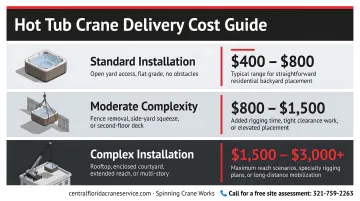
Price Range 1: Standard Hot Tub, Accessible Site — $500–$800
This covers a 2–6 person hot tub with a reasonably clear delivery path, minimal obstacles, and ground-level placement. According to Rigging Force, most standard residential hot tub lifts fall in the $500–$800 range.
What's typically included: crane mobilization, certified operator, and basic rigging (straps and attachment hardware). Some operators bundle rigging into the hourly rate; others itemize it separately.
Best for: suburban Florida homeowners with a side gate too narrow for a forklift but an otherwise open yard — the most common scenario in Central Florida neighborhoods.
Price Range 2: Larger Hot Tub, Moderate Site Complexity — $800–$1,500
Costs rise when the job involves a 6–8 person hot tub, placement over a fence or privacy wall, a longer boom reach, or proximity to overhead power lines. Angi's cost data places crane delivery at $800–$1,500 or more for these scenarios.
Additional line items that may appear at this tier:
- Rigging crew or ground spotter (billed separately from the operator)
- Standby time if coordination between the delivery truck and crane isn't tight
- Power line coordination or utility notification costs
Typical scenario: enclosed backyards, second-story decks, walled courtyards — very common in Florida subdivision layouts where privacy fences make standard delivery impossible.
Price Range 3: Swim Spas or High-Complexity Installations — $1,000–$1,500+
Swim spas are a different category. The H2X Trainer 15D, for example, weighs 2,430 lbs dry — already heavier than most hot tubs filled with water. That weight, combined with the longer dimensions, typically requires a 40–75 ton crane, longer setup time, and more rigging expertise.
Road use permits and traffic control can add to the total when the crane must operate from a public street. Rooftop placements fall in this tier as well.
Common use case: swim spa installations, rooftop hot tub placements, or any job requiring a 50-ton or larger crane.
Key Factors That Affect Hot Tub Crane Delivery Cost
Pricing depends on equipment, site conditions, and operational factors working together. Understanding each one helps you ask the right questions when gathering quotes.
Crane Size and Lifting Capacity
Cranes are rated by tonnage, and the required capacity isn't determined by the hot tub's weight alone — it's determined by weight plus the boom reach needed to clear obstacles. A 14–20 ton carry-deck crane handles many residential jobs with short reaches. A 25–45 ton boom truck is needed for over-fence placements or longer reaches.
Here's a counterintuitive fact worth knowing: a 1,000 lb load at 30 feet of reach can require more crane capacity than a 5,000 lb load at 10 feet. Reach drives crane selection as much as weight does.
Site Access and Obstacles
The crane truck itself needs room to position and deploy outriggers (wide stabilizing legs that can extend several feet on each side). Narrow driveways, parked cars, low-hanging landscaping, and tight streets all limit where the crane can set up.
When a crane can't get close to the fence line, it has to work from farther away — requiring a longer boom and a higher-rated (more expensive) crane. Power line proximity compounds this: OSHA's crane regulations require a minimum 10-foot clearance from lines up to 50 kV, and 15–20 feet for higher voltages.
Overhead service drops and distribution lines run directly through many residential lift paths in Florida — a challenge that requires pre-lift planning rather than on-the-fly adjustments. Spinning Crane Works conducts site surveys before the crane arrives to map approach angles and boom positioning around electrical infrastructure.
Minimum Hours and Mobilization Fees
Most crane companies charge a minimum of 2–4 hours regardless of how fast the actual lift goes. Missouri Crane, for example, states a 4.0-hour minimum with time charged portal-to-portal from their yard. Maxim Crane Works' rental agreement specifies that billing begins when equipment leaves their facility and continues until it's returned.
Travel distance is a direct cost factor. A crane company based 90 minutes from your property bills that round-trip travel time before a single lift occurs.
Hot Tub Weight and Type
Dry weight varies considerably across hot tub categories:
| Hot Tub Type | Dry Weight (approx.) |
|---|---|
| Small 2-person (e.g., Hot Spring TX) | ~635 lbs |
| Standard 6-person (e.g., Hot Spring Flair) | ~875 lbs |
| Large 7-person (e.g., Hot Spring Grandee) | ~790 lbs |
| Swim spa (e.g., H2X Trainer 15D) | 2,430 lbs |
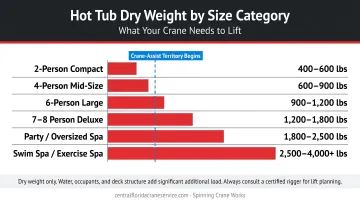
Always verify the dry weight with your retailer. Residual water adds up fast — at 8.34 lbs per gallon, just 50 gallons left inside adds over 400 lbs. The crane lift plan should be based on the actual drained weight.
Permits and Traffic Control
When a crane operates from a public road or outriggers touch a sidewalk, local permits are required. Specific requirements vary by jurisdiction:
- Hillsborough County: Temporary Traffic Control permit — $50 base fee plus $150 per closed collector or arterial lane
- Orlando: Right-of-way permit for any work in the street, sidewalk, or adjacent grassy area
- Other municipalities: Similar permit structures apply; confirm with your crane company during planning
The crane company typically handles permit acquisition and passes the cost to the client. Hillsborough County requires road closure submissions 30 days in advance, so site planning needs to happen well before you lock in a crane date.
Full Cost Breakdown: What You're Actually Paying For
The total bill is rarely just the hourly crane rate. Here's what goes into the final number:
| Line Item | Type | Notes |
|---|---|---|
| Crane hourly rate | Core charge | Billed from yard departure to return; varies by crane tonnage |
| Minimum time guarantee | One-time | Typically 2–4 hours regardless of lift duration |
| Rigging and operator fees | One-time | Sometimes bundled, sometimes itemized separately |
| Travel/mobilization | One-time | Often built into portal-to-portal billing |
| Permits and road use fees | Situational | Required when crane operates on public roads |
| Standby/delay charges | Situational | Full hourly rate applies if site isn't ready |
Standby charges are the most avoidable hidden cost. Billing doesn't pause because the delivery truck is late or the hot tub isn't ready when the crane arrives. Coordinate the delivery truck and crane on the same timeline — a 30-minute delay at the full hourly rate adds up fast.
When Do You Need a Crane for Hot Tub Delivery?
Not every hot tub installation needs a crane — but some site conditions leave no other safe option. Crane delivery is typically required when:
- No gate or side-yard opening wide enough for the hot tub on a dolly
- Hot tub must clear a fence, privacy wall, or roof structure
- Placement is on a second-story deck or rooftop
- Distance from the road to the installation point makes manual carry impractical or unsafe
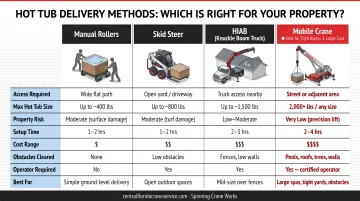
Alternative Methods and Their Limits
| Method | When It Works | Limitations |
|---|---|---|
| Manual rollers/labor crew | Short carries on flat, unobstructed ground | Anything heavier, steeper, or over an obstacle |
| Skid steer with forks | Open access, hard surface, adequate rated capacity | Tight yards, soft ground, weight beyond rated load |
| HIAB/knuckle-boom truck | Moderate reach over low obstacles, lower cost | Reach tops out around 36–43 feet; capacity drops sharply at full extension |
| Mobile crane | Confined or obstructed access, tall obstacles, swim spas, second-story decks | Requires level setup space for outriggers |
An on-site evaluation by a qualified rigging professional determines which method is right for your specific conditions — driveway width, ground bearing capacity, obstacle height, and total lift weight all factor in. Guessing the wrong equipment means showing up on delivery day without the means to complete the job.
How to Budget Smart for Hot Tub Crane Delivery
Answer these questions before requesting a quote:
- What is the dry weight of the hot tub? Get this from the manufacturer spec sheet, not the dealer's memory.
- What's between the street and the placement location? Walk the path and note every fence, gate, landscaping feature, and structure.
- Is there a clear, level area for the crane truck? Account for outrigger spread, not just the truck footprint.
- Are there overhead power lines along the lift path? If yes, flag this when calling for quotes.
Once you have those answers, avoid the mistakes that inflate costs or cause delays.
The Most Common Budgeting Mistakes
- Crane delivery is rarely included in the retailer's fee — most dealers bring the tub to your property line, not over obstacles
- Getting only one quote leaves money on the table — crane pricing varies widely by company, equipment availability, and location
- Scheduling the crane before confirming the hot tub delivery date creates misalignment that leads to standby charges
- Underestimating the crane size needed is costly — if the first crane can't complete the lift, a second mobilization means paying twice
Request an on-site assessment before committing. A reputable crane company will walk your property, identify obstacles, confirm the required crane size, and provide a written estimate — not a ballpark over the phone. Spinning Crane Works provides exactly this for residential hot tub and spa placements across Central and South Florida, dispatching from Melbourne, FL with statewide coverage.
Conclusion
Hot tub crane delivery costs depend on crane size, site complexity, travel distance, and time on-site — and the total is always higher than the hourly crane rate alone once minimums, rigging, and permits are factored in.
The most reliable way to get an accurate number is to work with an experienced local crane company that can assess your property in person. For homeowners throughout Florida, Spinning Crane Works handles hot tub placements involving power line proximity, second-story access, and tight residential layouts — with certified operators and full liability coverage on every job. Call 321-759-2263 any time, 24/7, to get a quote for your property.
Frequently Asked Questions
How much does it cost to crane a hot tub?
Most standard residential hot tub crane deliveries run $500–$1,500, depending on crane size, minimum hours, travel distance, and site complexity. Swim spas typically start at $1,000 and go higher due to their weight and the larger crane required.
When do you need a crane to deliver a hot tub?
A crane is needed when there's no gate or clear path wide enough to move the hot tub by dolly, when the unit must clear a fence, wall, or roof, or when placement is on a second-story deck. Most hot tub dealers flag these situations during a pre-delivery site check.
How long does hot tub crane delivery take?
The actual lift usually takes 30–90 minutes. Most crane companies bill a minimum of 2–4 hours including travel time, and total time on-site from arrival to departure typically runs 1–3 hours, depending on setup complexity.
What size crane is needed to lift a hot tub?
Crane size is determined by both weight and boom reach. A 14–25 ton crane handles most residential hot tubs. Swim spas or placements requiring long reaches may need a 40–75 ton crane, even if the spa itself isn't unusually heavy.
Can a crane deliver a hot tub over a fence or roof?
Yes, and clearing fences, walls, and rooflines is one of the primary reasons crane delivery is used. The operator calculates the lift angle and reach needed to clear the obstacle, then positions the crane truck accordingly. Site access for the crane truck itself is equally important in that planning.
What should I do to prepare my property for hot tub crane delivery?
A few steps make the process go smoothly:
- Clear the crane setup area of vehicles and obstacles
- Confirm the hot tub's dry weight with your retailer ahead of time
- Coordinate so the delivery truck and crane arrive together
Also check with your local Florida municipality or county whether a right-of-way permit is required before scheduling — rules vary by jurisdiction.