Introduction
Florida's construction industry is one of the most active in the country — contributing $101 billion to the state's GDP in 2025, according to the Associated General Contractors of America, with private nonresidential spending alone reaching $34 billion in 2024. Behind those numbers are thousands of job sites where the difference between a project that stays on schedule and one that doesn't often comes down to a single question: how are heavy materials being moved?
HVAC units, structural steel beams, precast concrete panels, and transformers aren't materials you improvise around. Without the right crane services, a rooftop mechanical installation becomes a liability, a steel erection sequence becomes a bottleneck, and a tight urban lift becomes a safety incident waiting to happen.
This article covers what modern crane services actually do — and what to look for when hiring a provider in Florida:
- What crane services handle on a construction project
- How they protect job site safety and scheduling
- Which industries depend on them most
- What to evaluate before hiring a crane contractor
Key Takeaways
- Every crane lift includes certified operators, qualified riggers, a pre-lift site survey, and a rigging plan — not just equipment
- Pre-lift assessment and OSHA-compliant procedures replace improvisation with engineered safety
- Precise first-time placement protects both project timelines and expensive materials
- HVAC contractors, steel erectors, utility companies, and telecom contractors all rely heavily on crane services in Florida
- Full-service crane providers differ significantly from bare-crane rental: operator expertise and liability coverage come with every job
What Do Crane Services Do in Modern Construction?
A professional crane service delivers far more than a machine on-site. The equipment, operator, rigging team, lift plan, and site knowledge all arrive together — purpose-built to move heavy materials safely on an active job site.
What Gets Lifted
On a typical commercial construction project, crane services handle:
- Structural steel beams, columns, and joists during erection phases
- Precast concrete panels and tilt-up wall sections
- Prefabricated modular components and mechanical equipment
- Rooftop HVAC units, chillers, cooling towers, and air handlers
- Generators, transformers, and switchgear during MEP rough-in
- Miscellaneous structural lifts as phased construction evolves
Each of these involves different load characteristics, rigging configurations, and placement requirements. The crane is the constant — the planning around it changes with every lift.
What Full-Service Looks Like
Spinning Crane Works, for example, delivers each job as a single coordinated service. Every lift includes a certified crane operator, qualified rigger, signal person, pre-lift site survey, rigging engineering input, and full liability and equipment insurance — no bare-crane rental, no separate operator sourcing.
This matters because the machine alone doesn't make the lift safe. The right equipment, properly rigged loads, trained personnel, and a site-specific plan have to work together — and on complex lifts, that coordination is what keeps the schedule and the crew intact.
How Crane Services Improve Job Site Safety
Heavy construction materials don't forgive errors. A dropped load, a crane tipping on unstable ground, or a boom swinging too close to a live power line can result in fatalities. According to BLS data covering 2011–2017, struck-by incidents — many involving falling objects from cranes — accounted for more than 50% of fatal crane injuries over that period, with private construction accounting for 43% of all crane-related deaths.
Professional crane services replace guesswork with documented procedure.
Pre-Lift Site Assessment
Before any equipment arrives on site, a qualified crane team evaluates:
- Ground bearing capacity — OSHA requires ground conditions to be firm, drained, and graded to manufacturer specifications before outrigger deployment
- Overhead obstructions — including power lines, building edges, existing equipment, and canopies
- Power line proximity — OSHA mandates a minimum 20-foot clearance zone from lines up to 350 kV must be identified before operations begin
- Load radius and lift height — determining whether the crane can safely reach the placement point without exceeding rated capacity
- Access routes — confirming the crane can reach its setup position without creating additional hazards
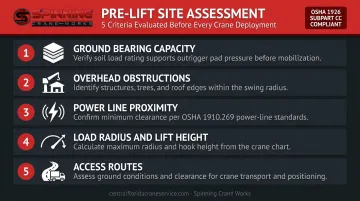
Skipping this step is how controlled lifts become emergencies.
Communication and Crew Coordination
During the lift, clear communication protocols govern every movement. OSHA requires signal persons to be qualified by a third-party evaluator, with documentation available at the job site. On urban Florida job sites — where pedestrian traffic, live utility lines, and adjacent structures are common — defined exclusion zones and structured crew positioning are non-negotiable.
Compliance Without Burden
OSHA's crane regulations under 29 CFR 1926 Subpart CC require operator certification (valid for up to five years), shift-by-shift visual inspections, monthly documented inspections retained for three months, and comprehensive annual inspections by a qualified person.
Non-compliance carries real costs: serious violations reach $16,550 per citation, and willful or repeated violations climb to $165,514.
Professional crane service providers manage this compliance layer directly — so the general contractor doesn't have to track certification cycles, inspection records, or equipment maintenance schedules alongside everything else on an active project.
Crew Protection Beyond the Operator
When a crane handles the heavy lifting, ground crews avoid the strain, crush hazards, and awkward positioning that come with manual material handling. Workers focus on skilled installation tasks instead of maneuvering oversized loads with inadequate equipment.
Boosting Project Efficiency and Placement Precision
Scheduling Alignment
A crane service that shows up without coordinating with the project schedule creates a bottleneck, not a solution. Professional providers align crane mobilization with material deliveries, staging sequences, and trade contractor schedules so that the lift day runs without idle time.
Spinning Crane Works coordinates directly with general contractors' superintendents, steel erectors, and mechanical contractors on lift sequences and jobsite logistics — keeping the crane operation integrated into the project's workflow from day one. For HVAC contractors, same-day and next-day scheduling options prevent equipment downtime from compounding into project delays.
Construction productivity growth has averaged just 1% annually over two decades according to McKinsey Global Institute — well below other industries. Crane services that are properly scheduled and coordinated are one of the more direct ways to improve throughput on a job site.
First-Time Placement Precision
Many construction materials have zero tolerance for misalignment. Even small errors ripple through the schedule:
- A structural steel column placed off-center forces downstream trades to adjust, reorder, or rework
- A rooftop HVAC unit an inch too far from the curb fails mechanical startup
- Precast panels that miss their bearing points create structural complications
Professional crane operators provide the controlled, deliberate movement required for accurate first-time placement. Combined with proper rigging — balanced load distribution, correct sling angles, and appropriate hardware — precision placement protects both the timeline and the materials themselves.
Adaptability Across Project Phases
Lifting needs change as a project moves from structural erection to mechanical installation to finishing work. A crane service with varied equipment and flexible scheduling can scale operations to match those shifts without requiring contractors to source new vendors mid-project.
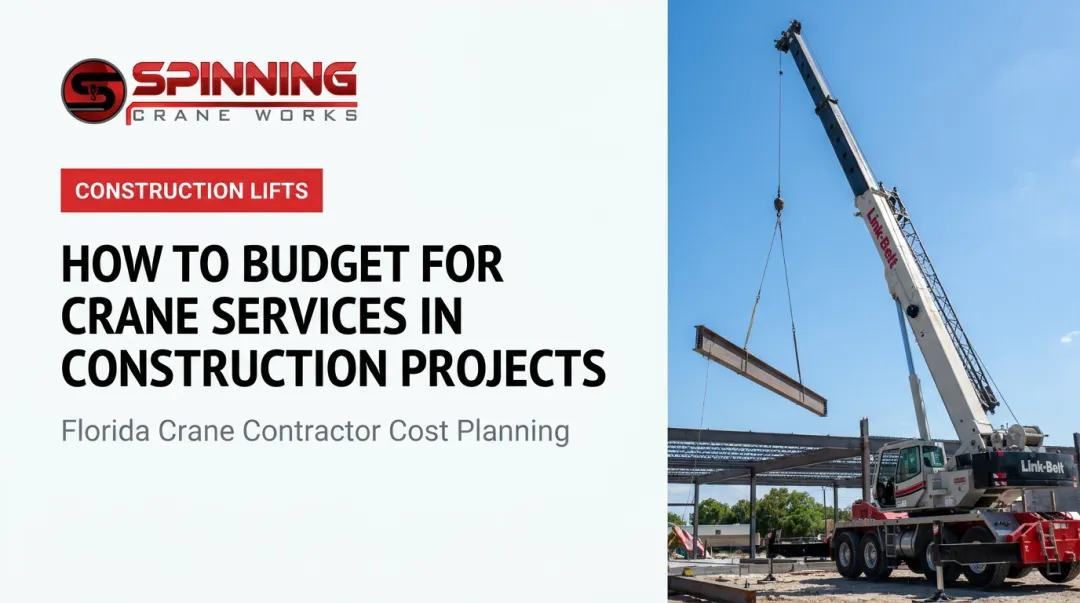
Spinning Crane Works' 100+ ton Link-Belt boom crane with 300-foot reach handles the vast majority of commercial and light-industrial lifts across all project phases — from steel erection through rooftop mechanical set — without triggering the cost and logistics of a 200+ ton heavy-lift mobilization.
Types of Cranes Used in Modern Construction Projects
Equipment selection is one of the most consequential decisions in crane operations. The wrong crane for a given lift creates risk, underperformance, or both.
Common Crane Types and Applications
| Crane Type | Best For |
|---|---|
| Mobile cranes | Versatile positioning, fast repositioning between picks, commercial and residential sites |
| Boom/boom truck cranes | Reaching over structures, tight-access areas, HVAC and telecom work |
| Crawler cranes | Heavy-duty lifts on uneven terrain, long-duration projects requiring stability |
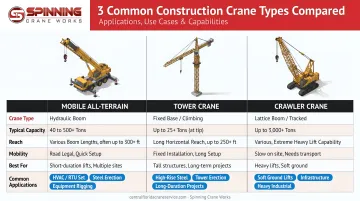
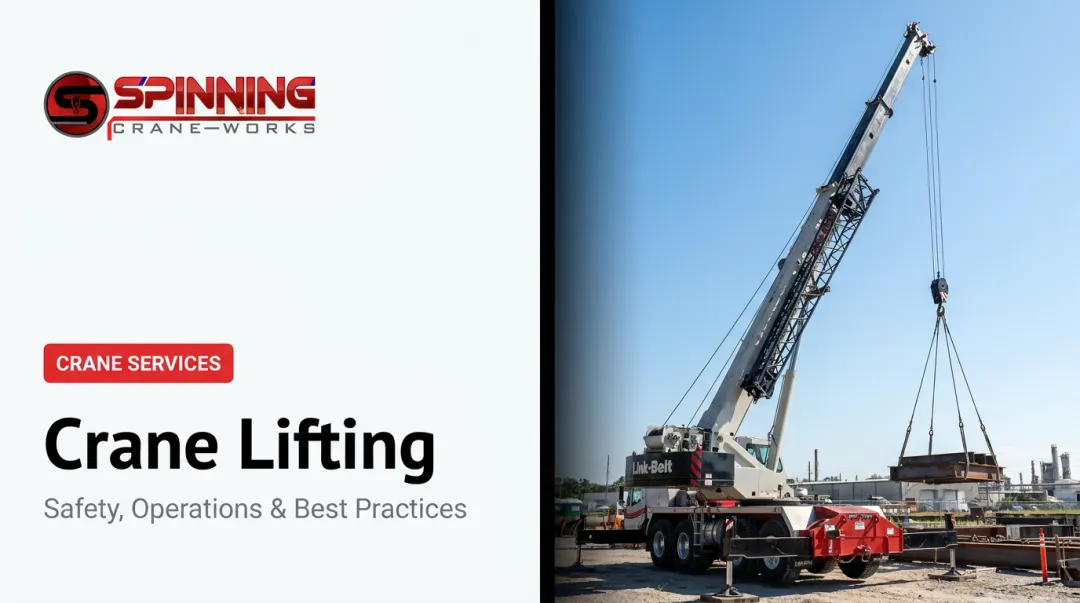
Spinning Crane Works deploys its Link-Belt boom crane — rated at 100+ tons with a 300-foot reach — as the primary platform for commercial HVAC, steel erection, utility infrastructure, and telecom work across Florida. This crane class is rated for the mid-to-heavy capacity range, covering the majority of commercial and industrial lift applications without the mobilization cost of a 200+ ton heavy-lift crane.
How Equipment Selection Actually Works
The right crane depends on:
- Load weight — including the rigging hardware, which must be deducted from chart capacity
- Lift radius — how far the load travels horizontally from the crane's center pin
- Height requirements — how high the load must travel to reach placement
- Ground conditions — OSHA requires ground to meet manufacturer specifications for support; known hazards beneath setup areas must be disclosed before deployment
- Site access — whether the crane can reach its setup position without creating additional constraints
A professional crane service assesses all of these upfront. Deploying the wrong equipment means either operating over rated capacity — a serious safety violation — or repositioning mid-project, which costs time and money.
Florida-Specific Considerations
Florida's operating environment adds layers to that general framework that affect every lift decision:
- Urban density — Sites in Miami and Tampa require careful boom configuration and positioning planning before mobilization
- Power line compliance — Utility and telecom projects require operators with demonstrated clearance expertise and OSHA 1910.269 experience
- 24/7 availability — Hurricane response and emergency lift needs don't follow business hours; Florida's construction calendar demands around-the-clock readiness
Industries That Depend on Crane Services in Florida
Construction and Heavy Equipment
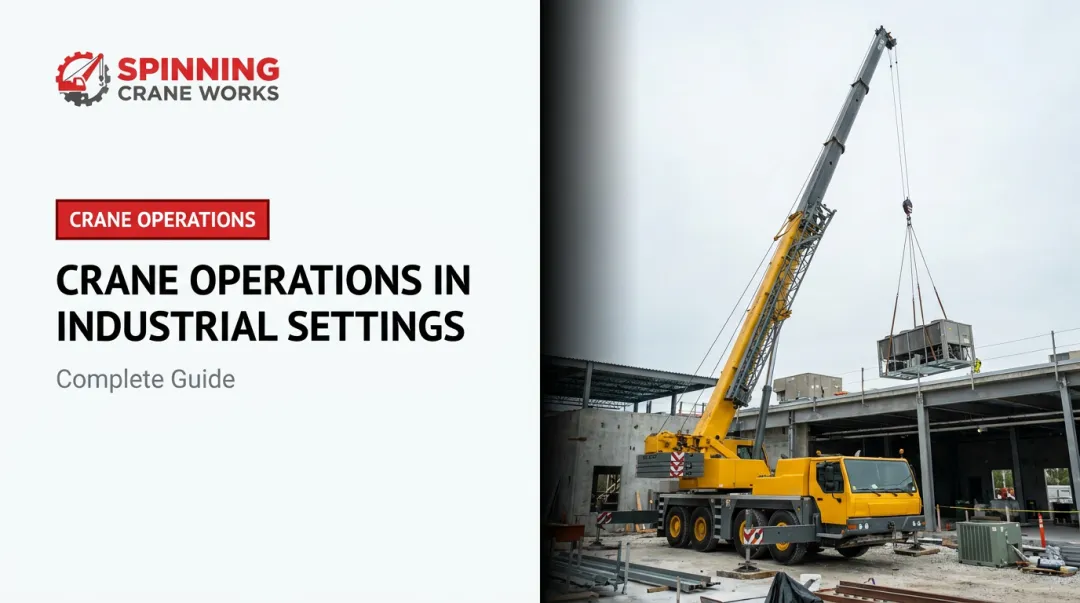
Structural steel erection, precast and tilt-up panel installation, modular component placement, and phased infrastructure builds all require cranes. There's no practical alternative for placing a 20-ton steel truss at elevation or setting a precast parking deck section on its bearing points.
HVAC and Mechanical Contractors
According to the DOE's Better Buildings initiative, nearly half of all cooling-conditioned commercial floor space in the U.S. uses rooftop units — most of which require crane service for installation or replacement. A commercial RTU can weigh up to 2,190 lbs for a 25-ton unit; a chiller or cooling tower is far heavier.
Florida's high cooling load and long operating seasons drive faster equipment cycles and more frequent replacements than most U.S. markets. Crane demand in this vertical spans the full commercial equipment range:
- Rooftop units (RTUs) and packaged HVAC systems
- Chillers and cooling towers
- Air handlers, boilers, and condensing units
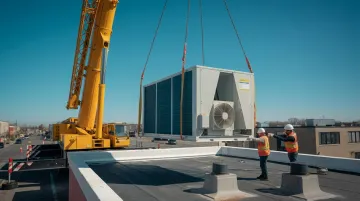
Same-day and next-day scheduling is often required — equipment failures in Florida's heat don't wait for the following week.
Utility and Telecom
Power companies set transformers, distribution poles, and switchgear near energized lines, where OSHA 1910.269 compliance is mandatory. Telecom contractors erect monopole and lattice towers, set antenna equipment, and perform tower-top swaps for 5G and LTE upgrades. Both sectors generate consistent year-round demand in Florida, with additional demand spikes after hurricane events.
Tree Removal and Specialty Applications
Large-scale tree removal in Florida — particularly storm-damaged trees over structures or near power lines — frequently requires crane assistance. When a 60-foot pine falls against a home, climber-only methods may not be safe or physically practical. Crane-assisted removal gives tree service crews controlled load management for sections that can't be safely dropped or rigged conventionally.
What to Look for When Hiring a Crane Service
Operator Expertise and Certification
OSHA requires every crane operator to be trained, certified, and employer-evaluated before operating covered equipment. Look for providers whose operators are current on certification (valid for up to five years) and have direct experience with the specific lift conditions your project involves — including urban environments, power line proximity, multi-phase construction, or specialty industrial equipment.
Expertise with power lines is worth asking about specifically. Operators with OSHA 1910.269 experience bring a fundamentally different safety posture to utility-adjacent work than general commercial crane operators.
Equipment Quality and Fleet Match
A provider that only offers one crane size creates a mismatch problem : the crane is either oversized (unnecessarily expensive) or undersized (unsafe). The right provider matches the machine to the job's actual requirements: load weight, lift radius, height, and ground conditions.
Well-maintained, up-to-date equipment also reduces breakdown risk. Monthly inspections documented and retained for three months, plus comprehensive annual inspections (both required by OSHA) should be standard practice, not something you have to request.
Safety Record and Compliance Posture
Ask how the provider handles:
- Lift plan documentation and pre-lift site surveys
- OSHA inspection records (monthly and annual)
- Signal person qualification and rigging certifications
- Liability and equipment insurance coverage
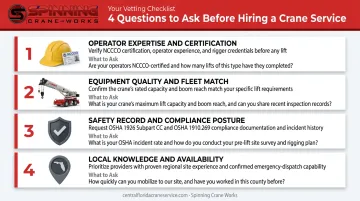
A company's safety commitment shows up in documented processes and credentialed personnel — not marketing language. Spinning Crane Works carries full liability and equipment insurance on every job, maintains OSHA 1926 Subpart CC and OSHA 1910.269 compliance, and includes a certified crane operator, qualified rigger, and signal person on every lift.
Local Knowledge and Availability
Florida permitting, terrain, and weather patterns are not generic. A provider with direct experience in your project's region understands local logistics, utility coordination protocols, and the scheduling pressures that Florida's construction market creates.
Spinning Crane Works operates 24/7 across the full state, covering Central Florida, Tampa Bay, South Florida, and North Florida from its Melbourne base. Emergency dispatch for storm cleanup and post-hurricane restoration is built into its core operations — the same crew and equipment that handles scheduled commercial lifts responds to hurricane recovery work throughout the season.
Frequently Asked Questions
What does a crane service do?
A crane service provides the equipment, certified operator, rigging personnel, and lift planning needed to safely move heavy or oversized materials on construction sites. The full-service model covers pre-lift site assessment through final placement, including load management, safety coordination, and OSHA compliance.
What types of cranes are used in modern construction?
Mobile cranes, boom truck cranes, and crawler cranes are the most common types. The right choice depends on load weight, lift height, site access, and ground conditions — a professional crane service conducts this assessment before deployment.
How do crane services improve construction site safety?
Professional crane services replace improvisation with engineered lift plans, certified operators, OSHA-compliant inspection schedules, and defined exclusion zones. Pre-lift site assessments evaluate ground conditions, overhead obstructions, and power line proximity before any equipment is deployed.
When should a contractor hire professional crane services?
Any time a project involves heavy or oversized materials, elevated placements, tight site access, or complex multi-phase lifts that standard equipment can't handle safely. HVAC replacements, structural steel erection, utility infrastructure, telecom tower work, and large-scale tree removal all require professional crane services.
What is the difference between crane rental and full-service crane services?
Crane rental provides equipment only, leaving the contractor to source the operator, rigging personnel, insurance, and lift planning separately. Full-service crane services include all of it: certified operator, qualified rigger and signal person, pre-lift site survey, rigging engineering input, and liability coverage — making it the lower-risk path for complex or high-stakes lifts.