Crane delivery is the industry standard for good reason. Hydropool states that 99.9% of its swim spas are delivered by crane, calling it the safest method for both the unit and the people involved. Arctic Spas reports that roughly 90% of its All Weather Pools are lifted by crane as well.
What this guide covers: the full swim spa crane delivery process from site preparation through post-delivery validation — so you know exactly what to prepare, what to expect on delivery day, and what questions to ask your crane company before booking.
Key Takeaways
- Swim spas require crane delivery in most residential settings due to their size and weight
- A fully cured, level concrete pad must be in place before scheduling the crane
- Coordinate the crane company, delivery truck, and electrician for the same day, and get all confirmations in writing
- Crane sizing depends on reach distance, not just the spa's weight
- Complete electrical hookup, water fill, and water chemistry checks before the spa is ready to use
Prerequisites and Site Preparation
A poorly prepared site doesn't just cause delays. It puts the crane clock running while nothing moves — and crane billing doesn't pause for problems.
The Concrete Pad
Your swim spa must sit on a fully cured, level concrete pad. Endless Pools specifies a reinforced pad of at least 6 inches thick, or a deck rated to withstand more than 250 lb/sq ft, for its Aquatic Fitness System. Hydropool is more direct: its warranty is void without a proper concrete pad, and the company won't deliver unless one is in place.
Pad sizing matters beyond the footprint. Plan for at least 2 feet of clearance on each side of the spa for future servicing access. Placing a spa on grass, gravel, or an uncured surface creates settlement risk over time.
On curing: concrete compressive strength testing is based on 28-day results under ACI 318-19. Don't schedule delivery before that threshold unless your contractor has verified earlier readiness with actual test data.
Access and Clearance
The crane needs a clear path from street to setup zone. Red flags to identify and resolve before delivery day:
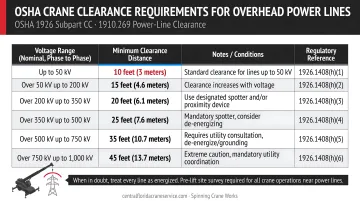
- Overhead power lines crossing the planned boom path — OSHA 1926.1408 Table A mandates a minimum 10-foot clearance from lines up to 50 kV, 15 feet for 50–200 kV, and 20 feet for 200–350 kV
- Low-hanging branches that interfere with the boom swing arc
- Soft ground or tree roots near the crane setup zone — the crane's outriggers need solid bearing capacity to operate safely
- Underground utilities beneath the outrigger positions — call 811 before delivery day
Permits and HOA Approvals
Many Florida municipalities require a street-use or right-of-way permit when a crane occupies public road space. Review times vary by jurisdiction. Start the permit process at least two to three weeks before your scheduled delivery — some Florida cities require:
- Tampa: 12–15 business days for right-of-way permits
- Gainesville: up to 7 additional days for certain reviews
If your neighborhood has an HOA, check whether commercial vehicles or crane equipment require advance written approval. This is property-specific and often overlooked.
The Pre-Site Inspection — Non-Negotiable
A crane company should conduct a physical site visit or detailed photo and satellite review before quoting or booking your delivery. This inspection determines the exact reach radius from the crane's rotation pin to the drop zone, identifies obstacles, and confirms the correct crane size.
Don't accept a quote from any provider who hasn't evaluated your site. Crane capacity changes with radius — a number given over the phone without site data is a guess.
At Spinning Crane Works, every swim spa lift begins with a pre-lift site survey before any booking is confirmed.
Equipment and Rigging Required
Knowing what equipment goes into a swim spa lift — and what each piece does — helps you vet crane companies with confidence and catch gaps before lift day.
Rigging Components
A proper swim spa lift uses three core rigging elements:
- Nylon lifting straps rated for the spa's specific weight
- Spreader bars positioned above the spa to keep straps vertical and prevent lateral pressure on the shell — Jacuzzi's 2025 PowerPlay installation guide explicitly requires strap spreaders "to prevent undue structural side load on the swim spa"
- Taglines attached to each corner of the spa so the ground crew can control rotation during the swing
The crane company determines the rigging configuration based on the spa's weight and lift geometry. The homeowner supplies none of this — all rigging, lifting equipment, and crane machinery comes with the service.
Crane Sizing
This is where most homeowners get confused. Crane capacity isn't determined by the spa's weight alone. According to OSHA's crane safety guidelines, the longer the radius at which a lift occurs, the smaller the load a crane can safely handle. A swim spa lifted over a two-story house at a 60-foot horizontal reach can require a 40- to 75-ton crane even though the unit itself weighs under 3,500 pounds.
The crane company calculates the required tonnage after inspecting your site. Expect questions about your property layout, obstacles, and the exact placement location — the answers directly shape the lift plan and the equipment class needed.
How to Complete a Swim Spa Crane Delivery (Step-by-Step)
The delivery follows a defined sequence. Reordering any step — the crane arriving before the truck, or the pad not being ready — creates expensive idle time. That cost adds up fast: crane billing is portal-to-portal, meaning the clock starts when the equipment leaves the dispatch yard.
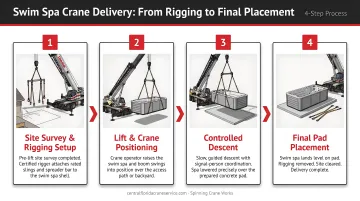
Step 1 — Crane setup The crane arrives first. The operator positions the unit, places protective mats under the outriggers to distribute weight and protect your driveway, then extends and positions the boom over the planned lift path. Nothing else moves until the crane is set and leveled.
Step 2 — Rigging the swim spa Once the delivery flatbed arrives, the rigging team attaches the following before anything leaves the ground:
- Lifting straps positioned beneath the spa
- Spreader bar assembly connected to the straps
- Taglines secured at each corner for load control
The spa should still have its factory protective packaging in place at this stage — it stays on through the entire lift.
Step 3 — The lift and swing The operator raises the spa vertically to a safe height above all obstacles, then swings the boom horizontally toward the drop zone. Ground crew use the taglines to stabilize the load and prevent rotation. This is the most visually dramatic part of the delivery and typically takes only a few minutes when properly planned.
Step 4 — Final placement The spa is lowered slowly onto the concrete pad. The rigging team guides it into exact position while the operator maintains tension on the load. Straps and spreader bars are removed only after the spa is fully settled and confirmed level.
If any positional adjustment is needed, this is the moment to make it. Repositioning after the rigging comes off is extremely difficult and may require bringing the crane back.
Post-Delivery Setup and Validation
Getting the swim spa into position is only part of the job. Three more steps stand between crane delivery and a fully operational spa.
Electrical Hookup
Swim spas require a dedicated 240V circuit installed by a licensed electrician. Most units need a 50A breaker, and larger dual-zone models may require two separate 50A connections. Per Jacuzzi's electrical guidance, the circuit must be hard-wired with GFCI protection positioned at least 5 feet from the spa.
Schedule the electrician to arrive on delivery day. An unconnected spa can't begin heating, and diagnosing wiring issues is faster and cheaper while the installation crew is still on-site.
Water Fill
With the electrical connection confirmed, fill the spa correctly from the start:
- Fill through the filter housing — not the footwell — to prevent air locks that can damage the pump (called out specifically in Master Spas' owner's manual)
- Expect the spa to reach operating temperature overnight after the initial fill
- Check your model's manual for any fill sequence variations before starting
Functional Validation
Before the installation crew leaves, verify:
- pH, alkalinity, and sanitizer levels are balanced
- All jets, lighting, and controls function correctly
- The heating system is cycling properly
- No error codes appear on the panel
Pump problems, panel faults, and wiring issues are far easier to address while the crew is still on-site. Once everyone has packed up, those same issues become a scheduling problem and a service call bill.
Common Swim Spa Crane Delivery Problems and Fixes
Overhead Power Lines Blocking the Crane Path
If your only viable crane position puts the boom near energized overhead lines, the lift cannot proceed safely — and shouldn't. This situation almost always traces back to a delivery scheduled before anyone physically confirmed clearance distances on site.
Contact your utility provider — FPL or Duke Energy in Florida — at least several days before delivery. Request a temporary line drop or discuss compliant clearance options. No lift should begin without confirmed OSHA 1910.269 clearance distances in place.
Crane and Delivery Truck Arrive Out of Sequence
When the crane arrives before the spa, the operator is on the clock with nothing to lift — paid idle time that's entirely avoidable. It happens when the crane company and spa dealer are scheduled separately rather than coordinated on a shared arrival window.
Put both parties in direct contact to align on timing. Stage the delivery truck to arrive 20–30 minutes before the crane so the spa is on-site and ready the moment the boom extends.
Spa Shell Damage During the Lift
Cracks or surface damage discovered after placement usually point to one of two rigging mistakes: straps attached without a spreader bar — which creates inward lateral pressure on the acrylic shell — or protective packaging removed before the lift was complete.
Before booking, confirm:
- The crane company uses spreader bars on all swim spa lifts
- Factory wrapping stays on the spa through the entire lift and is only removed after final placement
Here's a quick-reference summary of all three issues:
| Problem | Root Cause | Fix |
|---|---|---|
| Power lines blocking crane path | No physical site inspection before scheduling | Call FPL / Duke Energy days ahead; confirm OSHA clearance distances |
| Crane arrives before the spa | Crane and dealer not coordinated on timing | Direct communication between dispatcher and dealer; stage truck 20–30 min early |
| Shell damage after placement | No spreader bar; packaging removed too early | Require spreader bar; keep factory wrap on through full lift |

Most of these problems are preventable with a single pre-delivery phone call and a rigging company that has done swim spa lifts before.
Pro Tips for a Smooth Swim Spa Crane Delivery
Confirm all three parties in writing at least one week out — crane company, spa delivery truck, and electrician on the same day with agreed arrival windows. Crane billing runs portal-to-portal, so proximity matters — a locally dispatched crew like Spinning Crane Works (Melbourne, FL) keeps mobilization costs lower for Central and South Florida homeowners.
Build in a weather backup date — crane lifts are cancelled in sustained high winds or lightning. Locking in a backup date at booking prevents last-minute scrambling and extra minimum-hour fees.
Document your property before delivery day — take timestamped photos of your driveway, curbs, yard, and the finished concrete pad before the crane arrives. If outrigger mats or heavy truck traffic cause ground damage, those photos protect you in any dispute.
Conclusion
Swim spa crane delivery is a precision operation where your preparation directly shapes the outcome. A cured pad, confirmed access, aligned arrival times, and a licensed electrician on standby turn a complex delivery into a smooth one. Skip any of those steps and the crane clock keeps running while you solve them.
If you're planning a swim spa delivery anywhere in Florida, contact Spinning Crane Works at 321-759-2263 for a site-specific consultation. Their certified operators handle residential specialty lifts — including spa placement in tight backyard and second-story scenarios — with proper rigging, OSHA-compliant power-line procedures, and pre-lift site surveys as standard.
Frequently Asked Questions
Frequently Asked Questions
How much does it cost to crane a swim spa?
Hydropool estimates crane rental in the $500–$2,500 range, but swim spas typically push toward the higher end given their weight and the larger crane capacity required. Florida pricing shifts based on reach distance, site access, and permit fees — always get a site-specific quote.
Can a swim spa be delivered without a crane?
Hydropool's manual notes that a spa can be moved on rollers by 10–12 adults or relocated by forklift in some cases, but these methods require flat, wide-open ground and dealer approval. In most residential settings, gate widths, landscaping, and shell damage risk make crane delivery the practical choice.
What size crane is needed to lift a swim spa?
Crane sizing depends on the spa's weight combined with the horizontal reach distance from the crane to the drop zone — a longer reach reduces how much any crane can safely lift. The crane company determines the correct tonnage after a site inspection; don't accept a recommendation made without that evaluation.
How long does swim spa crane delivery take on the day?
The actual lift takes only minutes, but the full process — crane setup, rigging, lift, placement, and teardown — typically runs two to four hours on-site. Portal-to-portal billing means your total charge includes transit time from the dispatch yard, which is worth factoring in when choosing a crane service.
Do I need a permit for swim spa crane delivery?
Many Florida municipalities require a street-use or right-of-way permit when a crane sets up on a public road. Some HOAs also require advance written approval. Check both at least two to three weeks before your scheduled delivery date.
What should the concrete pad look like before the swim spa is delivered?
The pad should be fully cured (28 days is the standard strength benchmark under ACI 318-19), level, sized to the spa's footprint with at least 2 feet of clearance on each side, and completely cleared of construction debris.