Introduction
Weather kills crane workers — and wind is a leading cause. According to BLS fatality data, roughly 15% of the 297 fatal crane injuries recorded between 2011 and 2017 involved weather conditions. That translates to real consequences: workers killed, equipment destroyed, projects halted for weeks, and employers facing OSHA citations and civil liability.
The 1999 "Big Blue" collapse at Miller Park Stadium is one of the most cited examples. With winds at 25–30 mph and a roof panel load that hadn't been properly assessed for wind exposure, the crane failed — killing three workers. Wind wasn't a surprise that day. It was underestimated.
That underestimation is what this guide addresses. It covers the physics of why wind loads are so dangerous, the thresholds that trigger stop-work decisions, OSHA's regulatory stance, and the field practices that protect crews. Whether you're running a coastal lift in Miami, a rooftop HVAC set in Orlando, or a tower job on the Space Coast, the wind rules here aren't theoretical — they're the ones that prevent the next collapse.
Key Takeaways
- OSHA sets no universal wind speed limit — manufacturer specifications are the legal baseline
- Wind pressure increases with the square of wind speed; a modest speed increase creates dramatically larger forces
- Mobile cranes typically stop operations around 20 mph; tower crane climbing limits are stricter than their in-service thresholds
- Gusts — not just sustained speeds — can cause immediate, uncontrolled load swing
- Wind at 150–200 feet can be 1.5 to 2 times stronger than at ground level
How Wind Affects Crane Operations
Most jobsite wind assessments focus on speed. The more dangerous variable is pressure — and it doesn't scale the way most people expect.
Wind Pressure Rises With the Square of Speed
According to ISO 4302:2016 (the international standard for crane wind load assessment), wind pressure follows the formula p = 0.625 × v² (in N/m², with velocity in m/s). The practical implication:
| Wind Speed | Wind Pressure |
|---|---|
| 14 m/s (~31 mph) | 125 N/m² |
| 20 m/s (~45 mph) | 250 N/m² |
| 28.5 m/s (~64 mph) | 500 N/m² |
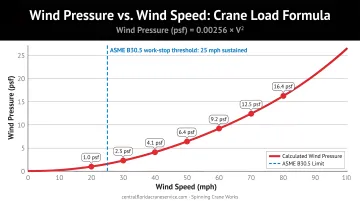
Double the wind speed and you quadruple the pressure on the boom, jib, and load. That's why conditions can shift from manageable to dangerous in minutes.
The Sail Effect: Load Shape Matters as Much as Load Weight
A compact steel block and a flat rooftop HVAC unit may weigh the same. In wind, they behave completely differently.
Large, flat loads — wall panels, prefabricated sections, signage, cooling towers — catch wind like a sail, generating lateral forces that can exceed rated capacity even when the load weight is within limits. Liebherr's crane wind training documentation notes that standard mobile and crawler crane load charts apply only when the load's wind area doesn't exceed 1.2 m² per tonne. Exceed that threshold, and permissible wind speed must be recalculated downward before the lift proceeds.
Pre-lift wind area assessment is required for rooftop HVAC equipment, tilt-up panels, and prefabricated building sections — any load with a large flat face relative to its weight.
Wind Speed Increases With Height
Ground-level anemometer readings are often misleading for elevated lifts. Wind speed increases with altitude because surface friction decreases. Using the engineering power-law relationship, at 150–200 feet:
- Open terrain: wind is approximately 1.3 times the ground reading
- Suburban terrain: approximately 1.5–1.7 times
- Urban/city terrain: approximately 1.8–2.1 times
Liebherr and Manitowoc both warn explicitly that wind at the boom head can be significantly higher than at ground level. Measuring at ground level when the boom head is at 200 feet isn't a conservative estimate — it's the wrong number entirely.
Sustained Winds vs. Gusts
These two measurements are not interchangeable, and treating them as equivalent is a common field mistake.
- Sustained wind: averaged over 1–2 minutes; what most weather apps report
- Gusts: rapid fluctuations lasting under 20 seconds; often significantly higher than the sustained average
Gusts generate sudden, uncontrolled forces on suspended loads. A load swinging under gust pressure can impose lateral loads the crane was never designed for. Liebherr specifically defines maximum permissible wind speed using 3-second gust speed at maximum hoist height — not the sustained average.
Wind Speed Limits and Regulatory Standards
OSHA's Position
OSHA does not prescribe a single mph limit that applies to all cranes. Two regulations define the framework:
- 29 CFR 1926.1417 (construction) requires employers to follow manufacturer procedures and directs the competent person to adjust operations for wind, ice, and snow
- 29 CFR 1917.45 (marine terminals) requires wind-indicating devices with audible/visible alarms; shutdown speed cannot exceed manufacturer recommendations
The manufacturer's operator manual is the effective legal standard. Following it isn't optional — it's the baseline OSHA compliance requires.
Wind Speed Thresholds by Crane Type
Because OSHA defers to the manufacturer, these thresholds are where regulatory compliance meets real-world practice. The figures below reflect manufacturer and ISO guidance — always verify against the specific crane manual in use:
| Crane Type | Typical Operational Limit | Notes |
|---|---|---|
| Mobile / rough-terrain cranes | ~20 mph (9 m/s) gust at boom head | Liebherr standard load charts; subject to load wind-area conditions |
| Tower cranes (normal in-service) | ~45 mph (20 m/s) | ISO 4302:2016 design benchmark — not a blanket permission for all configurations |
| Tower crane climbing / assembly | ~27 mph (12 m/s) | ISO 12480-3, per ANSI — strict limit for assembly/disassembly operations |
| Marine terminal / outdoor gantry | Manufacturer-specific | OSHA 1917.45 defers to manufacturer; wind-indication alarms required |
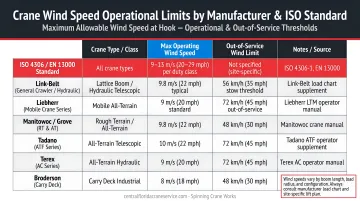
For model-specific cranes like Tadano or Link-Belt units, consult the technical data directly — generic thresholds don't substitute for the actual manual.
The Three-Zone Threshold Framework
A practical way to structure wind monitoring for any job site:
- Normal (0–15 mph): Operations proceed with standard monitoring
- Caution (15 mph to manufacturer-approach speed): Evaluate load wind-area against current conditions, reduce load radius, and brief the crew on a potential stop
- Stop-Work (at manufacturer limit): Halt all lifting immediately, boom down and secure the crane per the operator manual, and document the stoppage time and wind reading
Document these zones in the lift plan and post them in the crane cab before work starts. In Florida — where afternoon sea-breeze events and tropical weather can push winds through all three zones within an hour — having that threshold visible to the operator isn't a formality. It's what keeps the job moving safely or stops it before damage occurs.
Safety Guidelines for Crane Operations in High Wind
Wind safety is a layered system, not a checklist item you complete once at the start of the day. It runs through pre-lift preparation, active lift management, and site-specific environmental awareness.
General Safety Precautions
Before any lift, two things must be in place:
- Wind monitoring at the right height: Crane-mounted or boom-height anemometers are the standard. Ground-level handheld readings don't reflect what's happening at the load point for any elevated lift.
- Designated wind monitor with stop-work authority: One person — operator, signal person, or supervisor — must own this responsibility explicitly. Everyone on the crew needs to know who that person is and that their call is final.
Go/no-go criteria for the specific crane and load configuration should be established and communicated in the pre-shift briefing, not improvised once the lift is already in progress.
Pre-Lift Safety Considerations
Before each lift:
- Review the crane manufacturer's wind limits for the specific boom length, jib configuration, and load type being used that day — not the general crane limit
- Document those limits in the lift plan and job hazard analysis
- Reduce the operational wind limit by 5–10 mph for loads with significant sail area: flat panels, prefabricated sections, rooftop HVAC units, cooling towers, and signage
- If site or client policies are stricter than the manual, default to the stricter standard
Safety During Active Lifts
In elevated or gusty conditions:
- Use tag lines to control load rotation and reduce sway
- Reduce boom radius or lower boom angle to decrease wind exposure
- Avoid lifts over energized power lines or in confined spaces during marginal conditions — wind-induced load sway near energized infrastructure sharply increases risk
- Near live distribution or transmission lines, apply tighter wind thresholds than standard limits — even moderate gusts create compounding hazards that make conservative criteria essential
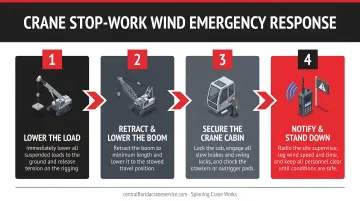
When wind reaches or approaches stop-work limits:
- Lower the load to the ground and secure it immediately
- For tower cranes, activate weather-vane (free-slew) mode
- Document the stoppage: time, wind speed, and actions taken
- Do not resume until wind has remained below restart thresholds for a defined period — follow manufacturer procedures and the site-specific lift plan
Environmental and Site Conditions
Florida's geography creates specific wind challenges:
- Coastal and open sites (common from Miami through Jacksonville, and across Tampa Bay) experience stronger and less predictable winds than sheltered inland locations
- Urban wind funneling between buildings can generate sudden gusts even when overall conditions appear calm
- Elevated sites — cell tower work, rooftop equipment sets — require applying height-amplification factors to any ground-level reading
Apply more conservative thresholds on exposed ridges, near shorelines, or in large open construction yards. Every pre-lift plan should explicitly evaluate the site's exposure category, not assume a standard ground-level reading is representative.
Common Safety Mistakes to Avoid
Checking Wind Speed at Ground Level for an Elevated Lift
This is one of the most frequent errors on job sites. If your boom is at 150 feet in suburban terrain, wind at that height may be 50–70% stronger than what you're reading at grade.
Liebherr defines permissible wind speed as the gust speed at maximum hoist height — not at the operator's position, not from a weather app, and not from a handheld device held at head height.
Continuing Operations Because "Sustained Speed" Is Within Limits
A sustained average within limits doesn't mean gusts are safe. Gusts generate immediate, uncontrolled lateral forces on a suspended load — forces that don't wait for an average to develop. Liebherr's own standards use 3-second gust speed as the measurement standard, and Manitowoc's wind conditions guidance specifically instructs job planners and supervisors to monitor wind speed including gusts. Manufacturers define the limit by gust speed. Treating gusts as a separate stop-work trigger is simply following that standard.
Applying the Crane's General Limit to All Loads Regardless of Shape
Large-area loads — roof panels, wall forms, curtain-wall sections — catch wind like a sail. The crane's general wind rating doesn't account for what those shapes do in crosswind conditions, and the difference can be dramatic.
The Big Blue collapse at Miller Park illustrates this directly: three workers killed, winds at 25–30 mph, and a large roof-panel load that hadn't been adequately assessed for wind exposure. It remains the clearest documented example of this mistake.
Before any lift with high wind-exposure potential, the pre-lift plan should address:
- Load dimensions and surface area exposed to wind
- Orientation of the lift path relative to prevailing wind direction
- Reduced wind speed thresholds specific to that load's shape
Frequently Asked Questions
What is the OSHA standard for crane wind speed?
OSHA does not set a single universal wind speed limit. Under 29 CFR 1926.1417 for construction, employers must follow manufacturer procedures and direct competent persons to account for wind, ice, and snow. The crane manufacturer's operator manual is effectively the legal standard.
What is the allowable wind speed for crane operations?
It depends on crane type and manufacturer specifications. Mobile crane load charts from manufacturers like Liebherr typically apply up to approximately 20 mph gust speed at boom head. Tower cranes have higher in-service limits but are restricted to about 27 mph during climbing and assembly per ISO 12480-3.
What is the 3-3-3 rule for crane operations?
No authoritative primary source — OSHA, ASME, NCCCO, ISO, or major manufacturers — defines a crane-specific "3-3-3 rule." The phrase appears in some secondary training materials without a confirmed regulatory origin. Rely on manufacturer manuals and your site-specific lift plan instead.
Should crane operations stop during wind gusts even if sustained speeds are within limits?
Yes. Gusts must be treated as an independent consideration. Both Liebherr and Manitowoc specifically incorporate gust speed into their wind monitoring guidance. A sustained average within limits offers no protection against a gust that exceeds the safe threshold; the load sees the full force instantly.
How does wind speed change with height during crane operations?
Wind increases with altitude as surface friction decreases. At 150–200 feet, wind can be 1.3 to 2 times stronger than at ground level, depending on terrain type. This is why anemometers should be positioned at or near boom height, not at ground level.
What should operators do immediately when wind speeds exceed safe limits?
Lower and secure the load, then halt all lifting operations and place the crane in its out-of-service configuration (weather-vane mode for tower cranes). Document the stoppage with the time and wind speed reading. Follow manufacturer procedures and your lift plan's restart criteria before resuming.
Conclusion
Managing wind in crane operations isn't about reacting when conditions deteriorate — it's about building the right protocols into every lift from the start. That means knowing the manufacturer-specific limits for your crane and configuration, measuring wind at boom height not ground level, adjusting thresholds downward for high sail-area loads, and stopping work decisively before conditions become critical.
For site managers and project owners across Florida — where coastal exposure, hurricane seasons, and urban wind funneling are part of nearly every job — these decisions carry real consequences on every lift. Spinning Crane Works brings certified operators, qualified riggers, and a structured pre-lift approach to each project, with the field experience to apply these protocols where it counts.
For lifts near energized infrastructure, on exposed coastal sites, or involving loads with significant sail area, contact Spinning Crane Works before the weather window closes — not after conditions have already pushed the limits.