Introduction
Overhead power line contact is one of the most preventable causes of crane-related death on construction sites, yet it keeps happening. According to industry safety research covering crane-related construction fatalities, electrocution accounted for 25% of all crane-related deaths, more than any other single cause, including struck-by incidents or crane collapses.
Crews struggle with overhead lines because the hazard is visible but easy to misread. Across Central and South Florida, lines can look insulated or inactive, yet they remain energized unless the utility has confirmed de-energization in advance.
For crane operators handling cell tower erections, power pole installations, or rooftop HVAC placements, the boom may sweep within feet of energized lines. That gap between assumption and reality is where fatalities occur.
This guide covers OSHA's clearance requirements, pre-operation planning obligations, encroachment prevention tools, and exactly what to do if contact happens.
Key Takeaways
- Electrocution causes 25% of crane-related construction deaths, OSHA’s leading crane fatality category
- Keep cranes at least 10 feet from lines up to 50 kV; higher-voltage lines require up to 45 feet under OSHA Table A
- Assume every power line is energized until the utility confirms it is de-energized and visibly grounded at the worksite
- Hold a pre-operation planning meeting with the operator and nearby crew before crane work where encroachment is possible
- If visual clearance is uncertain, use one control: dedicated spotter, proximity alarm, range limiter, or insulating link
Why Overhead Power Lines Are a Critical Crane Hazard
The core misconception on most job sites: overhead lines look insulated, so crews assume they are. Per OSHA 29 CFR 1926.1408(e), employers must assume all power lines are energized and uninsulated unless the utility owner/operator confirms otherwise. That confirmation must come from the utility itself, not from visual inspection or a supervisor's best guess.
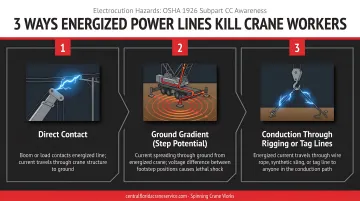
Three Ways Energized Lines Kill
Understanding the injury mechanisms changes how crews behave around crane operations:
- Direct electrocution: The boom, load line, or load contacts an energized line and completes a circuit through the equipment
- Step potential: Current radiates through the ground after line contact. A worker can be electrocuted without touching the crane by standing across two points with different electrical potential
- Fire or explosion: Arc flash from line contact can ignite fuel, hydraulic fluid, or nearby materials
The crane operator inside the cab is often the most protected person. OSHA requires training on the importance of remaining inside the cab after electrical contact unless there is imminent danger of fire or explosion. Ground workers face the greatest risk, especially anyone guiding a load, handling tag lines, or standing within reach of the crane's shadow.
Real Incidents That Illustrate the Pattern
Three documented case types show how quickly contact occurs:
- Arizona, 1985: A crane cable contacted a 13,800-volt line while laying concrete pipe. A worker touching the crane outrigger was killed without touching the line directly
- Telford, PA, 2003: A truck crane boom contacted a 7,200 VAC conductor during demolition. Three workers died: one while exiting the cab and two after touching the energized crane
- Maryland, 1987: A crane boom contacted a 13 kV line while a worker guided the load by hand. One worker died, and another suffered severe burns when hand contact completed the circuit
The pattern across all three: contact happened fast, ground workers bore the consequences, and secondary deaths occurred because bystanders didn't understand the step potential hazard.
Why Cranes Create a Dynamic Danger Zone
Unlike stationary equipment, a crane's hazard boundary moves constantly. The boom, load line, rigging hardware, and load all represent potential contact points.
Those contact points shift with every degree of swing and every foot of extension. On Florida job sites where distribution lines run at varying heights along streets and utility corridors, a lift that clears at the starting position may encroach at full extension.
Safety Guidelines for Cranes Near Overhead Power Lines
Safe crane operations near power lines require more than one precaution. They depend on a layered system: pre-operation planning, crew-wide understanding, operator discipline, and encroachment controls from site survey through job completion.
General Safety Precautions
Before any crane arrives on site, these baseline rules must already be understood by every person on the ground:
- Never touch the crane, load, or load line if the crane has contacted a power line. The surrounding ground may be energized
- Use non-conductive tag lines only, such as fiber rope rather than wire cable. Wire tag lines can put the load handler in direct electrical contact with energized equipment
- Post visible warning signs showing power line locations and minimum clearance distances before anyone approaches the work zone
Pre-Operation Hazard Assessment
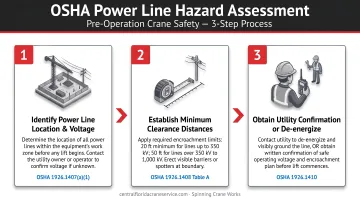
OSHA 1926.1408(a) requires a full hazard assessment before equipment arrives. This means:
- Map every overhead line within the crane's maximum working radius, including the full 360-degree sweep, not just the planned lift path
- Contact the utility to confirm voltage. OSHA requires the utility to provide this information within two working days
- Apply the 20-foot trigger rule: if the crane, load line, or load could get within 20 feet of a line rated up to 350 kV, the employer must use one of three OSHA-specified options:
- De-energize and visibly ground the line; the utility must do this, so coordinate well in advance
- Maintain a strict 20-foot buffer throughout all operations
- Determine exact voltage and apply Table A minimum clearance distances
De-energization is the safest option because it eliminates the electrical hazard. It also requires the most lead time, so address it during initial job planning, not the morning of the lift.
Under OSHA 1926.1408(b)(1), a pre-operation planning meeting is required with the crane operator and all workers in the area. This meeting must cover power line locations, clearance distances, and each person's role if encroachment occurs.
Operating Safely Near Power Lines
During a lift, safe distance is not the distance at rest. It is the furthest point any part of the boom, load line, or load could reach during the operation. That distinction matters most when the crane is mid-swing.
Key operational requirements:
- Use a dedicated spotter whenever standard visual clearance cannot be confirmed. Per OSHA 1926.1408(b)(4)(ii), the spotter must have no other task, maintain continuous communication, and stand where they can judge distance accurately
- Assume every line is energized until the utility confirms otherwise in writing. For Florida jobs near cell towers, power poles, or service drops, Spinning Crane Works treats visual cues as unreliable
- Pause for changed conditions. Fog, glare, night work, or obstructions that reduce visibility near power lines require stopping operations and reassessing before resuming
Encroachment Prevention Tools
OSHA 1926.1408(b)(4) requires at least one of the following when operating where encroachment is possible:
| Tool | What It Does | Key Limitation |
|---|---|---|
| Proximity alarm | Alerts operator before breach | Can produce false readings near multiple intersecting lines or when boom angle differs from calibration |
| Dedicated spotter | Human monitor with direct operator communication | Requires proper training and sole-task focus |
| Range control warning device | Automatically alerts operator to stop movement | Must be correctly calibrated to the specific site |
| Range-of-motion limiting device | Physically prevents the boom from entering the restricted zone | Limits operational flexibility |
| Insulating link (between load line and load) | Protects riggers from electrocution through the load | Does not protect the crane body or ground crew from step potential |
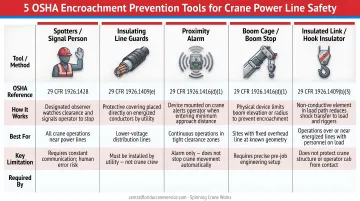
No single tool eliminates all risk. Insulating sleeves on power lines (installed only by the utility) and boom cage guards are supplemental layers. They do not replace minimum clearance requirements.
OSHA Clearance Requirements: Understanding Table A
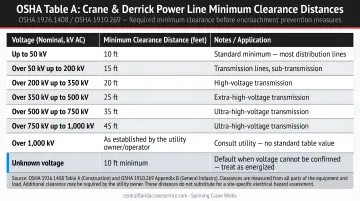
OSHA's Table A, found in 29 CFR 1926.1408, sets minimum clearance distances based on voltage. These distances apply to every component in motion : the boom tip, load line, rigging hardware, and the load itself.
| Nominal Voltage (kV, AC) | Minimum Clearance Distance |
|---|---|
| Up to 50 kV | 10 feet |
| Over 50 to 200 kV | 15 feet |
| Over 200 to 350 kV | 20 feet |
| Over 350 to 500 kV | 25 feet |
| Over 500 to 750 kV | 35 feet |
| Over 750 to 1,000 kV | 45 feet |
| Over 1,000 kV | Established by utility or registered professional engineer |
Two Thresholds That Are Not the Same
Operators and site managers need to separate two OSHA thresholds:
- The Table A minimum clearance is the distance the crane must never breach during operation
- The 20-foot trigger is the distance at which the employer must take protective action in the first place , even if the actual Table A clearance for that line is only 10 feet
If your crane could get within 20 feet of any line rated up to 350 kV at any point in its working radius, OSHA requires action before the lift begins. For example, a 13.8 kV distribution line may have a 10-foot Table A clearance, but the 20-foot trigger still starts the planning requirement.
When Voltage Is Unknown
OSHA requires the utility to provide voltage information within two working days of a request. If that information is unavailable for any reason, do not assume the lowest voltage category. Without confirmed voltage, treat the line as the highest applicable voltage category and plan the lift around that clearance.
What to Do If a Crane Contacts a Power Line
Contact with an energized line is an emergency. The next 60 seconds determine whether one fatality becomes three.
If you are the operator:
- Stay in the cab. The cab provides protection as long as you are not at the same time touching the crane structure and the ground
- Attempt to move the equipment away from the line if it is safe to do so
- Exit only if there is immediate danger of fire or explosion. If you must leave, jump clear with both feet together; do not step off.
- Once clear, shuffle or hop away in very small steps to avoid creating a circuit through your legs
If you are on the ground:
- Move away immediately. Do not touch the crane, the load, the load line, or the rigging
- Do not approach to help anyone near the crane
- Treat the ground around the contact point as energized. Step potential can electrocute you if your feet bridge two points with different electrical voltage
- Call 911 and contact the utility immediately
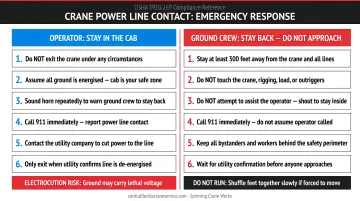
Before anyone approaches the crane: The utility must confirm the line has been de-energized and visibly grounded at the worksite. Do not rely on visual inspection of the line or assume a tripped breaker makes the area safe.
Common Safety Mistakes to Avoid
Most crane electrocution incidents trace back to three preventable failures:
- Assuming the line is insulated or inactive. Overhead distribution lines often look weatherproofed, but they are not insulated for contact. That assumption shows up in industry fatality data, where electrocutions account for 25% of crane-related deaths. Treat every line as live until the utility confirms otherwise.
- Checking clearance only from the crane's resting position. Calculate the hazard zone at maximum swing, maximum extension, and the highest boom angle. Encroachment often happens mid-lift because the crew measured only from the starting point.
- Treating the pre-operation planning meeting as a formality. OSHA's crane power line safety standard requires crews to identify the work zone and review power line hazards before operating near lines. Use that meeting to confirm the operator, spotter, and ground crew share the same boundary and emergency protocol before conditions change.
Conclusion
Crane safety near overhead power lines depends on layered controls. Distance requirements, hazard assessments, encroachment tools, trained crews, and emergency protocols have to work together. Remove one layer, and the others carry more risk than they were designed to absorb.
For crane work near energized infrastructure in Central or South Florida, experienced operators matter as much as the equipment. Spinning Crane Works regularly performs cell tower erections and power pole installations where proximity to live lines is part of the job, not an unusual scenario. That field experience, backed by disciplined pre-operation planning and real-time operator awareness, is what separates a completed lift from an incident report.
Frequently Asked Questions
What is the minimum clearance between a crane and any power line?
Under OSHA 1926.1408 Table A, keep at least 10 feet from lines up to 50 kV and up to 45 feet from 750–1,000 kV lines. For lines over 1,000 kV or unknown voltage, confirm the required distance with the utility or a registered engineer.
Is it safe to operate a crane near power lines?
Yes, if the lift plan controls the hazard before work starts. Use OSHA clearance distances, a site hazard assessment, encroachment prevention, and trained operators; never improvise around energized lines.
What should you do if a crane makes contact with a power line?
The operator should stay in the cab unless fire or explosion forces evacuation. Ground personnel must move away without touching the crane, load, or rigging, then call 911 and the utility. Do not approach until the utility confirms the line is de-energized and visibly grounded.
Who is responsible for de-energizing power lines before crane operations?
Only the utility owner/operator can de-energize a power line. The employer must request it in advance and wait for confirmation that the line is de-energized and visibly grounded at the worksite. Build in lead time; some shutdowns take days or weeks to schedule.
Do all overhead power lines require the same clearance distance?
No. Required clearance depends on verified voltage, with OSHA Table A ranging from 10 feet to 45 feet for standard categories. Confirm voltage with the utility before the crane or load could encroach on the line.
What training is required for crane operators working near power lines?
OSHA 1926.1408(g) requires training on clearance distances, emergency response, step potential, evacuation technique, equipment limits, and treating lines as energized unless the utility confirms otherwise. Dedicated spotters also need role-specific training before the lift.