Introduction
Getting an HVAC unit onto a commercial roof is far more involved than selecting the right equipment. Where the unit sits, how it gets there, and whether the structure beneath it can handle the load — these decisions determine whether that system runs reliably for 15 to 20 years or creates problems from day one.
Multiple disciplines have to align before any equipment moves: structural engineers assess roof capacity, HVAC contractors design duct and electrical routing, crane and rigging operators plan the lift, and local building officials review the permit package.
Leave any of these stakeholders out of early planning and the consequences follow quickly: structural deflection, code violations, drainage failures, and costly repositioning lifts.
This guide walks through every major decision in commercial HVAC unit placement: site assessment, code requirements, crane execution, system integration, and the most common mistakes that force contractors back to the roof with a crane a second time.
Key Takeaways
- Structural roof assessment must happen before equipment is ordered — not after
- Clearances are governed by ASHRAE 62.1, manufacturer IOMs, and local codes — check all three before finalizing equipment selection
- Every crane lift requires a formal lift plan: load weight, swing path, and power line clearance at minimum
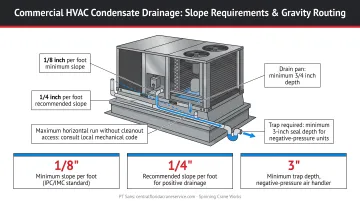
- Condensate lines must slope at least 1/8 inch per foot — code minimum under the 2024 IMC
- Post-placement inspection and functional testing must be completed before commissioning begins
Planning Commercial HVAC Unit Placement: Site Assessment and Prerequisites
Placement planning must begin before equipment is ordered. The unit's weight, footprint, and service clearances have to be confirmed against the roof's actual capacity and layout — in that sequence. Reversing the order is one of the most common and costly mistakes in commercial HVAC projects.
Structural Roof Assessment
A licensed structural engineer must review the roof's decking, joists, and beams before any unit is specified for a location. Flat commercial roofs are not uniformly rated, and load paths vary significantly across a single building.
Under 2024 IBC Section 1606.3, fixed service equipment weight — including maximum contents — must be included in dead load calculations. Section 1607.12.2 adds a 20% impact factor for light motor-driven machinery and 50% for reciprocating or power-driven units. These aren't optional adjustments; they're code requirements that affect whether existing structural members can carry the load.
Key structural review items:
- Operating weight of the unit (not just shipping weight) plus curb, refrigerant, and accessories
- Dynamic load impact factors per IBC Section 1607.12.2
- Complete load path from curb through decking, joists, and beams to bearing points
- Wind uplift and anchorage requirements under ASCE/SEI 7-22 load combinations
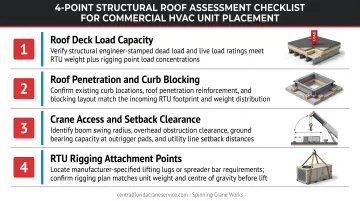
No universal weight threshold triggers mandatory reinforcement. Capacity is project-specific, which is exactly why the engineer review can't be skipped or substituted with generic roof ratings.
Clearance and Code Requirements
Clearance requirements come from three sources that must all be satisfied simultaneously:
- Manufacturer installation manuals — model-specific service clearances on all sides
- ASHRAE 62.1-2022 Section 5.4.1 — minimum outdoor air intake separation from exhaust outlets (10 ft for Class 2 exhaust, 15 ft for Class 3, 30 ft for Class 4 per Table 5-1)
- Local building codes and AHJ requirements — which may exceed ASHRAE minimums
In Florida specifically, 2023 FBC Mechanical Section 301.15 requires all wind-exposed mechanical equipment and supports to resist wind pressures calculated under FBC Building Chapter 16. This affects both where units can be anchored and how curb attachments are engineered.
Jurisdictions across Florida may also require wind design pressures and risk category documentation in the permit package. Gainesville, for example, specifies 130 mph Vult for Risk Category II structures.
Drainage and Condensate Planning
Once siting satisfies structural and clearance requirements, condensate management becomes the next placement constraint. The unit location must allow condensate lines to gravity-drain to approved discharge points without pooling on the roof membrane.
The 2024 IMC requires condensate piping to slope at least 1/8 unit vertical in 12 units horizontal (equivalent to 1%) as a minimum. The NRCA adds that condensate should never discharge onto the roof surface and must be piped to drains or scuppers. Mechanical units should not be positioned in roof valleys or drainage areas, and curbs 24 inches or wider should have upslope crickets to prevent water accumulation behind the unit.
Ductwork and Electrical Access Routing
Before finalizing placement coordinates, evaluate:
- Duct routing path to occupied zones below — shorter, more direct runs reduce pressure drop and leakage risk
- Electrical service routing from the main panel or rooftop disconnect to the unit location
- NEC working space requirements at the unit's disconnect (verify against NEC 440.14 and NEC 110.26 with a licensed electrician)
SMACNA's HVAC Air Duct Leakage Manual provides the standards-based method for setting allowable leakage targets for each duct section connected to the RTU. Use that method, not rule-of-thumb estimates, to evaluate whether the proposed routing is practical.
How to Place a Commercial HVAC Unit on a Roof: Step-by-Step
Placement follows a defined sequence: structural prep, crane mobilization, unit setting, then system integration. Each phase depends on the previous one. Skip or rush any step and you're troubleshooting expensive problems six stories up.
Preparing the Roof: Curb and Vibration Isolation Installation
The rooftop curb must be installed and leveled before the unit arrives on site. Per NRCA guidelines:
- Curbs must be firmly anchored to a properly supported roof deck — not set on or fastened through roof insulation
- Curb height should be detailed to 8 inches above the finished roof membrane for proper flashing clearance
- Factory curbs for larger units (25-50 ton class) are typically 14 inches high per Johnson Controls specifications
- Roof flashing must never be attached directly to the rooftop unit itself
Curb dimensions must match the unit's base exactly. Field-fabricated curbs or mismatched curbs are a documented source of air leakage, condensation problems, and roof membrane damage.
Vibration isolation — either pads or spring isolators — is placed on or within the curb before the unit is set. Johnson Controls cautions against providing vibration isolation both on the internal fan skid and the external curb without engineering analysis, since double-isolation can introduce resonance issues rather than solve them.
Crane Mobilization and Lift Planning
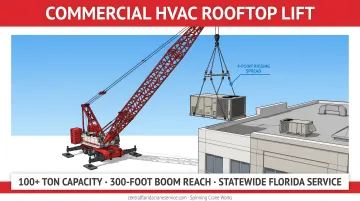
The crane must be sized for the unit's operating weight plus rigging hardware. The lift radius — the horizontal distance from crane position to placement point — determines the required boom configuration. A documented lift plan must specify:
- Unit weight and corner weights from the equipment submittal
- Rigging method and pick points per manufacturer specifications
- Crane position relative to the building and overhead obstructions
- Swing path from ground-level staging to the rooftop curb location
- Power line clearance controls under OSHA 29 CFR 1926.1408, which requires maintaining at least 20 feet of clearance from lines up to 350 kV unless the line is deenergized and grounded
OSHA 29 CFR Part 1926 Subpart CC governs all construction crane operations and requires operator certification, qualified riggers, and documented ground condition assessment before any lift proceeds.
Commercial RTU weights vary significantly by tonnage class: from a few hundred pounds for a 3-ton unit to several tons for a 50-ton packaged system. Crane sizing must come from the actual equipment submittal's operating weight, not catalog estimates. For Florida commercial RTU replacements, a 100+ ton crane with 300-foot boom reach typically covers the full range from small packaged units through mid-size chillers, without the cost of a 200+ ton heavy-lift mobilization.
Setting the Unit on the Curb
The crane operator rigs the unit using manufacturer-specified lifting lugs, raises it to roof level, and holds position while ground crew and roof crew guide alignment over the curb. Before rigging is released:
- All four corners must make full contact with the curb
- Unit alignment to duct openings must be confirmed
- The curb-to-unit base gap must meet manufacturer tolerances (Carrier 48TC series, for example, specifies 1/4 inch clearance between curb and base rail inside the curb)
Releasing rigging before alignment is confirmed is a leading cause of curb damage, air leaks, and misalignment that requires a second crane lift to correct.
Integrating the Unit: Electrical, Ductwork, Controls, and Drainage
Post-setting integration involves four parallel workstreams:
- Electrical: Line voltage power at the unit's disconnect; low-voltage control wiring to thermostat or BAS termination points
- Ductwork: Supply and return connections at the unit's discharge and return openings, fully sealed with mastic or approved tape — unsealed curb-level duct joints are among the highest-loss points in a commercial HVAC system
- Condensate: Drain lines connected and flow-tested before the system starts
- Controls: BAS or thermostat wiring run and terminated per the controls contractor's drawings
Duct connections at the curb interface require close inspection before sign-off. A DOE/NREL study on small commercial RTU faults identified duct leakage as a top fault category with major energy impact, and curb-level joints are where the worst leakage typically originates.
Common HVAC Unit Placement Problems and How to Fix Them
Most placement problems surface during or immediately after installation — and catching them at that stage costs far more than addressing them in planning.
Insufficient Roof Structural Capacity
Problem: The roof shows deflection under load, or the structural engineer flags inadequate capacity after the unit has been specified or ordered.
Cause: Structural assessment was skipped or performed using general roof ratings rather than actual load path calculations at the specific placement point.
Fix: Engage a structural engineer to assess reinforcement options — sistering joists, adding steel spreader beams to distribute load across multiple structural members. In some cases, the unit must be relocated to a structurally stronger zone, which may require rescheduling the crane.
Inadequate Clearances Causing Code Violations
Problem: The installed unit fails inspection because it's too close to a parapet, an adjacent unit, or a fresh air intake.
Cause: Clearance requirements weren't verified against the actual submitted equipment drawings, or a last-minute unit substitution changed the footprint without a clearance recheck.
Fix: A second crane lift is required to reposition the unit. Prevent it by verifying clearances against the actual equipment submittal dimensions (not catalog cut sheets) before the lift date.
Condensate Drainage Failure
Problem: Water pools at the unit base or backs up through the drain pan after commissioning.
Cause: The condensate line was routed without sufficient slope, or the drain point elevation is above the unit's drain outlet.
Fix: Reroute the condensate line to an approved drain point. Two requirements drive this:
- Minimum 1/8 inch per foot slope maintained throughout the run
- If gravity drainage isn't achievable from the placement location, add a condensate pump — identify this during placement planning, not after the unit is set
Pro Tips for Effective Commercial HVAC Unit Placement
1. Plan Crane Access During Design
Lock down the crane staging area, swing path, and ground conditions before mobilization — not the week of installation. Conflicts with site fencing, adjacent tenant parking, or overhead utilities discovered at the last minute trigger crane remobilization fees that far outweigh the cost of early coordination.
2. Specify Corrosion-Resistant Curb Materials
In Florida's warm, humid climate — particularly in coastal markets like Miami, Fort Lauderdale, and the Space Coast — standard galvanized hardware degrades quickly under constant UV exposure and condensation cycling. Specify UV-resistant curb materials and stainless or coated fasteners from the start. Rooftop curbs in salt-air environments face accelerated corrosion rates and may sit exposed for 20+ years.
3. Document As-Built Conditions After Every Installation
Capture unit coordinates, curb heights, drain routing, and electrical routing with as-built drawings and photographs. This documentation:
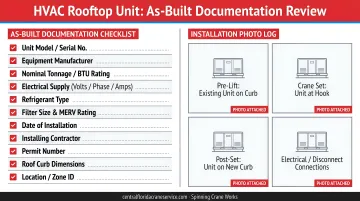
- Cuts troubleshooting time during future maintenance calls
- Satisfies warranty claim requirements from most manufacturers
- Gives the next crane crew exact curb dimensions and roof constraints — shaving hours off a future changeout
Conclusion
Commercial HVAC unit placement is a multi-discipline coordination task where structural adequacy, code compliance, crane execution, and system integration must all succeed together. A failure in any one area — an undersized structural member, a clearance violation, a condensate line routed without sufficient slope — creates problems that compound over the system's service life and cost significantly more to correct than to prevent.
Building owners and HVAC contractors who invest in thorough pre-placement planning, qualified crane and rigging partners, and documented post-placement validation will see that investment returned many times over across a 15-to-20-year equipment lifecycle. That starts with choosing a crane and rigging partner — like Spinning Crane Works — who arrives with a pre-lift site survey, a documented rigging plan, and the equipment capacity to place your RTU or chiller correctly the first time. Getting the lift right on day one is the lowest-cost decision you'll make on the whole project.
Frequently Asked Questions
What is the rule of thumb for commercial HVAC sizing?
A commonly cited estimate is 1 ton of cooling per 350–400 square feet of commercial space, but this figure shouldn't drive equipment selection. Accurate commercial sizing requires a full load calculation per ACCA Manual N, accounting for occupancy density, glazing, internal equipment loads, and local climate — not just square footage.
What is the $5,000 rule for HVAC?
The $5,000 rule is a rough replacement guideline: multiply the system's age (in years) by the estimated repair cost, and if the result exceeds $5,000, replacement is generally more cost-effective than repair. It's a quick screening tool, not an engineering standard, and shouldn't substitute for a proper equipment assessment.
Which type of HVAC system is best suited for large commercial spaces?
For large commercial buildings, rooftop units (RTUs), chiller systems, and VRF/VRV systems are the most common configurations. The best choice depends on building size, zoning complexity, energy goals, and budget — and typically requires an HVAC engineer's analysis rather than a general recommendation.
Do commercial HVAC units have to be on the roof?
No. Rooftop placement dominates commercial buildings because it preserves indoor space and simplifies duct routing, but units can also be ground-mounted or installed in dedicated mechanical rooms. Building design, local zoning, and site constraints all influence which configuration is practical for a given project.
What are the minimum clearance requirements for commercial rooftop HVAC units?
Clearance requirements are set by the manufacturer's installation manual, ASHRAE 62.1 for intake/exhaust separation, and local building codes. Service-side clearances typically range from 18 inches to 4 feet depending on the unit and AHJ — always verify against the specific unit's submittal documents and confirm with your local authority having jurisdiction before finalizing placement.
How much does it cost to crane a commercial HVAC unit onto a roof?
Crane costs for commercial HVAC placement vary based on unit weight, lift height, site access, and regional labor rates — no reliable flat rate exists because every job is different. Get multiple quotes from licensed crane and rigging contractors early; discovering crane cost late in the project creates budget problems. Florida HVAC contractors typically coordinate directly with their crane provider to get a site-specific number before scheduling the lift.