Introduction
Picture this: a crew arrives to replace a pad-mounted transformer at a Florida substation. The crane is on-site, the outage window is open, and the line contractor is ready. Then someone checks the load chart. At the required working radius, the crane tops out well below the transformer's actual weight. The window closes. The outage gets extended. The utility pays for the delay.
That scenario plays out more often than it should — almost always because someone selected a crane based on its headline capacity rather than actual job conditions.
Utility crane selection is more complex than general construction lifting. You're dealing with proximity to energized infrastructure, load weights that range from a few hundred pounds for a recloser to 20,000+ lbs for a large transformer, access constraints across Florida's varied terrain, and federal regulatory requirements that govern both the equipment and the operator.
Get it wrong, and the consequences go beyond schedule delays: regulatory violations, voided equipment ratings, and serious safety incidents.
This guide walks through crane types used in utility work, the critical selection factors unique to power and telecom environments, and how to match the right crane to your specific job conditions across Florida.
Key Takeaways
- Always evaluate lifting capacity at the actual working radius — a 10,000 lb rating drops significantly at full extension.
- Hydraulic telescopic cranes handle the widest range of utility lifts; articulating cranes suit confined or obstructed sites.
- OSHA 1926.1408 mandates a 10-foot minimum clearance from energized lines up to 50kV.
- Florida-specific ground conditions (sand, muck, saturated soils) affect crane stabilization as much as the load chart does.
- Renting from a licensed provider with utility experience typically beats ownership for project-based or infrequent lifts.
What Is a Service Crane?
A service crane is a truck-mounted lifting system designed to hoist, position, and place heavy loads at a jobsite. Unlike a full-scale mobile crane, it integrates directly with a service vehicle — crane and truck operate as one unit.
That integration is what makes it practical for utility work: rapid deployment, on-site versatility, and none of the setup complexity that comes with mobilizing a dedicated crane.
Types of Service Cranes Used in Utility Operations
Three crane configurations dominate utility work, and each suits a different application profile:
Electric/Electric-Hydraulic Telescopic Cranes: Best for light-duty, intermittent lifting — typically 4,000 to 6,000 lbs capacity with outreach around 16 to 21 feet. Palfinger's PSC 3216 and Stellar's 5521 EH are representative examples. Suited for non-energized equipment installation where lift frequency is low.
Hydraulic Telescopic Cranes: The workhorse of utility crane work, covering roughly 7,500 to 14,000 lbs with reaches up to 30 feet. Palfinger's PSC 8029 (8,000 lbs, 29.3 ft outreach) falls in this class. Transformer placement, switchgear sets, and utility pole equipment typically land here.
Articulating (Knuckleboom) Cranes: Fold at a joint rather than extending in a straight line, giving them better maneuverability in confined corridors or around existing infrastructure. When the crane must reach around obstacles rather than lift straight up, articulating configurations outperform telescopic options. IMT notes that lifts exceeding 14,000 lbs may require an articulating crane. ASME B30.5 treats these as a distinct category, not interchangeable with telescopic service cranes.
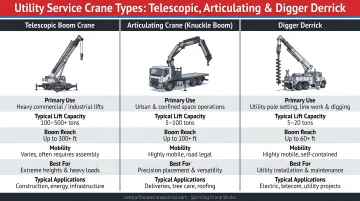
Digger Derricks (for reference): Combine an auger with a boom and are widely used by power companies for pole setting. They're a specialized utility category, distinct from general service cranes, and not covered in depth here.
Why Utility Companies Rely on Service Cranes
The core value is operational efficiency:
- Eliminates the need to transport heavy equipment off-site for repair or staged installation
- Reduces the crew size needed to execute precision lifts safely
- Enables exact placement of transformers, switchgear, and telecom shelters without improvised rigging
- Compresses job completion time within tight outage windows
For utility and power companies operating across Florida, from urban substations in Miami to distribution infrastructure along the Space Coast, fast crane deployment across distributed sites directly cuts outage duration and cost.
Key Factors When Selecting a Service Crane for Utility Work
Utility crane selection introduces variables that don't exist in standard construction lifting: proximity to energized conductors, irregular site access, load types spanning hundreds to tens of thousands of pounds, and strict federal oversight. The following factors connect crane specifications to measurable job outcomes.
Lifting Capacity and Load Chart Requirements
The single most common selection mistake: choosing a crane based on its maximum rated capacity rather than its capacity at the actual working radius.
A crane rated at 10,000 lbs at minimum reach might lift far less at full extension. Stellar's 5521 EH illustrates this clearly — it's rated at 5,000 lbs at 5 ft 10 in, but only 1,400 lbs at its full 21-foot reach. That gap matters enormously when you're placing equipment at distance.
Utility load weights vary widely. Verified Eaton data shows:
| Equipment Type | Example Weight |
|---|---|
| 45 kVA pad-mount transformer | 2,100 lbs |
| 500 kVA pad-mount transformer | 4,650 lbs |
| 1,000 kVA pad-mount transformer | 8,200 lbs |
| 2,500 kVA pad-mount transformer | 14,500 lbs |
| Eaton VacClad-W switchgear assembly | 3,550–3,850 lbs |
| Vertiv XTE telecom walk-in shelter | 4,875–8,870 lbs |
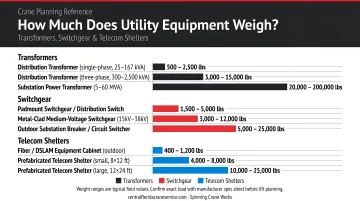
Always calculate the load weight — including rigging hardware — against the load chart at the actual working radius and boom angle before committing to a crane. OSHA 1926.1417 requires load charts to be available in the cab and prohibits operating above rated capacity.
Boom Length and Working Radius
Boom length determines how far the crane can reach horizontally and vertically — critical when placing equipment on elevated platforms, setting pole-mounted hardware, or clearing existing structures without repositioning the truck.
Most utility-relevant service cranes fall in the 10 to 35-foot boom range, with common models clustered around 16, 21, 25, 29, and 30 feet. Florida utility jobsites frequently present access challenges: easements, existing infrastructure overhead, and right-of-way restrictions that limit where the truck can legally stage.
The crane must achieve the required reach from a position that is both legally permissible and practically stable. Confirm boom length requirements against the site plan before mobilizing — not after.
Electrical Safety and Power Line Proximity
Electrical proximity is where crane selection decisions carry the most direct safety consequences.
OSHA 1926.1408 establishes minimum clearance distances for crane operations near energized lines:
- 10 feet for lines up to 50kV
- 15 feet for lines over 50kV to 200kV
- 20 feet for lines over 200kV to 350kV
OSHA also requires that lines be treated as energized unless the utility owner confirms deenergization and visible grounding is in place. The crane must complete its full lift cycle — including boom travel and load swing — without violating these clearances at any point.
One important clarification: insulated boom options are more commonly associated with aerial devices and digger derricks than with telescopic service cranes. Don't assume a service crane has electrical isolation features unless the specific manufacturer and configuration document it.
The primary protection on most utility service crane lifts is operational: maintaining clearance distances through strict positioning, qualified spotters, and coordination with the utility on outage windows and minimum approach distances (MAD).
Any team operating near energized infrastructure should work exclusively with crane operators who have documented experience in electrical proximity safety, not just general crane operation hours.
Site Access and Truck Body Compatibility
The crane is mounted to a service truck, and the combined vehicle must access the site, comply with road weight limits, and provide a stable outrigger platform for the lift.
Florida's utility sites span a wide spectrum:
- Urban substations with minimal maneuvering room
- Coastal sites with saturated or sandy soils
- Rural distribution corridors accessible only via unpaved easements
- Bridge crossings with strict load limits
Florida's varied soils — including sand, muck, fibrous peat, and clay-sand formations — directly affect outrigger stability. A crane that looks adequate on a load chart may be inappropriate for a site where the ground cannot support the outrigger load. OSHA 1926.1402 places responsibility on the controlling entity to verify ground conditions before operations begin.
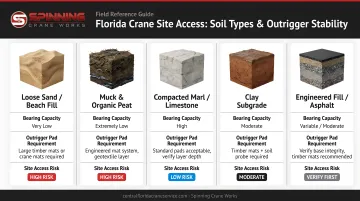
Before mobilizing, operators and fleet managers should confirm:
- Vehicle gross weight versus posted road/bridge limits (FLHSMV overweight fines run $0.05 per pound over legal weight without a permit)
- Outrigger footprint requirements versus available surface area
- Soil conditions and whether cribbing or matting is needed
- FDOT right-of-way or FPL transmission easement restrictions at the staging position
Control Systems and Safety Features
Modern service cranes for utility applications should include safety systems that alert operators before the crane exceeds safe working limits — especially when load visibility is limited or work is happening near energized infrastructure.
OSHA 1926.1416 requires equipment manufactured after March 29, 2003, with rated capacity over 6,000 lbs, to have at least one of the following: a load weighing device, load moment indicator (LMI), rated capacity indicator, or load moment limiter.
Features worth evaluating during crane selection:
- Load moment indicator (LMI) or overload protection — alerts operator before rated capacity is exceeded at the current radius
- Anti-two-block system — prevents hook-to-boom contact during operations
- Wireless radio remote control — allows the operator to maintain safe distance from the load and energized infrastructure
- Emergency stop functions — immediate shutdown capability
- Outrigger and stabilizer design — appropriate for the site surface type and load requirements
Palfinger's MEXT system and Stellar's CDTpro remote with Range Finder technology are examples of integrated safety and load-visibility systems available on hydraulic service cranes. On utility sites, these systems are baseline operational requirements.
Regulatory Compliance and Operator Certification
Crane operations in utility environments fall under OSHA 29 CFR 1926 Subpart CC, which requires crane operators to be certified by an accredited organization. NCCCO's Service Truck Crane (STC) certification is the primary path for service crane operators — it requires both a written exam and a practical hands-on exam, and is recognized by federal OSHA.
NCCCO defines the STC category as covering telescopic boom cranes with 10 to 35-foot booms and 1 to 7-ton capacities. For utility work involving energized line proximity, additional training in electrical safety and minimum approach distance compliance goes beyond the baseline certification requirement.
Compliance extends beyond the crane itself:
- Rigging equipment (slings, chains, wire rope) must meet ASME B30.9 standards
- Hooks and shackles are governed by separate applicable ASME rigging hardware standards
- Multiple-crane lifts require additional planning and oversight under OSHA 1926.1432
- Annual crane inspections are required under Subpart CC
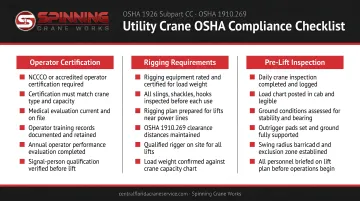
Non-compliance exposes both the operator and the employer to project shutdowns and significant liability.
Ownership vs. Rental: Matching the Decision to Your Operational Model
For utility companies or contractors executing frequent, scheduled lifts, owning a properly specified crane can offer long-term cost advantages. But ownership carries real obligations that must be factored into the total cost of operation:
- Annual inspections and ongoing maintenance
- Operator certification management and renewal
- Load chart verification and documentation
- Road permitting and vehicle compliance
For project-based utility work, emergency outage response, or lifts that exceed in-house equipment capacity, renting from a licensed crane and rigging service with utility experience is typically the more practical option. A provider like Spinning Crane Works bundles the certified operator, compliant equipment, lift planning input, and OSHA compliance into a single engagement — cutting out the overhead of managing those components separately.
That bundled model raises a straightforward financial question: at what point does ownership cost less? The break-even calculation depends on utilization frequency, crane class, and the ongoing cost of maintaining operator certifications. Get quotes from a qualified provider, map them against your actual job volume, and let the numbers drive the decision before committing to a fleet purchase.
How Spinning Crane Works Can Help
Spinning Crane Works is a Florida crane and rigging contractor headquartered in Melbourne (Brevard County / Space Coast), with hands-on experience supporting power and utility companies across the state. The team has performed distribution and transmission power pole sets, transformer placements (both pad-mount and pole-mount), switchgear sets, substation equipment lifts, and post-hurricane power restoration work for utilities including FPL, Duke Energy Florida, TECO, JEA, and OUC — coordinating directly with utility and line contractor teams on outage windows and MAD compliance under OSHA 1910.269.
Utility-adjacent crane work demands more than equipment — it requires operators who understand energized infrastructure, outage coordination, and MAD compliance before the lift ever begins.
Key capabilities for utility clients:
- 100+ ton Link-Belt boom crane with 300-foot reach — covers the vast majority of Florida utility lifts without heavy-lift mobilization costs
- Certified operators with documented field experience working around live distribution and transmission lines
- OSHA 1910.269 compliance with active coordination on outage windows and MAD requirements
- Full liability and equipment insurance on every engagement
- Pre-lift site survey and rigging plan input included on every job
- Statewide Florida coverage — Melbourne to Miami, Tampa to Jacksonville — for scheduled lifts and emergency storm response
- BBB Accredited, serving Central and South Florida's power and telecom sectors
Whether it's a planned substation equipment set or an emergency transformer replacement during hurricane restoration, every Spinning Crane Works engagement includes the crane, certified operator, rigger, compliance documentation, and pre-lift planning.
Conclusion
Selecting the right service crane for utility work is a safety-critical decision. Mismatches between equipment specifications and job conditions cause delays, regulatory violations, and serious incidents. The right crane isn't the most powerful or the most affordable — it's the one matched to the verified load weight, working radius, site geometry, proximity hazards, and compliance requirements of your specific project.
Treat crane selection as a per-project decision, not a standing assumption. Site conditions, load types, and compliance standards change — and the crane that worked on last month's transformer set may not be the right choice for next week's substation lift. Spinning Crane Works provides a pre-lift site survey and rigging plan input on every job, so the equipment, operator, and lift approach are verified before anyone gets on site — not assumed from a previous project.
Frequently Asked Questions
What is the best service truck crane for utility work?
The best crane depends on the application. Hydraulic telescopic cranes handle most medium to heavy utility lifts — transformer sets, switchgear placement, and pole equipment. Articulating cranes suit confined sites where the boom must reach around existing infrastructure.
What OSHA regulations apply to crane operation near power lines?
OSHA 1926.1408 sets minimum approach distances — 10 feet for lines up to 50kV, 15 feet for lines up to 200kV — and requires a qualified spotter when operating near energized conductors. OSHA 1910.269 applies specifically to electric power generation, transmission, and distribution work. Operators must hold NCCCO certification under Subpart CC.
What is the difference between a telescopic and articulating crane for utility applications?
Telescopic cranes extend in a straight line for vertical and horizontal reach, making them the standard choice for most utility lifts. Articulating (knuckleboom) cranes fold at a joint, providing greater maneuverability around obstacles — they perform better in congested utility corridors or on sites with overhead obstructions that prevent straight-line boom travel.
When should a utility company rent a crane instead of owning one?
Renting makes more sense for project-based or emergency lifts. A licensed operated crane provider bundles the certified operator, compliant equipment, and insurance into one engagement — cutting out the ownership costs, annual inspections, and operator certification management that come with running a fleet.
How much does a service crane for utility work cost?
Pricing varies widely based on lifting capacity, boom reach, and job scope — no universal rate applies. Get quotes directly from licensed operated crane services; for Florida utility work, Spinning Crane Works provides project-specific pricing. Operated rental typically delivers better total value for contractors without daily crane utilization needs.
What certifications should a crane operator have for utility crane work?
OSHA requires certification from an accredited body — NCCCO's Service Truck Crane (STC) credential is the primary path for service crane operators. For utility work near energized lines, additional electrical safety training, minimum approach distance compliance, and rigging qualification are required beyond the baseline STC.