Choose wrong and you're looking at a failed lift, an OSHA violation, or a damaged unit that costs more than the crane rental ever would have. This guide covers the crane types suited to rooftop HVAC work, the factors that drive the selection decision, and the safety and compliance requirements Florida contractors need to plan for before the crane ever arrives on site.
Key Takeaways
- RTU weights vary by model; always pull the exact weight from the manufacturer spec sheet, not a rough estimate
- Mobile hydraulic and telescopic boom cranes handle most commercial rooftop lifts; davit cranes fit lighter maintenance work
- Lift radius is the common miss: crane capacity drops fast as the boom reaches farther
- OSHA 1926.1408 requires 10-foot clearance from power lines up to 50kV; plan the setup around it
- Florida permit lead times vary: Tampa ROW often takes 12–15 business days; Jacksonville closures need 30 days' notice
What a Rooftop HVAC Crane Lift Actually Involves
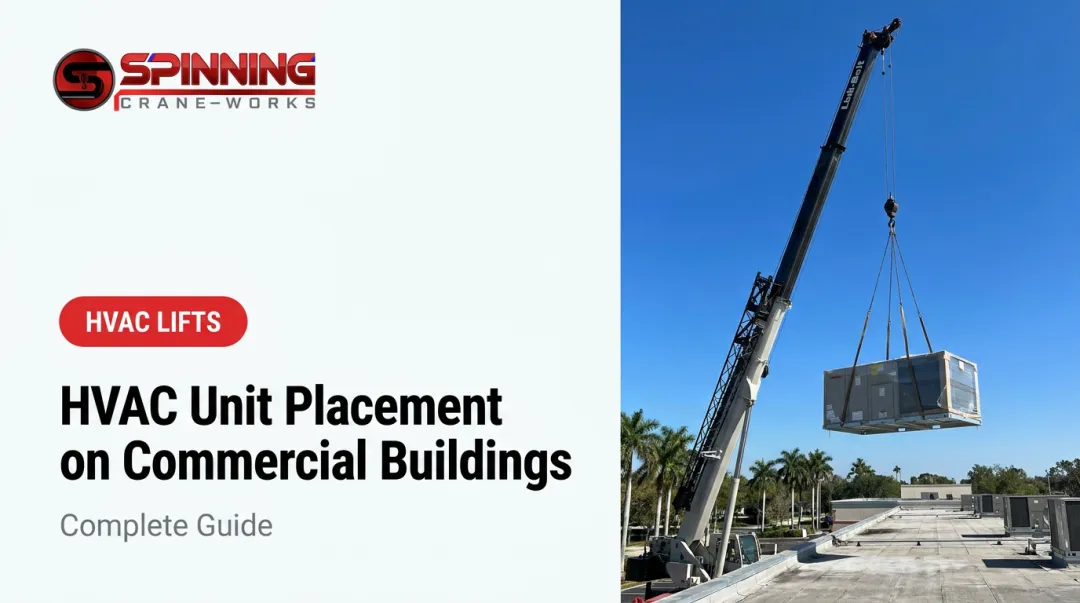
A rooftop crane lift means hoisting a rooftop unit (RTU), such as a packaged AC system, air handler, cooling tower, or similar unit, from ground level to the building roof using a crane and rigging system. The challenge starts with the weight range.
Manufacturer specifications confirm that commercial packaged units vary significantly in weight across the product line. Larger multi-story commercial installations can be especially heavy. At those weights, manual placement or forklift work isn't a realistic option on most rooftop jobs.
What makes rooftop lifts more complex than standard crane work:
- The boom must clear the building's edge and position over a specific curb or mounting pad
- The lift path is often constrained by power lines, adjacent buildings, or parked vehicles
- The crane operates within a limited footprint, so outrigger placement must fit the available ground space
- Precise final placement is required without damaging the unit or the roof membrane
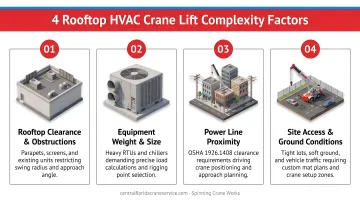
Crane lifts are used for both new RTU installations and unit changeouts. Changeouts involve removing the old unit first, which adds a second rigging cycle and may require different positioning between the two lifts.
Types of Cranes Used for Rooftop HVAC Lifts
Not every crane type suits rooftop work. Building height, load size, and site access narrow the field quickly.
Mobile Hydraulic Cranes (All-Terrain and Truck-Mounted)
These are the most widely used cranes for commercial RTU placements. Mobile hydraulic cranes offer high lift capacity, telescoping boom reach, and the ability to reposition between multiple buildings on the same day.
- All-terrain variants handle tighter urban sites where road access is limited
- Truck-mounted cranes set up faster on straightforward jobs with clean access
- Both require adequate ground space for outrigger deployment because outrigger clearance is the main site constraint to verify before selecting either type
Rough-Terrain Cranes
When the setup area is unpaved, uneven, or soft, rough-terrain cranes are often the right call. These conditions show up on active construction zones or suburban properties without paved access.
They're slower to transport between sites than truck-mounted cranes, so they make the most sense when the lift location is the challenge, not day-to-day mobility across multiple sites.
Telescopic Boom Cranes
Telescopic boom cranes extend to precise heights and radii, giving operators fine placement control. That's critical when an RTU needs to land on a specific curb or mounting pad with limited maneuvering room.
One important point: extending the boom increases reach but reduces safe lifting capacity. Crews confirm rated capacity at the planned radius before committing to the crane, because a unit that is safe at 60 feet may not be safe at 140 feet.
Spinning Crane Works operates boom crane equipment sized for large commercial buildings and multi-story structures across Central and South Florida.
Load chart verification is required before any boom crane lift. The crane must be sized at the beginning of planning, not adjusted on the day of the job.
Davit and Rooftop Cranes
Davit cranes are compact, roof-mounted or parapet-mounted systems suited for maintenance work, such as replacing fan motors, filters, condensers, and small components. Their capacity is limited and intended for light maintenance tasks.
That ceiling matters: a full commercial RTU can easily exceed what a davit crane is rated to handle, especially once rigging hardware is added. Davit cranes work for light maintenance lifts, not full RTU installations on commercial buildings.
Key Factors in Crane Selection for Rooftop HVAC Lifts
Picking the right crane means connecting specific lift requirements to verified crane capabilities. Miss one factor and the crane either can't complete the job or isn't legal to operate in those conditions.
Load Weight and Rated Capacity
This is where every selection starts. The crane's rated capacity at the working radius must exceed the total lifted load, which includes:
- RTU weight (from the manufacturer submittal, not an estimate)
- Spreader bar and rigging hardware
- Hook block deduction
- Any curb or accessory sections lifted with the unit
OSHA 1926.1417 is clear: equipment must not be operated above rated capacity. Exceeding it is not a paperwork issue; it is a safety-critical threshold and a common cause of tip-overs.
Lift Height and Boom Length
Required boom length equals the building height plus enough additional reach to clear the parapet and lower the unit into position. Buildings with tall parapet walls need more overhead clearance than the roof elevation alone suggests.
Boom length selection ties directly to capacity. A longer boom at full extension carries less rated load, which is why crane sizing must happen during early planning, not after the crane has mobilized.
Lift Radius
Lift radius is the horizontal distance from the crane's center of rotation to the center of the load. It is consistently the most underestimated variable in HVAC crane planning.
Here's why it matters: a crane's capacity can drop dramatically as the operating radius increases — an 86% or greater capacity reduction is possible, driven entirely by where the crane is positioned relative to the building.
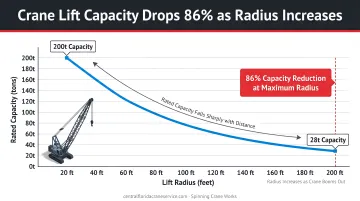
When the crane can't set up directly adjacent to the building because of landscaping, traffic lanes, underground utilities, or adjacent structures, the required radius increases and available capacity shrinks. All radius calculations must happen during the planning phase using the actual load chart, not on the morning of the lift.
Site Access and Ground Conditions
OSHA 1926.1402 requires ground to be firm, drained, and graded enough to support the equipment per manufacturer specifications. The same regulation requires the controlling entity to disclose any known hazards beneath the setup area, such as voids, tanks, drainage structures, and underground utilities.
Before scheduling a crane for any Florida rooftop job, confirm:
- No underground voids, septic tanks, or drainage structures beneath the outrigger setup area
- No parking decks or structural cavities under paved surfaces
- Outrigger pads are available for soft or deteriorated surfaces
- Site access for crane transport (some setups require temporary road closures in urban areas)
Florida municipalities including Miami, Tampa, and Jacksonville require permits for road closures and right-of-way impacts. Tampa ROW permits take approximately 12–15 business days; Jacksonville street closure requests need to be submitted at least 30 days in advance. Build this lead time into the project schedule.
Proximity to Power Lines
OSHA 1926.1408 Table A sets minimum approach distances that apply to the boom, load line, and the load itself throughout the entire lift — not just at the closest point:
| Voltage | Minimum Clearance |
|---|---|
| Up to 50 kV | 10 ft |
| Over 50–200 kV | 15 ft |
| Over 200–350 kV | 20 ft |
| Over 350–500 kV | 25 ft |
If the lift path cannot maintain these distances, the utility must be contacted to de-energize and visibly ground the lines before the lift proceeds. That coordination requires advance scheduling — it cannot be sorted out on the day of the lift.
Industry safety research on crane-related construction deaths found that overhead power-line electrocution caused 157 of 632 fatalities between 1992 and 2006. For Florida rooftop HVAC lifts, choose a crane provider with documented power-line planning experience. Spinning Crane Works supports these lifts across Central and South Florida, where lines often run directly beside commercial buildings.
FAA Part 77 notification may also be required for cranes operating near airports. Submit it at least 45 days before the planned start date.
Safety and Compliance Requirements
Every commercial rooftop HVAC lift in Florida must meet non-negotiable crane safety requirements. These apply regardless of lift size or duration.
Key compliance checkpoints include:
- Operator certification: OSHA 1926.1427 requires operators on cranes over 2,000 lb rated capacity to hold an accredited certification and receive employer evaluation. Certifications are portable and valid for five years.
- Competent person inspections: A competent person must visually inspect the crane, rigging, and ground conditions before each shift.
- Signalperson qualifications: Signalpersons must pass written and practical tests, know standard hand signals, and keep qualification documentation on site. One designated signalperson should direct the operator during the lift.
- Rigging standards: ASME B30.9 covers slings; ASME B30.26 covers detachable hardware such as shackles, links, and swivels. A competent person must inspect rigging before each shift.
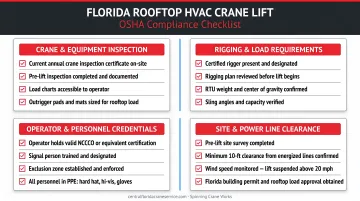
Custom lifting accessories must be proof-tested to 125% of rated load before first use.
Large RTUs typically require spreader bars to distribute load evenly across the unit's lift points. Without one, sling angles concentrate force and can damage the rigging, curb, or unit cabinet before it ever reaches the roof.
How Spinning Crane Works Can Help
Spinning Crane Works is a professional crane and rigging company serving Central and South Florida, including Melbourne, Miami, Fort Lauderdale, Tampa, Saint Petersburg, Jacksonville, and Saint Augustine. The company is BBB Accredited and operates 24/7 to accommodate both scheduled installations and emergency RTU changeouts.
Its boom crane is sized for the job, with lift capability depending on load weight, radius, setup, and site conditions. That range covers many commercial rooftop HVAC lifts, from mid-size packaged units on retail buildings to large industrial systems on multi-story structures.
What sets Spinning Crane Works apart for HVAC contractors:
- Trained operators with demonstrated experience on commercial lift projects
- Extensive experience working around energized power lines, which matters on Florida's congested urban job sites
- Full-service approach from rigging to final placement, so HVAC contractors don't need to coordinate rigging logistics separately
- Local Florida knowledge across the Central and South Florida markets they serve daily
For HVAC contractors managing multiple changeout schedules or facility managers planning a new RTU installation, call Spinning Crane Works at 321-759-2263 to discuss your project parameters early before permits, ground assessments, and crane availability become scheduling constraints.
Conclusion
Choosing the right crane for a rooftop HVAC lift starts with a disciplined pre-lift checklist:
- Verify the RTU weight, curb adapter, spreader bars, slings, and shackles
- Measure the lift radius from the actual crane setup point, not a site-plan estimate
- Confirm boom length needed to clear parapets, setbacks, and rooftop obstructions
- Check ground conditions at each outrigger position before mobilization
- Map power line clearances across the full swing path
Permits and utility coordination should be in motion weeks before crane arrival, not the week of.
As Florida's commercial building stock ages and RTU changeout cycles accelerate, contractors and facility managers need crane planning that removes guesswork early. Working with a qualified crane and rigging contractor such as Spinning Crane Works helps identify radius, access, rigging, and clearance issues before they become field delays.
Frequently Asked Questions
How do I select a crane for lifting?
Start with the total load weight, including the RTU and rigging hardware, then confirm lift height and horizontal radius. Match those numbers to the crane’s load chart, and check site access, ground conditions, and nearby power lines before choosing equipment.
What size crane do I need for a rooftop HVAC unit?
Crane size depends on the RTU’s manufacturer-listed weight, the building height, and the lift radius from setup point to placement point. Share those numbers with your crane provider so capacity can be checked against the load chart before the job is scheduled.
Do I need permits to operate a crane for HVAC installation in Florida?
Often, yes. Florida cities may require permits for road closures, sidewalk use, or right-of-way impacts; Tampa ROW permits can take 12–15 business days, while Jacksonville street closures require 30 days’ notice. Projects near airports may also need FAA Part 77 notification at least 45 working days ahead.
How close can a crane boom get to power lines during an HVAC lift?
OSHA 1926.1408 requires at least 10 feet of clearance from lines rated up to 50kV, with more distance for higher voltages. If the lift path cannot maintain clearance, the utility must de-energize and visibly ground the lines before work begins.
What is the difference between a mobile crane and a boom crane for rooftop HVAC work?
Mobile cranes are built for flexible setup and repositioning, while telescopic boom cranes provide controlled height and reach for rooftop placement. Many modern cranes combine both advantages, so the right fit depends on building height, working radius, and site access.
Should I hire a crane company or rent a crane for my rooftop HVAC project?
For most HVAC contractors, hiring a full-service crane company is the safer and simpler choice. The provider handles the certified operator, lift planning, rigging support, and site assessment; bare rental leaves those responsibilities with the contractor.