Costs heading into 2026 are being pushed upward by diesel prices — U.S. average on-highway diesel hit $5.35/gallon as of June 2026 — combined with tighter labor markets for certified riggers and crane operators, and increasingly complex permitting requirements for oversized loads.
This guide breaks down realistic 2026 rate ranges by job size, explains the variables that drive costs up or down, and covers what a complete quote should include — so you can budget accurately and avoid the line items that catch most buyers off guard.
Key Takeaways
- Small local hauls may cost hundreds; oversized moves with permits, escorts, or cranes can reach $10,000–$20,000+
- Rigging labor is billed per rigger per hour; crane operator fees and crane rental are typically separate line items
- Per-mile rates drop with distance — short hauls cost proportionally more per mile than long-distance moves
- Cheap bids can backfire if insurance, OSHA compliance, or equipment capacity are unverified
Heavy Equipment Moving & Rigging Rates in 2026
Heavy Equipment Moving & Rigging Rates in 2026
No single published rate card covers this industry. Every project quote reflects a unique combination of equipment weight, distance, service scope, site conditions, and regulatory requirements. That uncertainty is frustrating because buyers need a clean number early, but it reflects how heavy-lift pricing works.
What gets buyers into trouble is assuming the base rate is the final cost. In practice:
- Underbudgeting happens when extra fees such as permits, fuel surcharges, and escort vehicles aren't included in the initial estimate
- Service mismatches occur when buyers hire a hauler when rigging is needed (or vice versa), creating gaps in liability coverage
- Permit delays push project start dates when lead times aren't factored into the timeline
Typical Cost Ranges by Job Size
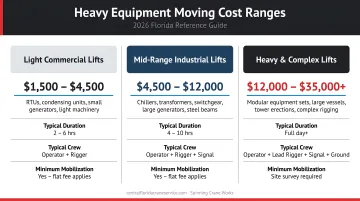
The ranges below reflect 2026 market conditions in the continental U.S., drawing on public labor benchmarks, FEMA equipment rate schedules, and carrier cost data.
| Job Tier | Typical Range | What's Usually Included |
|---|---|---|
| Entry-level: under 5 tons, local haul under 100 miles, no crane rigging | $300–$1,500 | Standard flatbed transport, basic load securing, driver labor |
| Mid-range: 5–50 tons, 100–500 miles, basic rigging required | $1,500–$8,000 | Lowboy or RGN trailer, rigging labor at origin/destination, standard permits |
| High-end/complex: 50+ tons, oversized loads, crane rigging, long-distance or urban routes | $8,000–$25,000+ | Engineered lift plan, certified crane operators, escort vehicles, full permit management |
Florida-specific note: projects in South Florida metro markets, especially Miami-Dade, Broward, and urban Tampa corridors, often push toward the upper end of each range.
Florida Administrative Code restricts oversized loads over 85 feet from moving through congested areas during peak traffic hours. That can mean night moves, extra coordination, and added cost for HVAC rooftop placements, utility work, or other heavy lifts in dense corridors.
Hourly Rigging Rates
Rigger labor and crane operator fees are separate line items that buyers often combine by mistake.
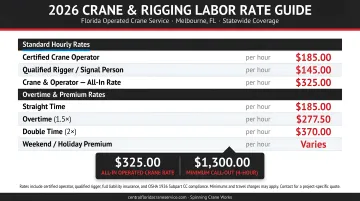
Use employee wage data as a baseline, not a contractor rate. The BLS May 2023 rigger wage data and BLS crane and tower operator wage data show:
- Riggers (SOC 49-9096): National median hourly wage of $27.03, with the 75th percentile at $36.22 and top earners reaching $46.67/hour
- Florida riggers average $24.66/hour at the employee wage level
- Crane and tower operators (SOC 53-7021): National median of $31.10/hour; Florida mean at $30.73/hour, rising to $32.67/hour in the Miami–Fort Lauderdale–West Palm Beach metro area
These are employee wage benchmarks, not contractor bill rates. Rigging firms typically bill 1.5–2.5× the employee wage to cover overhead, insurance, and profit margin.
In contractor pricing, $45–$80+ per hour per rigger is common before crane rental, permits, or escort costs.
For crane rental, FEMA's 2025 equipment rate schedule lists published hourly rates for crawler lattice-boom cranes (equipment only, operator billed separately). Specialty or high-reach cranes command higher rates.
Key Factors That Drive Moving & Rigging Costs Up or Down
Key Factors That Drive Moving & Rigging Costs Up or Down
Pricing is shaped by technical, logistical, and site-specific variables. Understanding each one lets you estimate more accurately before the quote arrives.
Equipment Size, Weight, and Configuration
Gross weight and physical dimensions determine which trailer type is required:
- Standard flatbed: Light equipment under 48,000 lb
- Lowboy trailer: Heavy machinery; deck heights of 18–30 inches for large industrial loads
- RGN (removable gooseneck): Equipment too tall for standard lowboy loading, or machinery requiring drive-on access
Equipment that can't be disassembled requires more complex rigging plans and additional labor hours. A monolithic piece of industrial machinery at 40 tons takes longer to rig safely than the same weight in modular components.
Distance and Route Complexity
Per-mile rates usually decrease as distance increases. A 50-mile local haul may run $4–$5/mile, while a 500-mile interstate move can drop closer to $1–$2/mile. Distance still does not tell the whole story.
Route complexity can override the distance economy entirely:
- Narrow county roads or bridge weight restrictions may require detours adding miles and time
- Urban corridors in Miami or downtown Tampa often require night moves under Florida Administrative Code restrictions
- Routes through congested areas trigger additional permits, traffic control costs, and sometimes law enforcement escorts
Type of Service Required
There are three distinct service tiers, each priced differently:
- Hauling only: over-the-road transport, billed by distance and load size
- Rigging only: lifting, positioning, and securing at a fixed location, billed hourly
- Turnkey service: dismantling, rigging at origin, transport, rigging at destination, and reinstallation; typically the highest cost but lowest coordination overhead
Permits, Escorts, and Regulatory Requirements
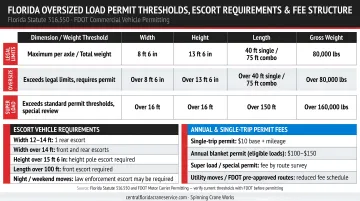
In Florida, loads exceeding legal size or weight limits require permits from the state transportation authority. Key thresholds and costs include:
- Permits required when width exceeds 102 inches, height exceeds 13 ft 6 in., or legal weight limits are exceeded
- Florida Administrative Code fee examples: $5–$25 for dimension trip permits depending on load size; overweight permits calculated by weight and mileage formulas, ranging from $0.27/mile (up to 95,000 lb) to $0.47/mile (up to 162,000 lb) for trip permits
- Escort requirements: Width over 12 ft or length over 95 ft requires at least one qualified escort; width over 14 ft requires two; extreme dimensions may require law enforcement
- Standard permits generally restrict movement to daytime hours, prohibiting weekend and holiday travel unless specifically authorized
Timing and Urgency
Last-minute or after-hours requests carry premium surcharges at most providers. Emergency moves, especially equipment failures that halt production, can run 25–50% above standard rates. For businesses in time-sensitive industries, planning moves as far in advance as possible is the most straightforward way to avoid urgency premiums.
Spinning Crane Works operates 24/7 across Central and South Florida. Before scheduling an urgent lift or move, ask how after-hours, emergency, and mobilization charges are calculated.
Full Cost Breakdown: What's Typically Included in the Quote
The base rate is rarely the total cost. A complete quote should itemize each component, so you can confirm which charges are fixed, hourly, or pass-through.
| Line Item | Billing Type | Notes |
|---|---|---|
| Base transport or rigging fee | One-time per job | Core service charge covering labor hours, standard equipment, and the primary lift or haul |
| Mobilization fee | Per project | Getting crane/equipment and crew to the job site; may be a flat fee or distance-based |
| Fuel surcharge | Per project | ATRI reports trucking fuel costs at about $0.48/mile in 2024; diesel price swings can change the final surcharge |
| Permits and route surveys | Per project | Florida permit fees vary by load dimensions and mileage; factor these in before scheduling |
| Escort/pilot vehicle fees | Per project | Required when width exceeds 12 ft or length exceeds 95 ft in Florida |
| Rigging labor and crane operator fees | Hourly | Typically billed separately from transport; multiple riggers may be required |
| Reinstallation, leveling, and alignment | Hourly or flat | Often an add-on; full-service rigging providers may include it; basic haulers often do not |
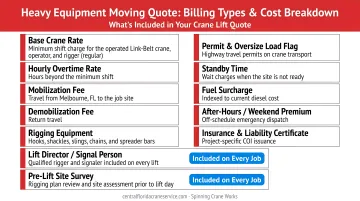
Before approving the job, confirm whether these charges are included or billed separately:
- Permits, route surveys, and escort vehicles
- Mobilization, fuel surcharge, and standby time
- Reinstallation, leveling, alignment, or after-hours crane time
Rigging vs. Equipment Hauling: How the Rates Differ
These two services are easy to mix up, and that mistake can mean overpaying for work you do not need or underbudgeting for work you do.
Equipment hauling refers to over-the-road transport of machinery between locations using specialized trailers (flatbed, lowboy, RGN). Billing is primarily distance-based, with load size determining trailer type and permit requirements.
Rigging refers to lifting, securing, and precisely positioning equipment using cranes, gantries, or hydraulic systems. Billing is primarily hourly, with complexity (lift height, load configuration, site access) driving total cost.
When You Need One vs. Both
- A factory press being relocated across town may need crane rigging at origin and destination but only minimal road transport
- A bulldozer being shipped from Tampa to a job site in Orlando may need flatbed hauling but no crane rigging at either end
- An industrial chiller for a downtown Miami rooftop may need crane placement after manufacturer delivery, with no separate hauling required
Knowing which service applies directly affects your budget. Crane and rigging specialists serving Central and South Florida, such as Spinning Crane Works in Melbourne, handle the lifting and positioning side with cranes of all sizes to complete your lifts safely.
For projects requiring both transport and rigging, ask upfront whether one provider can bundle the work or whether you need a separate hauler. Bundled service typically reduces coordination overhead and simplifies billing.
How to Budget Smart & Avoid Common Mistakes
How to Budget Smart & Avoid Common Mistakes
The biggest budget problems in heavy equipment moving usually come from missed costs, not the headline hauling rate.
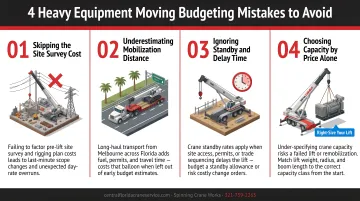
Most Common Mistakes
- Choosing the lowest quote without verification: Federal motor carrier regulations require at least $750,000 in liability coverage for many carriers hauling loads over 10,001 lb GVWR. Verify coverage before signing.
- Assuming experience equals qualification: OSHA rigging guidance notes that prior experience does not automatically qualify a rigger for unstable, eccentric, or multiple-lift jobs. Confirm the crew is qualified for your specific load.
- Ignoring permit lead times: Some states require significant advance notice for route restrictions. Florida's automated permitting system handles routine loads quickly, but complex routes still require planning time
- Missing reinstallation costs: Hauling a machine to a new facility is only half the job. Post-move alignment, leveling, and reconnection are often quoted separately and catch buyers off guard if not requested upfront
Practical Budgeting Guidance
- Request fully itemized quotes — labor, permits, escorts, fuel surcharges, and reinstallation as separate line items
- Add permit timelines to your schedule — especially for oversized loads through South Florida metro corridors
- Ask about volume pricing if you have recurring moves — HVAC contractors, utility companies, and telecom installers with regular crane needs often qualify for contract pricing
- Book in advance to avoid urgency surcharges, particularly for night moves in urban corridors
For projects in Central and South Florida, working with a local crane and rigging specialist reduces mobilization costs compared to bringing in out-of-state equipment. Spinning Crane Works serves Melbourne, Miami, Tampa, Fort Lauderdale, Jacksonville, and nearby areas with 24/7 availability, giving project teams one local contact for crane service and rigging coordination.
Frequently Asked Questions
How much does it cost to move heavy equipment?
Small local hauls under 5 tons may cost about $300–$1,500. Complex oversized jobs with crane rigging, permits, and escort vehicles often run $8,000–$25,000+, depending on weight, distance, route, and site access.
What does heavy equipment rigging cost per hour?
For 2026 budgeting, rigger labor often runs $45–$80+ per hour per rigger at contractor bill rates. Operated crane time, lift planning, and mobilization are usually billed separately.
How much does it cost per mile to haul heavy equipment?
Short hauls under 200 miles typically run $4–$5 per mile; longer interstate hauls can drop to $1–$2 per mile. Oversized loads requiring special trailers, permits, or escort vehicles push rates higher regardless of distance.
Do you need permits to move heavy equipment in Florida?
Yes. Florida requires permits for loads over legal size or weight limits, including width over 102 inches, height over 13 ft 6 in., or excess axle weight. A qualified heavy haul or rigging provider can usually handle the permit process.
What is the difference between rigging and heavy equipment hauling?
Hauling refers to over-the-road transport between locations using specialized trailers. Rigging refers to lifting, securing, and precisely positioning equipment using cranes or other lifting systems. Many projects require both, though some jobs need only one service.
How do I get the most accurate quote for a heavy equipment move?
Provide exact dimensions, gross weight, pickup and drop-off addresses, site access limits, and your timeline. Ask for itemized pricing by permits, escort fees, labor, mobilization, and reinstallation, then confirm insurance coverage.