
Introduction
Lifting a heavy commercial HVAC chiller onto a high-rise rooftop in downtown Miami is not the same problem as setting a long-span structural steel beam in Tampa. Both jobs need the right crane, but the wrong choice on either one means delays, permit violations, or worse.
Commercial construction lifts routinely involve loads that standard mobile cranes cannot handle. When a job requires placing precast panels on a high-rise, erecting a cell tower, or positioning structural steel across wide spans, you are squarely in high-capacity territory. The crane that worked on last month's warehouse slab simply will not do.
For context, OSHA's cranes and derricks standard excludes only equipment rated at 2,000 pounds or less, so most commercial lifts require formal compliance planning.
This guide covers what "high-capacity" means in practice: crane types, capacity matching, OSHA requirements, and lift-plan essentials for Florida commercial sites.
Key Takeaways
- High-capacity means heavy commercial lifts where load weight, radius, and height drive crane selection.
- Crawler, tower, and all-terrain cranes handle different commercial site conditions and lift profiles.
- Load charts control safe capacity: a crane's rated capacity at short radius may drop significantly at extended radius.
- OSHA 29 CFR 1926 Subpart CC requires inspections, certified operators, and in-cab load charts.
- Complex lifts need formal lift plans so teams can model the pick before equipment arrives.
What Makes a Crane "High-Capacity"?
There is no single regulatory definition. OSHA, ASME, and industry standards bodies do not set one formal "high-capacity" threshold. For commercial construction, the practical cutoff is where project requirements, permitting complexity, and engineering oversight meaningfully increase.
Standard telescopic truck cranes cover a wide range of lift capacities. The transition into high-capacity work occurs where boom configuration, counterweights, ground bearing checks, and site preparation all become more involved.
Rated Capacity vs. Real-World Capacity
The number on a crane's spec sheet is not what it will lift on your job site. A crane's rated capacity is achievable only under specific conditions:
- Minimum radius (load directly below the boom tip at close range)
- Optimal boom configuration for the specific lift height
- Level, prepared ground meeting ground bearing requirements
- Rigging weight deducted from the rated load figure
Per industry load chart standards, the hook block, slings, spreader bars, and any auxiliary lifting devices all count against the crane's rated capacity. The load you hang is the object plus everything used to hang it.
Commercial Scenarios That Drive High-Capacity Needs
- Multi-story structural steel erection
- Rooftop mechanical equipment placement (chillers, cooling towers, large HVAC units)
- Precast concrete panel installation on mid- and high-rise buildings
- Cell tower and utility infrastructure erection
- Bridge girder placement
These jobs often combine reach and weight: setting a rooftop chiller, for example, may require lifting across a building footprint rather than straight up. For Central and South Florida contractors, that is where an operator-supplied crane service such as Spinning Crane Works belongs in the planning conversation.
Types of High-Capacity Cranes for Commercial Construction
Choosing a crane type comes down to three variables: how much the site can be prepared, how long the crane needs to stay, and what horizontal reach and height the lift demands.
Crawler Cranes
Crawler cranes travel on steel tracks that distribute weight across soft or recently disturbed ground. That makes them useful on sites where wheeled equipment would sink or destabilize.
Configured with lattice boom systems, they reach extreme heights and carry some of the highest mobile lift capacities available, making them suited for the most demanding industrial applications.
The trade-off: crawlers move slowly and require flatbed transport to new job sites. For a single-day commercial lift, that mobilization cost and time often makes them impractical.
Tower Cranes
Tower cranes are the standard solution for long-duration, high-rise commercial projects in urban environments. They offer consistent lifting capacity at height, a minimal footprint on tight sites, and 360-degree rotation. The four main configurations each solve a different problem:
| Type | Best For |
|---|---|
| Hammerhead (flat-top) | Long-duration projects, multiple lifts daily |
| Flat-top | Urban sites where multiple cranes must work in overlapping airspace |
| Luffing jib | Dense urban environments where swing radius must be minimized |
| Self-erecting | Smaller commercial projects, faster setup |
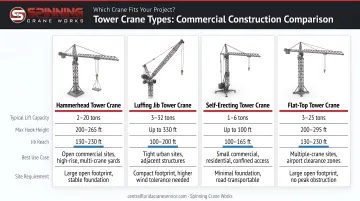
Luffing jib cranes are particularly relevant for South Florida urban sites. Miami and Fort Lauderdale construction environments frequently require a crane whose jib raises rather than sweeps horizontally, keeping it clear of adjacent buildings and restricted airspace.
All-Terrain and Hydraulic Truck Cranes
All-terrain cranes bridge the gap between slow crawlers and lighter truck cranes, spanning a wide range of lifting capacities from mid-range to very large-capacity configurations.
Both are designed to drive at highway speeds between job sites, deploy on outriggers within hours, and handle a wide range of commercial lift demands.
For Central and South Florida commercial work, including rooftop HVAC placements, cell tower erection, and power pole installation, all-terrain and hydraulic truck cranes are often the most practical choice. Spinning Crane Works operates a boom crane covering this class of commercial lifts across the region from Melbourne to Miami, Tampa, and Jacksonville.
Static vs. Mobile: The Core Decision
- Tower cranes for projects with many lifts over months at a fixed location
- All-terrain or crawler cranes for projects requiring repositioning, faster setup, or work across multiple site areas
- Many commercial projects use both: a tower crane for the structural phase, then a mobile crane for rooftop mechanical placement once the building is enclosed
How to Match Crane Capacity to Your Commercial Project
Stating only a load weight is incomplete information. Without radius and height, weight alone cannot drive crane selection.
Calculate the Gross Suspended Load First
The crane must be rated for the total suspended load: not just the object being lifted. Per industry certification standards, subtract rigging weight from the crane's rated capacity to determine the net load it can carry.
Include every item that hangs below the boom tip:
- Hook block
- Slings and shackles
- Spreader bars
- Specialty lifting hardware
On commercial lifts, that hardware can add hundreds or thousands of pounds. Get exact rigging weights before finalizing crane selection.
Understand the Radius Problem
This is where most crane selection mistakes happen. A crane's capacity at 15 feet of radius bears almost no relationship to its capacity at 60 feet of radius.
Load chart data consistently shows that a crane's safe capacity can drop dramatically as the working radius increases — the same crane may handle a much heavier load at close range than it can at extended reach. The load does not change. The horizontal distance does. Extended radius often controls crane selection more than the object's weight ever will.
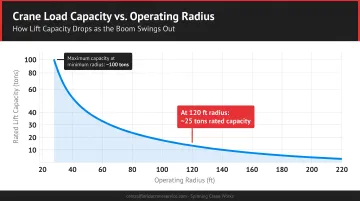
The crane's load chart is a manufacturer document that specifies rated capacity at every combination of boom length, jib configuration, and operating radius. It is a mandatory operating document. OSHA 1926.1417 requires load charts to be in the cab and prohibits operation above rated capacity.
Account for Lift Height and Boom Configuration
Boom length, jib attachments, and available hook height must exceed the required lift height plus the rigging length. Adding a jib to reach greater heights reduces available lift capacity further.
On high-rise commercial projects, height, radius, and rigging often leave you with a working capacity far below the crane's nominal rating.
Site Conditions Matter
Ground conditions can eliminate crane options entirely:
- Soft soil or recently excavated areas may require crane mats or engineered timber pads for ground pressure distribution
- Slopes or confined access routes may prevent crawler or large all-terrain deployment
- Overhead power lines (a consistent hazard across Florida's dense utility corridors) affect boom geometry, positioning, and required clearances
Urban sites in Miami, Fort Lauderdale, or Tampa often impose swing radius restrictions due to adjacent structures, active roads, and protected airspace near airports.
Match Duration to Equipment Type
A single rooftop HVAC lift often calls for an all-terrain crane that arrives, completes the pick, and breaks down the same day. That is usually the most cost-effective approach for one-time commercial lifts.
Long-duration projects work differently:
- Use a tower crane when daily structural steel or concrete work justifies the setup cost
- Choose a mobile crane when picks are intermittent or spread across multiple areas
- Confirm mobilization distance, operator requirements, and rigging needs before comparing quotes
For Central and South Florida projects, Spinning Crane Works can review capacity, radius, height, access, and rigging before quoting crane service. Published rate averages are not capacity-specific and vary by location, operator fees, and mobilization distance.
Safety Standards and Compliance for High-Capacity Crane Lifts
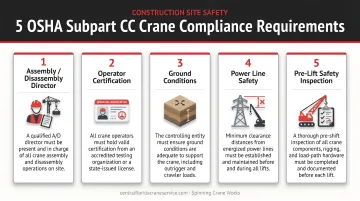
Florida is not an OSHA-approved State Plan state, meaning all commercial construction crane operations fall under federal OSHA jurisdiction , specifically 29 CFR 1926 Subpart CC, Cranes and Derricks in Construction. Non-compliance can lead to stop-work orders and OSHA penalties.
Core OSHA Requirements
- Pre-operation inspection: A competent person must visually inspect the equipment before each shift (1926.1412)
- Load charts in the cab: Rated capacities, operating procedures, and operator manual must be readily available (1926.1417)
- Operator certification: Operators must be trained, certified or licensed, and evaluated. An accredited certification satisfies this requirement and is portable for 5 years (1926.1427)
- Signal person: Required whenever the operator cannot fully view the point of operation or travel path (1926.1419)
- Qualified rigger: Must meet OSHA's qualified-person criteria for rigging during assembly, disassembly, and certain lift operations (1926.1404)
Power Line Clearances
Power lines are among the most critical hazards on Florida commercial sites. OSHA Table A minimum clearances require:
- 10 feet for lines up to 50 kV
- 15 feet for lines 50–200 kV
- 20 feet for lines 200–350 kV
These clearances apply to the entire crane (boom tip, load line, and load) at all positions during the lift. Spinning Crane Works regularly supports cell tower and power pole lifts in Florida, where utility-clearance planning should be addressed before the crane arrives onsite.
Critical Lift Threshold
Under OSHA's steel erection definitions (1926.751), a lift is classified as critical when it exceeds 75% of the crane's rated capacity or requires multiple cranes working together. Critical lifts require additional engineering oversight and documented lift plans.
Operator and Rigger Credentials to Verify
When hiring a crane service for commercial work, confirm:
- Crane operator certification for the specific crane type being operated
- Rigger and signal person qualifications on file at the worksite
- Current proof of liability insurance
- Load charts available for the specific crane and configuration
Planning a Successful High-Capacity Crane Lift
Every high-capacity commercial lift should start with a formal lift plan. This document identifies the crane make and model, load chart reference, gross suspended load, rigging configuration, ground bearing calculations, and site layout.
It should also show the crane position, swing arc, and known hazards. The SC&RA's crane safety management framework calls for reviewing site obstructions, underground facilities, load dimensions, center of gravity, radius, boom length, and contingency planning.
For lifts exceeding 75% of rated capacity, many contractors treat the pick as a critical lift and require a licensed engineer to review the plan. ASME P30.1 formalizes the distinction between Standard Lift Plans and Critical Lift Plans, with the latter requiring more rigorous engineering analysis.
3D Lift Planning Tools
3D lift simulation software allows project teams to model the lift before the crane arrives on site. The simulation can check clearances, show the load path, and estimate ground pressure. Running it in advance catches problems that are expensive to discover in the field.
Site Preparation Checklist
Before mobilizing a high-capacity crane to any commercial site:
- Install crane mats or pads to distribute outrigger or crawler pressure across the required bearing area
- Verify access road ratings for crane transport vehicles; oversized loads may require Florida Department of Highway Safety transport permits
- Survey and mark power lines , then de-energize them or assign spotters per OSHA clearance requirements
- Check FAA notification requirements under 14 CFR 77.9; structures exceeding applicable height thresholds or located near airports may require FAA Form 7460-1 notice
- Obtain local permits for building department approvals, right-of-way use, and lane closures, which vary by Florida jurisdiction
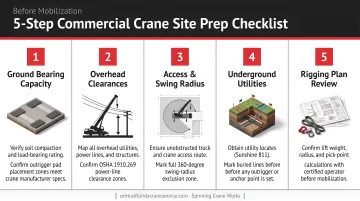
Spinning Crane Works coordinates lift planning and site logistics for commercial clients throughout Central and South Florida, including crane selection, rigging, access planning, permitting coordination, and day-of-lift support.
Day-of-Lift Execution
On the lift day, the plan turns into field controls:
- Final equipment inspection by a competent person
- Wind speed check against the crane's rated operational limits for that crane and boom configuration
- Full crew briefing covering communication protocol between operator, rigger, and signal person
- Confirmation that the load's actual weight matches the lift plan
- Verification of swing radius exclusion zones before the first pick
Frequently Asked Questions
What size high-capacity crane do I need for a heavy commercial construction lift?
Crane selection starts with the load weight, the working radius, and the required lift height — not weight alone. Share all three with your provider so they can verify the exact load chart for your lift.
How much does a high-capacity crane cost to rent?
High-capacity crane rates vary widely and are rarely standardized. Ask for an operated crane-service quote that separates mobilization, operator time, rigging, mats, permits, and standby charges.
What is the 3-3-3 rule for cranes?
The 3-3-3 rule is a field reminder used in some safety training, not an OSHA, ASME, or recognized industry standard. Use it only as a prompt; your formal lift plan and OSHA Subpart CC requirements control the job.
What is the difference between a high-capacity crane and a standard construction crane?
Standard mobile cranes often handle smaller commercial lifts with lighter capacity requirements. High-capacity cranes require larger counterweights, higher-rated rigging, more site prep, and tighter engineering review.
Do I need a permit to use a high-capacity crane at a commercial construction site in Florida?
Yes. Most Florida commercial sites need local approval for crane work, and cranes elevated above certain thresholds near airports may trigger FAA Form 7460-1 notice. Oversized crane transport also requires Florida oversize/overweight permits.
What should I look for when hiring a crane service for a commercial high-capacity lift?
Look for certified operators and riggers, project-specific load charts, current insurance, and a written lift plan. For rooftop HVAC units or multi-story placements, choose a provider with high-capacity commercial lift experience in similar site conditions.