Introduction
According to BLS data, crane-related work killed 297 workers between 2011 and 2017 — an average of 42 per year. Overhead power-line electrocutions account for 25% of all crane-related construction fatalities, making utility-adjacent crane work the most dangerous category in the field.
Transformer crane lifts concentrate every one of these hazards into a single operation. The load can weigh anywhere from a few tons to over a hundred. Internal components — windings, insulation, core assemblies — are fragile enough to be destroyed by shock or improper rigging.
The surrounding environment is often partially energized, and site constraints frequently limit where a crane can actually set up.
A transformer lift is a precision operation where a single skipped step can mean equipment destruction, electrocution, or a grid outage affecting thousands of customers. This guide covers what safe transformer crane lifting actually requires — from pre-lift planning through execution — and where crews most often get it wrong.
Key Takeaways
- Obtain certified transformer weight (including oil fill) and center of gravity before selecting any crane or rigging
- Apply sling de-rating factors for hitch angle — a 10-ton vertical rating drops to ~5 tons in a choker hitch
- Verify ground bearing capacity for outrigger loads before mobilizing; saturated or unknown soils can fail within rated limits
- Maintain OSHA-required electrical clearances on crane boom, load line, rigging, and transformer body throughout the full arc of travel
- Conduct a trial lift 6–12 inches off the ground and hold before proceeding to full lift height
Safety Guidelines for Crane Lifting Transformers
Transformer lifts combine three distinct risk categories simultaneously: mechanical (crane capacity, rigging, ground stability), electrical (energized infrastructure clearance), and operational (personnel coordination, load control). Managing any one of them without the others does not produce a safe lift.
The critical point most teams underestimate: pre-lift preparation carries more weight than operator skill. Even the most experienced crane operator cannot compensate for wrong rigging selection, unverified ground conditions, or a missing abort plan. Every transformer lift — no matter how routine it looks — requires a formal lift plan, a pre-task safety briefing, and defined abort criteria before the crane moves.
General Safety Precautions
PPE requirements for transformer lifts:
- Hard hats, high-visibility vests, cut-resistant gloves, and steel-toed boots for all personnel in the lift zone
- Insulated gloves and arc-flash-rated PPE for any crew working near energized equipment during the lift
- No unauthorized personnel, vehicles, or obstructions within the crane's swing radius or beneath the suspended load at any time
Communication structure matters as much as equipment. A dedicated signal person and a lift director (both in visual or radio contact with the crane operator) must be assigned before work begins. All movement commands route through the signal person. Simultaneous direction from multiple people is an immediate stop condition.
Spinning Crane Works includes a qualified signal person and rigger on every transformer lift, with operators who have hands-on experience working around live distribution and transmission lines throughout Florida.
Pre-Lift Planning and Load Assessment
Start with the transformer's exact weight — not an assumption.
Oil-filled transformers are significantly heavier than dry-type units, and the difference is not trivial. Eaton's pad-mounted fluid-filled transformer data shows weights ranging from 2,100 lbs for a 45 kVA unit to 46,900 lbs for a 7,500 kVA unit. A transformer listed at 50,000 lbs dry may be substantially heavier in operating condition. Always obtain certified manufacturer weight documentation because nameplate ratings are not sufficient for crane selection.
Never skip lifting lug verification. Factory-designated lugs or pad eyes are engineered for specific load paths. Lifting from any non-engineered point risks deforming the tank or damaging internal windings. If lugs are missing, corroded, or damaged, stop and consult the manufacturer before the lift proceeds.
Formal lift plan requirements under OSHA:
- OSHA 29 CFR 1926.1432 requires a qualified-person lift plan for any multiple-crane lift, reviewed with all involved workers before operations begin
- OSHA 29 CFR 1926.1417 requires load weight verification when the load exceeds 75% of maximum rated capacity at the longest radius
- ASME P30.1-2024 establishes Standard Lift Plan and Critical Lift Plan categories for load handling activities ; consult the current standard for applicable thresholds
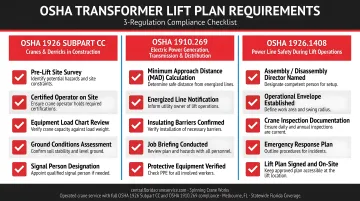
Ground bearing pressure determines whether the lift can proceed at all. Large mobile cranes generate outrigger reactions exceeding 100,000 lbs per jack point. Link-Belt HTC-8675 II technical data lists main jack reactions at 106,000 lbf at 218 psi. Sandy soils, compacted fill, and substation floors must all be evaluated against the crane-specific outrigger load case — not a generalized estimate. If the ground is marginal, steel mats, cribbing, or engineered outrigger pads are required before mobilization.
Also confirm overhead and lateral clearances: the crane boom must rotate without contacting structures, bus bars, cable runs, or live electrical infrastructure anywhere along the full lift path.
Rigging and Equipment Selection
Sling type selection depends on the transformer housing.
Wire rope slings offer high capacity and durability. Synthetic slings are required when the transformer housing has painted surfaces, protruding fittings, or components vulnerable to abrasion. Either way, the Working Load Limit (WLL) must account for the actual hitch angle — not just gross weight.
OSHA sling guidance shows how dramatically hitch angle reduces effective capacity:
| Configuration | Capacity Factor |
|---|---|
| Vertical single-leg | 1.00 |
| Basket hitch at 60° from horizontal | 1.73 |
| Basket hitch at 45° from horizontal | 1.41 |
| Basket hitch at 30° from horizontal | 1.00 |
| Choker at 90–120° choke angle | 87% of rated choker capacity |
| Choker at 30–59° choke angle | 62% of rated choker capacity |
A sling rated for 10 tons in a straight pull may only carry 6.2 tons in a tight choker hitch. Failure to apply these de-rating factors is one of the most common and preventable rigging errors on heavy lifts.
Spreader beams are frequently required. When a transformer has multiple lifting lugs spaced widely apart, a spreader beam distributes load evenly and eliminates inward compression forces on the tank. Rigging from widely spaced lugs without a spreader introduces side-loading forces that can deform the structure and damage internal components.
Pre-lift hardware inspection checklist:
- Visually inspect shackles, hooks, swivels, and master links for cracks, deformation, and corrosion
- Confirm capacity markings are legible and match the load case
- Remove any component with illegible, removed, or non-matching load ratings from service immediately
- Confirm the crane's load chart (at the actual working radius) shows capacity exceeding the total suspended load (transformer plus all rigging hardware)
Crane capacity degrades sharply with radius. A Link-Belt HTC-8675 II shows 124,900 lbs capacity at 10 ft radius, dropping to 30,600 lbs at 30 ft radius on the same boom configuration. Transformer weight alone does not determine crane selection — site layout and working radius do.
Safety During the Active Lift
Execute a trial lift before proceeding to full height. Raise the transformer 6–12 inches off the ground, hold, and check for:
- Load tilt indicating center-of-gravity error
- Rigging shifting or settling under load
- Ground settling or outrigger movement
If any of these conditions appear, lower immediately and re-rig. Do not proceed.
Control lift speed deliberately. Transformer windings, insulation, and core assemblies are sensitive to mechanical shock. Sudden starts, sudden stops, and load swing all create dynamic forces that can exceed the crane's rated static load. Anti-sway practices (tag lines deployed by trained personnel, controlled swing technique) must be active throughout the lift.
Communication protocol during active lifts:
- All movement commands come from a single designated signal person only
- Standardized hand signals or radio — not shouted verbal directions
- Any second person issuing direction to the operator = immediate stop condition
- Tag line handlers must maintain safe positions relative to the load and any energized infrastructure overhead
Environmental and Electrical Safety Considerations
Electrical Clearance Requirements
The applicable regulatory framework depends on who is doing the work and where. Two separate OSHA standards govern crane operations near energized lines:
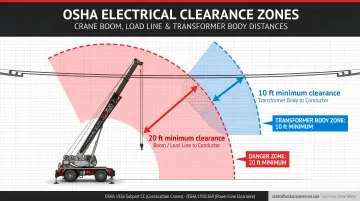
- OSHA 1926.1408 / 1926.1409 (Construction): Requires 20 ft minimum clearance for lines up to 350 kV and 50 ft for lines over 350 kV — applies to construction crane operations near power lines
- OSHA 29 CFR 1910.269 (Utility Work): Uses voltage-specific minimum approach distances (MAD) — for example, 1.13 m (~3.7 ft) phase-to-ground for 72.6–121 kV lines — applies to utility operations and maintenance work
These clearances apply to the crane boom, load line, rigging hardware, and the transformer body — not just the hook. The full arc of travel must be mapped against every energized element in the work zone before the lift begins.
Spinning Crane Works coordinates directly with utilities, line contractors, and power companies on outage windows, MAD requirements, and OSHA 1910.269 compliance for transformer lifts near energized infrastructure.
Florida-Specific Environmental Factors
Florida's climate creates specific hazards that are not present in most crane operation guidelines written for northern or arid climates:
- Afternoon thunderstorms develop rapidly, particularly May through September — a lift started in clear morning conditions can encounter dangerous wind within hours
- Ground saturation after rain events can destabilize sandy soils and compacted fill that appeared adequate before the weather event — ground conditions must be re-verified after any rain before a scheduled transformer lift proceeds
- Offshore wind events can develop with minimal warning along coastal Florida sites
Wind limits are crane-specific and load-specific, not universal. Establish a site-specific abort threshold based on the crane manufacturer's load chart data and the transformer's wind surface area. Large transformers present significant sail area that adds substantial lateral load to the crane structure — a factor load charts alone won't account for without site-specific wind calculations.
Common Safety Mistakes to Avoid When Crane Lifting Transformers
1. Skipping or Shortcutting the Lift Plan
Teams that rely on experience and a verbal briefing have no documented record of ground conditions, rigging selections, clearances, or abort criteria. That gap has consequences.
An OSHA-documented transformer lift fatality involved a 17,500 lb transformer core that tipped during crane movement when a chain sling hook became entangled — the crane operator was killed. Documented plans create accountability and catch the gaps that verbal planning misses.
2. Assuming the Listed Weight Is the Actual Weight
Assuming the listed weight is the actual weight. A transformer listed at 50,000 lbs dry may weigh significantly more when oil-filled. Confirm the exact condition and weight with the owner or manufacturer before finalizing crane selection and rigging. No exceptions.
3. Applying Sling WLL Without Hitch De-Rating
Applying sling WLL without hitch de-rating. This is the most common preventable rigging error on transformer lifts. A sling rated at 10 tons vertically may carry as little as 50–70% less in a choker or angled basket configuration. Apply the appropriate de-rating factor from OSHA's sling guidance tables before committing to any rigging setup.
4. Ignoring Dynamic Load Effects
Stopping a heavy transformer suddenly, allowing load swing, or traveling on uneven ground with a suspended load can create momentary forces well above the crane's static load rating.
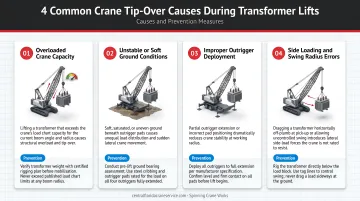
OSHA-documented fatal tip-over cases include incidents caused by ground failure, overloading, wind gusts to 27 mph, and load shift during multi-crane lifts. These are predictable consequences of dynamic loading — consequences that pre-lift planning exists to prevent.
Conclusion
Safe transformer crane lifting is not primarily a function of crane capacity. It is a function of plan quality. The right crane at the wrong radius, on unverified ground, with rigging de-rated improperly, near energized infrastructure with no abort criteria, fails just the same as underpowered equipment.
Every transformer lift demands a formal lift plan, verified ground conditions, properly de-rated rigging, confirmed electrical clearances, controlled execution, and a team that understands all three risk categories simultaneously.
Project managers and site engineers across Florida — whether for scheduled utility infrastructure work or post-storm power restoration — can contact Spinning Crane Works at 321-759-2263 for transformer lifting support statewide.
The company provides:
- 100+ ton Link-Belt boom crane with 300-foot reach
- Certified operators with documented experience around energized utility infrastructure
- Emergency response capability for post-storm transformer restoration across Central, South, North, and West Florida
Frequently Asked Questions
What type of crane is typically used to lift a power transformer?
Mobile all-terrain or truck-mounted cranes are most common for transformer lifts. Crane selection depends on the transformer's certified weight, required lift radius, site access constraints, and ground bearing capacity — not simply the transformer's kVA rating or nominal tonnage.
How do you determine the correct rigging for a transformer lift?
Rigging must be based on the manufacturer-specified lift points, total weight including oil fill, and the actual sling angle at the hook. Spreader beams are frequently required to distribute load evenly across multiple lugs and prevent inward compression forces on the transformer tank.
Can you crane-lift a transformer that is filled with oil?
Yes, but the total operating weight must be confirmed from manufacturer documentation — not assumed from the nameplate rating. The tank must be verified as sealed and intact, and handling must be controlled to prevent shock damage to internal components.
What is the minimum electrical clearance required when lifting near power lines?
For construction operations, OSHA requires at least 20 ft from lines up to 350 kV (29 CFR 1926.1408) and 50 ft from lines over 350 kV (29 CFR 1926.1409). For utility work, OSHA 1910.269 applies voltage-specific MAD values — and in both cases, clearances apply to the crane boom, load line, rigging, and transformer body, not just the hook.
What causes crane tip-overs during transformer lifts?
The most common causes are exceeding the crane's rated capacity at the actual working radius, inadequate outrigger support on soft or saturated ground, and dynamic loading from sudden stops or load swing. Ground failure under a single outrigger — even within manufacturer load limits — has caused fatal tip-overs.
Do transformer crane lifts require a formal lift plan?
OSHA 29 CFR 1926.1432 requires a qualified-person plan for any multiple-crane lift. OSHA 1926.1417 triggers documented weight verification when the load exceeds 75% of rated capacity at the longest radius. Best practice is a formal documented plan on every transformer lift, regardless of whether a specific regulatory threshold applies.