
This guide breaks down how crane service pricing actually works in Florida construction: what drives costs up or down, what belongs in every budget line, and how to avoid the mistakes that turn a manageable crane budget into a project-delaying overrun.
Key Takeaways
- Crane service costs vary widely — crane type, capacity, site conditions, and project duration all affect the final number
- Mobilization, operator labor, and permits can match or exceed the base equipment rate on complex jobs
- Standby time during weather delays is billable and frequently overlooked
- Itemized quotes — not lump-sum estimates — are the only reliable budgeting foundation
- Build in a 10–15% contingency buffer — especially critical during Florida's hurricane season
How Much Do Crane Services Cost?
There is no single "standard rate" for crane services. Pricing depends on crane class, lifting capacity, project duration, site access, crew requirements, and additional cost components that rarely appear in initial quotes.
That gap between the advertised rate and the real project cost is where most budget problems start:
- Underbudgeting forces costly change orders mid-project
- Selecting the wrong crane type triggers expensive re-mobilizations
- Overlooking permit and mobilization costs creates overruns before the first lift happens
Typical Cost Ranges
The ranges below reflect publicly available vendor data as illustrative examples — not authoritative market benchmarks. Actual Florida pricing varies by project and should be confirmed with itemized quotes.
| Crane Class | Typical Use Cases | Illustrative Hourly Rate |
|---|---|---|
| Small/light-duty (boom truck, 15–35 ton) | HVAC sets, light commercial, small structural picks | $245–$260/hr (35-ton example) |
| Mid-range (50–100 ton hydraulic, RT, AT) | Commercial steel, telecom, mechanical equipment | $320–$460/hr (60–90-ton examples) |
| Large capacity (150–300 ton AT or crawler) | Industrial, heavy structural, high-rise work | $570–$665/hr (225–275-ton examples) |
| Tower crane | Long-duration high-rise vertical construction | Project-quoted; erection/dismantle billed separately |
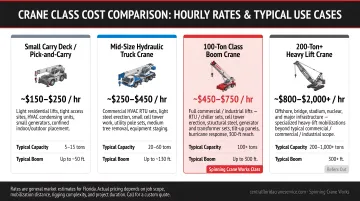
Source: Truck Crane Rental rate sheet, July 2024–2025 — illustrative vendor example only.
These ranges typically cover the crane and operator for operated rentals. Mobilization, rigging accessories, permits, and standby time are usually separate line items — and each one adds to your total project cost in ways that catch first-time buyers off guard.
Key Factors That Affect the Cost of Crane Services
Crane service pricing depends on technical, logistical, and site-specific variables. Knowing which factors drive cost is how project managers avoid budget surprises before the crane arrives.
Crane Type and Lifting Capacity
The crane you specify directly determines your base rate. A 35-ton mobile crane runs roughly $245/hour; a 110-ton crane runs closer to $475/hour — nearly twice the rate before mobilization, permits, or crew differences are factored in. Scale up to 225-ton equipment and you're looking at $570/hour or more.
Right-sizing crane capacity is the single most impactful budgeting decision you'll make:
- Over-specifying wastes budget — you pay a premium for capacity you don't need
- Under-specifying creates safety risks and may force re-mobilization, which costs far more than the original savings
- Matching capacity to the actual lift plan is how experienced contractors control this cost
Spinning Crane Works operates a Link-Belt 100+ ton boom crane with a 300-foot reach. That capacity class handles most commercial, industrial, HVAC, telecom, and structural lifts across Florida — without the mobilization cost that a 200+ ton heavy-lift crane requires.
Rental Duration and Scheduling
Crane services are typically billed hourly, daily, weekly, or monthly. Longer rental periods generally reduce the effective per-day cost, but idle crane time — waiting on other trades, weather, or site approvals — still accrues charges.
Florida's active construction market creates its own scheduling pressure. ARA's Q4 forecast projected $80.5B in U.S. construction and general tool rental revenue for 2025, up 3.3% year over year, and demand from HVAC, utility, and telecom contractors keeps mid-capacity cranes booked. Booking early provides scheduling leverage and, in some cases, better rates.
Mobilization, Transportation, and Distance
Mobilization costs include crane transport to and from the site, fuel, pilot car escorts for oversized loads, and assembly/disassembly for larger equipment. For complex cranes, this can equal or exceed one full day's rental rate.
Florida adds its own layer. FDOT's fee schedule includes overdimension trip permits ranging from $5 to $25 and overweight per-mile fees up to $0.47/mile for loads up to 162,000 lbs. Overweight movement without a valid permit triggers a penalty of $0.05 per pound over legal limits — a significant exposure on large crane transports.
For projects in South Florida, Tampa Bay, or Northeast Florida — all served from Spinning Crane Works' Melbourne base — mobilization is included in the project quote. Distance from the home market still affects total cost, so confirm what mobilization covers in writing before accepting any quote.
Site Conditions and Access
Ground conditions, overhead obstructions, and access constraints add cost when they're not accounted for in advance. Florida's geography creates specific challenges:
- Soft coastal or sandy soil may require crane mats or cribbing to meet OSHA's ground condition requirements under 1926.1402
- Power line proximity triggers mandatory clearance requirements — OSHA 1926.1408 sets a minimum 10-foot clearance for lines up to 50 kV, with greater distances for higher-voltage lines
- Underground utilities require locates before any lift — Sunshine 811 reports Florida contractors strike underground utilities 100 times per day; locates are a pre-lift necessity, not an optional step
- Confined urban access in South Florida markets may require specialized positioning or lane closures that add cost
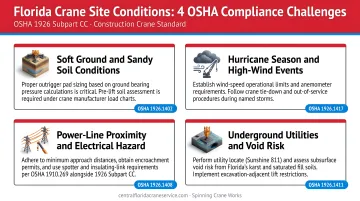
A pre-lift site evaluation catches these variables before they become day-of surprises. Spinning Crane Works includes pre-lift site surveys as part of its heavy equipment lifting and rigging service to assess ground conditions, access routes, overhead obstructions, and rigging requirements before the crane arrives.
Labor: Operators, Riggers, and Support Crew
BLS data shows crane and tower operators average $32.44/hour in wages. Billing rates are higher — they recover payroll taxes, workers' compensation, insurance, overhead, and profit margin on top of base wages.
For operated crane services, the operator is typically bundled into the rate. Complex lifts may also require:
- Certified riggers
- Qualified signal persons
- Additional spotters for power-line or confined-space work
Each additional crew member adds hourly labor cost. Before work begins, verify minimum call-out hours, overtime rates, and weekend premiums — these vary significantly between providers.
At Spinning Crane Works, every job includes a certified crane operator, a qualified rigger, and a signal person as part of the operated service package — not as separate line items.
Full Cost Breakdown: What You're Actually Paying For
The total cost of crane services goes well beyond the daily rate. Here's what belongs in every construction project budget.
Base Equipment Rate
Covers the crane itself, standard rigging hardware, and fuel for standard operations. What it typically does not cover:
- Specialty attachments or man baskets
- Additional counterweights for heavy or long-radius picks
- Crane mats for soft ground conditions
Operator and Crew Labor
In an operated rental (the standard for construction crane services), operator labor is bundled into the quoted rate. Bare rentals, where the client supplies a certified operator, are less common. They also carry additional compliance and liability obligations: OSHA 1926.1427 requires operators to be trained, certified, and evaluated before operating covered equipment.
Mobilization and Demobilization
Covers crane transport to and from site, pilot vehicles for oversized loads, transport permits, and assembly/teardown time for larger cranes. This can be structured as a flat fee or an hourly charge (confirm which applies before signing).
Permits, Insurance, and Compliance
Common permit categories include:
- Oversized/overweight load transport permits (FDOT/FLHSMV)
- Road closure or right-of-way permits (varies by city and county)
- Local construction activity permits
Insurance — general liability, workers' compensation, and equipment coverage — may be absorbed into the service rate or passed to the client. Spinning Crane Works carries full liability and equipment insurance on every job as part of its standard service rate. Always verify this in writing with any provider.
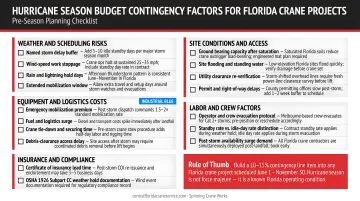
Standby Time, Weather Delays, and Contingency
Most crane service contracts include a standby rate — a reduced hourly charge when the crane cannot operate due to weather, site unreadiness, or delays from other trades. This is one of the most common sources of budget overruns.
Florida's weather makes this especially relevant. NOAA notes that the Atlantic hurricane season runs June 1 through November 30, with peak activity around September 10, and Florida's rainy season extends from mid-May through October. Build contingency time and budget into any lift scheduled during this window.
A practical contingency reserve is 10–15% of the total crane budget. Push toward the higher end if your project involves any of the following:
- Hurricane-season scheduling (June–November)
- Soft or unstable ground conditions requiring crane mats
- Power-line coordination with the utility
- A tight critical path with no schedule float
How to Estimate the Right Budget for Your Project
An accurate crane service budget starts with your specific lift requirements — not a generic hourly rate.
Inputs You Need Before Requesting a Quote
Gather this information before contacting any crane provider:
- Load weight and dimensions — exact figures, not estimates
- Number and type of lifts — single pick, multiple picks, multi-day sequence
- Lift height and radius — determines boom configuration and capacity requirements
- Site access conditions — ground type, access routes, overhead obstructions, power lines
- Project duration and scheduling flexibility — including hard deadlines that could trigger overtime
- Special requirements — power-line proximity, confined space, night or weekend work
Spinning Crane Works offers pre-lift site evaluations to assess these factors and generate a project-specific quote — which gives you a line-item cost breakdown you can plug directly into your project budget.
A Simple Budgeting Structure
| Budget Line | Notes |
|---|---|
| Base equipment cost | Crane and standard rigging for estimated duration |
| Operator and crew labor | Included in operated rental; confirm minimums |
| Mobilization/demobilization | Flat or hourly; confirm before signing |
| Permits and insurance | Transport permits, local permits, COI requirements |
| Contingency buffer (10–15%) | Weather, standby, and unforeseen site conditions |
| Total crane service budget | Sum of all line items above |
Get multiple itemized quotes and compare what is — and isn't — included in each. A lump-sum estimate without line items is a red flag. If a provider can't break down their pricing, that's a signal to keep shopping.
What Most People Get Wrong When Budgeting for Crane Services
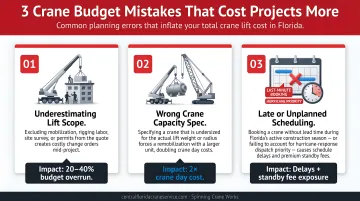
Three mistakes account for most crane budget overruns on Florida construction projects.
Focusing only on the hourly or daily rate. The equipment rate is often less than half the true project cost once mobilization, standby time, permits, insurance, and crew are factored in. A $400/hour crane rate looks very different on the final invoice when mobilization adds a full day's equivalent charge and weather delays trigger three hours of standby billing.
Underestimating setup and teardown time. Crane assembly, rigging checks, test lifts, and post-lift disassembly all consume billable hours. On a full-day commercial project, these activities can represent two to three hours that project managers simply don't account for in their lift-day calculations.
Choosing the lowest bid without vetting the provider. Equipment condition, operator certification, and safety record don't appear in the hourly rate. An operator lacking documented certification under OSHA 1926.1427 creates legal exposure that far exceeds any upfront savings. When a provider fails mid-job, re-mobilization costs erase the original price difference — plus delay penalties on top.
Frequently Asked Questions
How much is crane service per hour?
Hourly rates vary by crane type and capacity. Based on publicly available vendor data, smaller boom trucks and 35-ton mobile cranes start around $245/hour, while mid-range 60–90-ton cranes run $320–$460/hour, and large-capacity cranes exceed $570/hour. Always request a project-specific quote — these figures are illustrative starting points, not fixed market rates.
What is typically included in a crane service quote?
A complete quote should itemize the base equipment rate, operator labor, mobilization/demobilization, rigging equipment, and any additional fees for permits or specialty attachments. Vague lump-sum estimates without line items are a red flag: you won't know what's missing until the invoice arrives.
How far in advance should I book crane services for a construction project?
Book standard commercial lifts once your lift date, load specs, and site conditions are confirmed. For large-capacity cranes, multi-day projects, or jobs involving road closures and special permits, start coordination several weeks out and lock standby and cancellation terms in writing.
How do weather delays affect crane service billing?
Most contracts include a standby rate, a reduced hourly charge when the crane cannot operate due to weather. This is especially relevant in Florida, where rainy season and hurricane activity create regular delay windows. Build contingency time and budget to cover this, particularly for June–November projects.
Does crane service cost more for projects near power lines or in tight spaces?
Yes. Power-line proximity requires compliance with OSHA clearance distances and often additional coordination with utilities, which affects scheduling and may require specialized positioning or additional safety personnel. Confined urban environments can also require lane closures or specialized access , all of which add cost.
What is the difference between operated crane rental and bare crane rental?
Operated rental includes a certified crane operator, qualified rigger, and signal personnel. Bare rental provides equipment only: the client supplies a licensed operator and assumes full compliance and liability under OSHA 1926.1427. Spinning Crane Works operates exclusively as an operated service, so the crane, operator, rigger, and signal person are included in every job.
The only reliable budget is one built from a detailed, itemized quote tied to your actual lift plan — crane type, site conditions, duration, and ancillary fees all move the number.
For project managers in Central and South Florida, Spinning Crane Works provides professional pre-lift site evaluations and project-specific quotes for HVAC installations, cell tower work, structural steel erection, utility infrastructure, and heavy equipment lifts across the state. Contact the team at 321-759-2263 or through centralfloridacraneservice.com/contact/ to discuss your project.