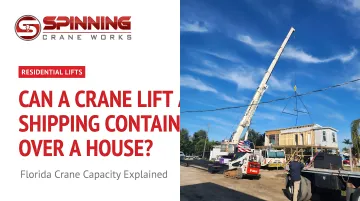
The short answer is yes, it's possible. But the longer answer involves the right crane, the right site conditions, and a crew that knows what they're doing.
This guide covers exactly what you need to know: whether the lift is feasible, which crane handles it, what your property needs beforehand, and what the whole process actually costs.
Key Takeaways
- Yes — a properly sized crane can lift a shipping container over a house when capacity and reach are matched to the actual lift radius
- Empty 20ft containers weigh ~5,000 lbs; 40ft containers ~8,157 lbs — well within range for the right crane class
- Ground conditions, overhead power lines, and Florida weather are the three factors most likely to delay or complicate the lift
- Permit requirements vary by Florida municipality — check before you book the crane
- This is not a DIY lift; certified operators and a formal lift plan are non-negotiable
Can a Crane Lift a Shipping Container Over a House?
Yes — and a properly selected mobile hydraulic crane can lift a shipping container over a house. Feasible, though, isn't the same as straightforward. The lift requires the right crane class, a site that meets specific clearance conditions, and an operator who has planned every phase before the hook goes up.
Why Standard Delivery Methods Fall Short
Most container deliveries use tilt-bed trucks or HIAB knuckle-boom trucks. These work fine when you have direct, unobstructed access. For an over-house placement, they don't.
- Tilt-bed trucks require roughly 120 feet of straight-line clearance and 25 feet of overhead space; they also can't swing a container laterally over a structure
- HIAB knuckle-boom cranes lose capacity rapidly with outreach; the HIAB X-HiPro 558, for example, drops to under 10,000 lbs at 34 feet of horizontal reach, which isn't enough to clear a roofline at distance
An over-house lift demands both height and horizontal span simultaneously. That combination requires a full mobile crane.
Container Weight Dictates Crane Selection
Hapag-Lloyd's container specifications place common tare weights at:
- 20ft standard dry container: approximately 5,000 lbs empty
- 40ft standard dry container: approximately 8,157 lbs empty
- Maximum gross weight: up to 71,650 lbs for either size when fully loaded
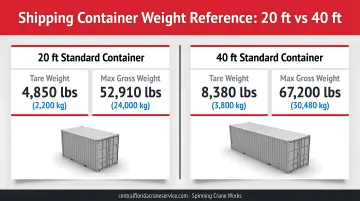
For a typical backyard placement, you're likely moving an empty or lightly loaded container, which is a manageable lift. A container near maximum gross weight is a different calculation entirely and requires a separate lift plan.
Rigging to the Right Points
ISO 1161 corner castings are the only correct attachment points for lifting a shipping container. These standardized fittings are engineered for the task: top-corner fittings are rated for 150 kN of lifting force, while bottom fittings handle 300 kN with a sling at 30 degrees.
Rigging chains or straps around the container body bypass these engineered points entirely, creating real risk during any over-house maneuver. A four-point lift from the corner castings distributes the load correctly and keeps the container level through the swing. That stability matters most when the load is passing directly over a roof.
What Size Crane Do You Need?
Two specifications determine whether a crane can handle this job: lifting capacity and boom length. These aren't independent numbers — as the crane extends its boom further out horizontally, its effective lifting capacity drops. The further the container must travel from the crane's position, the stronger the crane needs to be.
How Crane Capacity Works at Radius
Real load chart data illustrates why radius matters so much:
| Crane Model | Class | Capacity at 10 ft | Capacity at 25 ft |
|---|---|---|---|
| Tadano TR-300XL-3 | 30 ton | 60,000 lbs | 28,500 lbs |
| Grove RT540E | 40 ton | 72,200 lbs | 26,300 lbs |
An empty 20ft container weighing 5,000 lbs looks trivial against those numbers — until you factor in boom weight, rigging hardware, and the actual horizontal distance from the crane's setup position to the drop point behind the house. Every foot of extra radius costs capacity.
The Right Crane Class for Residential Over-House Work
Mobile hydraulic cranes — specifically rough-terrain and all-terrain models — are the standard choice for residential over-house container lifts. For this application, these models offer three practical advantages:
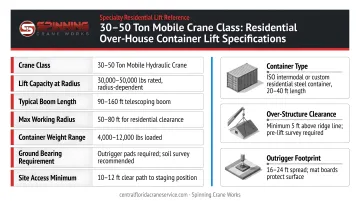
- Telescoping booms reach 98–110 feet on 30–50 ton models, enough to clear a two-story roofline
- Sufficient horizontal reach to swing a container into a backyard without repositioning
- Street-ready mobility that fits most residential access constraints
The 30–50 ton telescoping rough-terrain or all-terrain crane class covers most standard residential over-house lifts for an empty container. No universal minimum tonnage rule exists: the correct crane is always selected from the actual lift plan, which accounts for radius, height, rigging weight, and setup position.
Crawler cranes handle heavier-duty or longer-reach lifts but require component transport, on-site assembly, and more setup space. For a tight residential property, that added complexity makes them the exception rather than the rule.
Spinning Crane Works operates a Link-Belt boom crane with 100+ ton capacity and 300-foot reach, well beyond what a standard residential over-house container lift requires. Their team assesses container weight, house height, and site layout to confirm the right setup for jobs throughout Florida.
Key Factors That Affect Whether the Lift Is Safe and Feasible
Getting a crane on-site is only part of the equation. Four site-specific factors determine whether the lift actually happens safely.
Ground Stability
OSHA 1926.1402 requires that ground conditions be firm, drained, and graded before any crane operates. Crane outriggers can apply loads exceeding 58,000 lbs per pad — on a residential property with soft soil or grass, that means outrigger pads, timber mats, or cribbing are often necessary before the crane can safely extend its boom.
Soft ground mid-lift isn't a recoverable situation. This is one of the first things a crane crew evaluates.
Power Line Clearance
Overhead utility lines are a hard constraint in residential areas. OSHA Table A under 1926.1408 requires a minimum 10-foot clearance from lines carrying up to 50 kV, with larger buffers at higher voltages.
In Florida's dense suburban neighborhoods, distribution lines frequently run along rear property lines — directly in the path of a backyard lift. On jobs where the boom path and the utility corridor overlap, the crew must map exact clearances before the lift plan is finalized — and OSHA 1910.269 power-line standards apply regardless of whether lines are energized.
Florida's Weather Window
Florida's afternoon storm pattern is a scheduling reality, not a minor inconvenience. The Florida Climate Center at FSU reports that the western peninsula sees over 80 thunderstorm days per year, with the rainy season running roughly May 15 through October 15. Hurricane season runs June 1 through November 30.
High winds — typically above 20–25 mph — make a suspended container uncontrollable. The crane operator and competent person on-site follow manufacturer wind-speed limits and stop the lift if conditions deteriorate — no exceptions. For Florida jobs, scheduling early morning starts and building weather flexibility into the timeline is standard practice.
Swing Path Planning
The crane doesn't touch the house. But a container swinging off-path could. Before the lift, the crew maps the exact arc the container will travel — identifying how much clearance exists between the load and the roofline, chimney, gutters, or any other structure along the swing path. That planning happens before the crane even leaves the yard.
How to Prepare Your Property for a Crane Lift
Property prep has a direct impact on whether lift day runs on schedule — or stalls before the container clears the roofline. Three areas need your attention before the crane arrives: site access, ground conditions, and permits.
Access and clearance:
- Clear the crane's access path of vehicles, landscaping obstacles, and low-hanging branches
- The area directly below the lift path must be completely empty of people and property during the lift
- Crane trucks need substantial maneuvering room — discuss specific access dimensions with your crane company when you book
Ground preparation:
- Identify where the outriggers will be placed and confirm the ground can handle the load
- Soft soil or grass may require gravel, timber mats, or steel plates — your crane company can advise whether site prep is needed based on a pre-lift assessment
Permits are a separate step that catches many homeowners off guard. Requirements vary by municipality, and skipping this step can delay or halt the job.
Permits:
- Florida municipalities vary on what they require for container placement and crane operations in residential zones
- Orange County requires a zoning permit for temporary container placement; Miami-Dade requires a Certificate of Use
- If the crane truck operates on a public street, an FDOT or municipal right-of-way permit may apply
- Check with your local building department before scheduling — don't assume no permit is needed
What Does the Crane Lift Process Look Like?
Pre-Lift Setup
The crane operator conducts a site inspection, confirms the lift plan, and extends outriggers onto prepared ground. The rigging crew attaches shackles to the container's four ISO corner castings. Guide ropes go on at least two corners to control swing during the lift.
The Lift Sequence
- The container rises straight up to clear ground-level obstacles
- The boom swings horizontally, carrying the container over the roofline
- The load descends carefully on the far side — slow and deliberate throughout
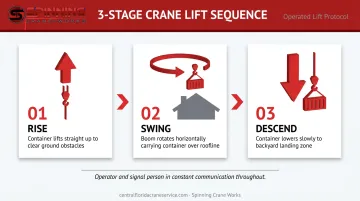
The operator and a signal person stay in constant communication for every foot of that sequence.
Final Placement
Once the container drops within a few feet of the landing zone, ground crew guide it into exact position. The team then checks that the container sits level, the doors open correctly, and the unit is stable before the rigging comes off.
How Much Does It Cost to Crane a Shipping Container Over a House?
Crane lift costs typically break into two parts: crane service fees and container delivery/transportation fees. Most crane companies bill hourly with a 1–2 hour minimum.
Vendor rate examples from public sources show 40-ton operated crane rates running roughly $255–$315 per hour, but these figures vary by Florida market, mobilization distance from the crane's base, and job complexity. Treat them as a planning reference — not a fixed quote.
Factors that raise the cost:
- Larger container (40ft vs. 20ft)
- Greater horizontal distance from crane to drop point
- Taller structure requiring more boom extension
- Ground prep requirements (mats, cribbing, gravel)
- Permit and right-of-way fees
- Pre-lift site survey if required separately
Get an itemized quote that accounts for all these variables. A flat-rate estimate for an over-house container lift often omits mobilization, ground prep, and permit costs — the line items that push the final number higher.
Frequently Asked Questions
Can a crane lift a shipping container over a house?
Yes. A properly sized mobile hydraulic crane can lift a shipping container over a residential structure when the crane has adequate boom reach and lifting capacity at the actual lift radius, the site is prepared correctly, and a certified crew executes the lift.
What size crane do you need to lift a 20ft shipping container over a house?
Crane size depends on container weight, structure height, and horizontal distance from the crane to the drop point. Most residential over-house lifts for an empty 20ft container fall in the 30–50 ton range — the exact requirement is calculated from your specific lift plan before the job is scheduled.
How much does it cost to crane a shipping container over a house?
Crane service is typically priced hourly with a minimum, plus mobilization. Operated rates for a 40-ton crane generally run $255–$315/hour, but total cost shifts based on crane size, lift duration, site complexity, and travel distance. Request an itemized quote for an accurate number.
Do I need a permit to crane a shipping container over my house?
Permit requirements vary by municipality. Orange County requires a zoning permit; Miami-Dade requires a Certificate of Use. Some jurisdictions also require right-of-way permits for crane truck access. Check with your local building department before scheduling — Spinning Crane Works can flag common Florida permit requirements during the pre-lift planning call.
Is it safe to lift a shipping container over a house?
Yes, when a certified crane operator uses properly rated equipment and follows a detailed lift plan. The risk comes from undersized cranes, poor ground conditions, high winds, or unqualified operators — not from the lift itself when it's executed correctly.
How do I prepare my property for a crane lifting a container over my house?
Clear the crane's access path and lift zone of all vehicles and obstacles. Confirm the outrigger placement areas can support the crane's ground bearing loads. Coordinate with the crane company on delivery truck access, timing, and whether ground preparation is needed before arrival.