The outcomes, however, vary widely. Crane selection, lift radius, ground stability, site access, and local permits all determine whether the job finishes safely and on schedule. A poorly planned lift can result in property damage, a canceled job day, or worse.
This guide covers when a mobile crane lift is the right call, what preparation it requires, the exact steps involved, the variables that shape results, and the mistakes that derail lifts before they start.
Key Takeaways
- Mobile cranes are the primary solution when side or rear access is blocked by fencing, narrow passages, soft ground, or grade changes
- Crane size depends on both load weight and lift radius — a lightweight module may still require a large crane on a deep lot
- Successful lifts require site surveys, ground assessment, utility mark-out, permits, and engineered rigging — all coordinated in advance
- Always require a Certificate of Insurance with hook liability (on-hook) coverage from the crane company before equipment arrives
- Start planning 3–4 weeks out; last-minute scheduling is the most common cause of lift delays
When Should You Use a Mobile Crane to Lift a House or Structure?
Not every placement requires an over-the-house lift — but specific site conditions make a mobile crane the only safe or practical option.
Common Use Cases
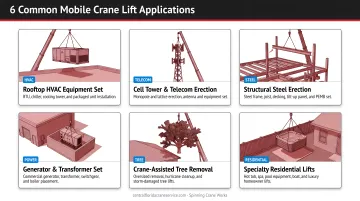
Mobile crane lifts make sense for:
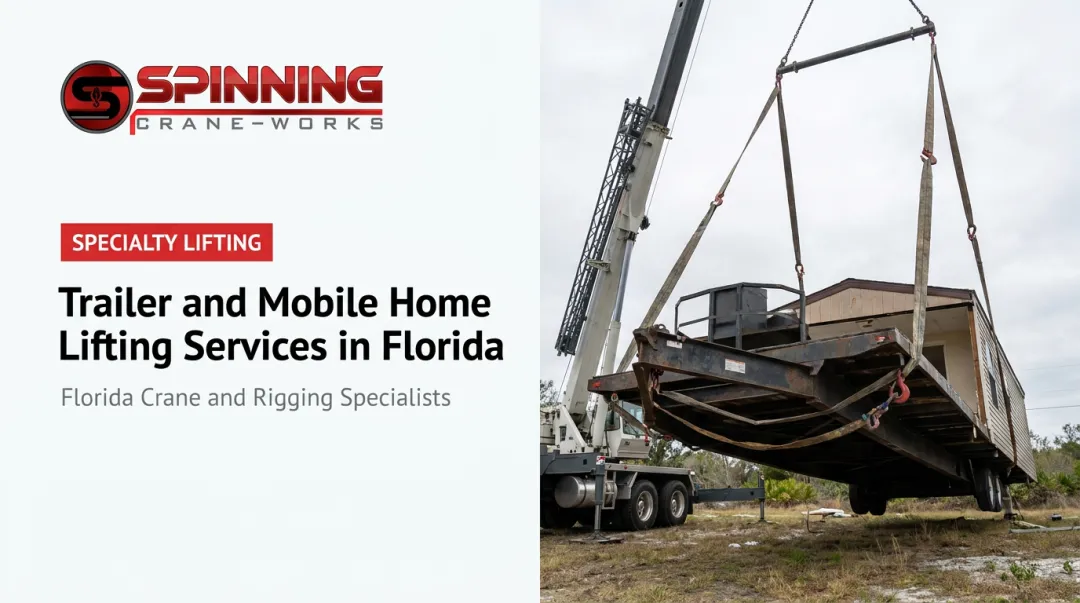
- Installing prefabricated or modular home modules on inaccessible lots (modules can weigh 15,000 lb to over 40,000 lb)
- Placing fiberglass pool shells — most shells weigh between 2,000 and 3,500 lb but require crane access when side clearance is blocked
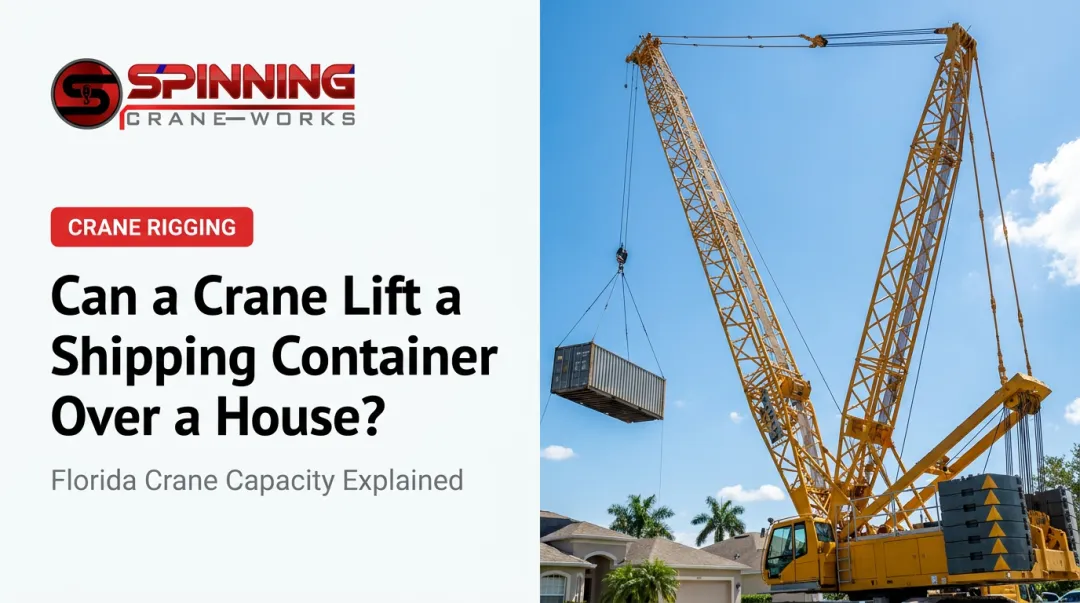
- Positioning shipping containers and container-based structures
- Setting packaged rooftop HVAC units on commercial or residential buildings
- Delivering garden offices, backyard studios, or hot tubs over walls or through narrow passages
- Setting modular room additions onto existing structures
Conditions That Trigger Crane Necessity
A mobile crane becomes necessary when:
- Side access is blocked — fencing, retaining walls, neighboring structures, or mature landscaping that cannot be removed temporarily
- Ground cannot support truck weight — soft, sandy, or marshy soils common throughout Florida sink under delivery vehicles
- Grade changes prevent ground-level approach — steep slopes, retaining walls, or elevation changes block direct access
- The structure must pass over an existing building — crane boom clearance is the only way to clear an occupied or finished structure without contact
Situations That Require Extra Planning
Some site conditions don't make a lift impossible, but they require advance coordination:
- Overhead power lines that need utility involvement (de-energizing or temporary covers)
- Lots so deep that the required crane reach pushes into the upper range of practical capacity
- Structures heavy enough that weight combined with radius exceeds available crane classes
What You Need Before the Lift
Every element of pre-lift preparation directly determines whether the job completes safely, on time, and within budget. Skipping any step typically results in delays billed at the hourly crane rate.
Equipment and Crane Requirements
Crane selection must account for both load weight and lift radius simultaneously — these are equally important inputs.
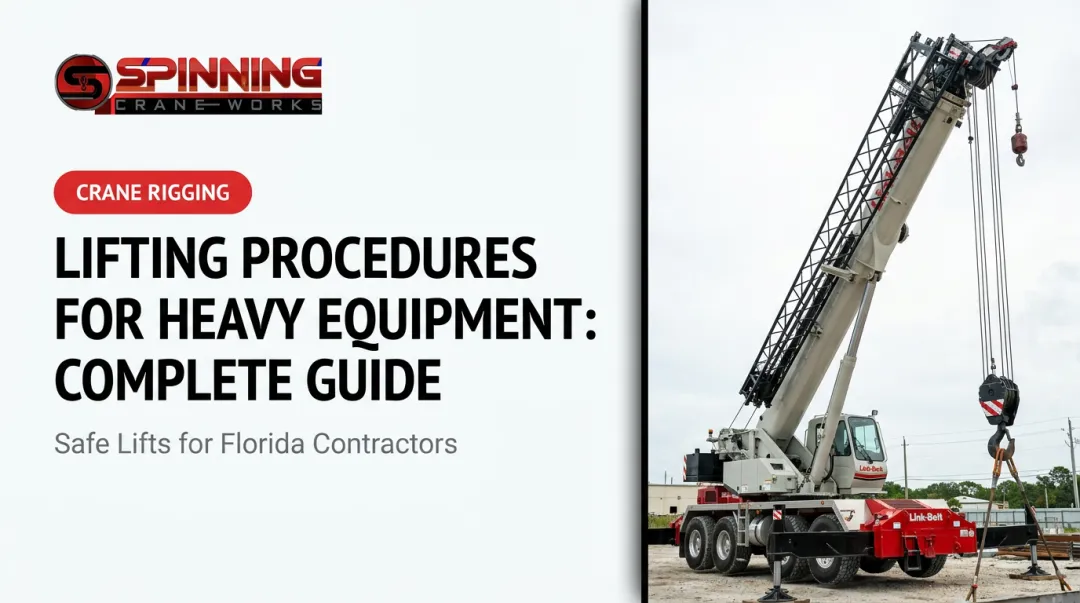
Crane capacity drops sharply as the boom extends further from the machine's center. According to Link-Belt's published load chart data for the 175AT all-terrain crane, capacity falls from 101,050 kg at a 3.0-meter radius to just 15,650 kg at a 12.0-meter radius. A relatively light prefab module at the back of a deep lot can demand a much larger crane than the module's weight alone would suggest.
Common mobile crane types for residential structure lifts:
| Crane Type | Best For |
|---|---|
| Hydraulic truck crane | Street-accessible residential jobs with paved road access |
| All-terrain crane | Properties requiring road travel plus work on less-ideal surfaces |
| Rough-terrain crane | Unfinished lots, soft access routes, unpaved surfaces |
Spinning Crane Works deploys a Link-Belt boom crane with 100+ ton lift capacity and 300-foot boom reach — a mid-to-heavy class that covers the vast majority of residential structure lifts across Florida without requiring the cost of a 200+ ton heavy-lift mobilization.
Site and Ground Conditions
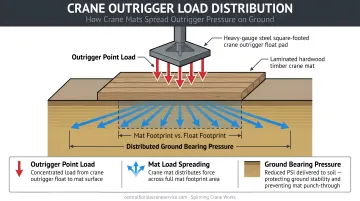
Standard residential driveways are built for passenger cars and light trucks. Under OSHA 1926.1402, crane equipment must not be assembled or used unless ground conditions are firm, drained, and graded to support the load. A 100-ton hydraulic truck crane can generate outrigger reactions exceeding 100,000 lbf, far beyond what a residential driveway is rated for.
Crane mats (also called outrigger pads or cribbing) distribute this point load across a larger area, protecting the surface, buried utilities, and any septic or drainage infrastructure below. Ground conditions must be verified during the site survey, not assumed.
Florida-specific note: Many Florida soils are sandy with seasonally high water tables. Surface appearance does not reliably indicate bearing capacity — always factor this into the ground assessment before mobilizing.
Permits, Notifications, and Insurance
Administrative requirements vary by municipality but typically include:
- Street closure authorization — Orlando requires submission 10 business days before closures under 14 days; Tampa's ROW permit review takes 12–15 business days; Miami Beach requires site plans for crane setup in the right-of-way
- Utility mark-out — Florida Statute 556.105 requires notice to Sunshine 811 at least 2 full business days before excavation or any work near underground utilities. This is a legal requirement, not optional
- Police traffic details — required for residential street closures in many Florida municipalities
- Lift plan submission — some jurisdictions require a formal plan; treat this as project- and municipality-specific
Insurance is non-negotiable. Standard general liability insurance does NOT cover a dropped load.
You need a Certificate of Insurance that explicitly includes rigger's liability or on-hook (hook liability) coverage — this protects the structure being lifted and any property it might damage if the lift fails.
How to Lift a House or Structure with a Mobile Crane: Step-by-Step
Step 1: Site Survey and Lift Plan Development
A professional crane company conducts a physical site visit to measure all clearances, identify obstacles (power lines, trees, chimneys, roof vents, utility poles), determine exact crane positioning, and calculate the lift radius from the crane's center pin to the final placement point.
The lift plan output specifies:
- Crane model, boom angle, and length
- Rigging attachment points on the structure
- Load path through the air
- Tag line positions and wind contingency
- Communication protocol between operator and ground crew
Any power line conflicts identified during the survey must be addressed before scheduling the lift. Contacting the utility to arrange temporary line covers, de-energizing, or relocation typically takes two to four weeks and cannot be rushed.
Spinning Crane Works has established working relationships with major Florida utilities including FPL, Duke Energy Florida, and TECO. That coordination experience matters on residential lifts near energized infrastructure, where utility scheduling delays are the most common reason a job gets pushed back.
Step 2: Crane Mobilization and Staging
When the crane arrives, the crew positions it in the street or staging area, extends stabilizing outriggers onto crane mats, and mounts counterweights from a secondary transport truck if the crane class requires them. This setup phase typically takes one to two hours and is billed at the hourly rate.
Before accepting any load, the operator confirms that outriggers are on stable, level ground. If ground conditions differ from what was surveyed, the lift stops until the issue is resolved.
Step 3: Rigging the Structure
The rigging crew prepares the structure by:
- Attaching engineered lifting slings — nylon or chain slings rated for the specific load
- Spreading load with steel spreader bars — keeps straps vertical and prevents crushing or deforming the structure's walls or frame
- Securing tag lines — ropes attached at multiple points on the structure for wind drift control during the swing
Before the crane takes any weight, the rigging supervisor visually inspects all slings, shackles, hooks, and spreader bar connections. OSHA 1926.251 requires rigging equipment to be inspected before use on each shift, and ASME B30.9 governs sling fabrication and inspection standards. This pre-lift check is not optional.
Step 4: The Hoist, Swing, and Placement
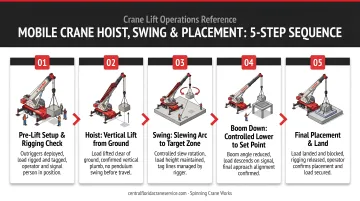
With rigging confirmed and all personnel at their stations, the hoist begins. The sequence:
- The structure rises vertically until it clears all ground obstacles
- The operator extends the boom to bring the load to the height needed to clear the roofline, chimneys, and roof vents
- Once the load passes over the roof, the operator typically loses direct sight of it — from this point, all direction comes from the backyard ground crew via radio or hand signals
- Ground crew members hold tag lines to prevent spinning or wind drift, guiding the structure precisely over the placement point
- The operator lowers the structure slowly, following continuous radio direction from the crew at the foundation or mounting location
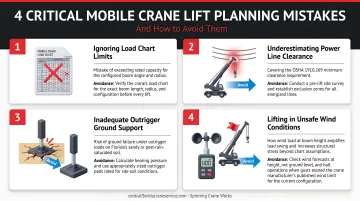
Wind is the critical variable during this phase. Lightweight structures with large surface areas act like sails. According to Liebherr's published guidance, standard crane load tables generally apply up to 9 m/s (approximately 20 mph) gust speed measured at boom height (not at ground level, where readings are typically lower).
If gusts exceed the manufacturer's threshold, the lift is halted. This is not a judgment call; it is a manufacturer and OSHA requirement.
Step 5: Rigging Removal and Demobilization
Once the structure is seated and confirmed stable by the ground crew:
- The hook is slackened and slings and spreader bars are disconnected and removed
- The crane retracts its boom
- Outriggers are retracted, crane mats are loaded onto transport, and counterweights are reloaded
- The street or driveway is reopened
Demobilization typically takes about one hour and is also billed at the hourly rate.
Key Variables That Affect the Lift
Lift Radius
Lift radius is the single most critical variable in crane selection. As the boom extends further from the machine's center, capacity drops sharply — a crane that handles 100+ tons at close range can drop below 16 tons at 12 meters out.
For a house lift, radius is measured from the crane's center of rotation to the farthest point where the structure must be placed. A deep backyard, a tall two-story structure, or a street-only staging position all increase this number and drive up the required crane class.
Wind Speed
Wind is measured at boom height, not ground level, and conditions can differ significantly between the two. Crane companies monitor boom-level readings throughout the operation. Mobilization fees are often still charged if a lift is canceled on delivery day due to wind — confirm this policy before booking.
Ground Bearing Capacity
Florida soil conditions create real staging risks. Common hazards the pre-lift site survey must identify include:
- Sandy or unstable soils that shift under outrigger point loads
- Buried septic tanks and drainage pipes
- Unmarked voids or subsurface structures
If any of these are missed, the lift stops. There's no workaround once the crane is on site.
Power Line Proximity
Active overhead power lines are the most common obstacle that forces crane repositioning or job cancellation. OSHA 1926.1408 Table A sets minimum clearance at 10 feet for lines up to 50 kV, with higher clearances required for higher voltages. NIOSH data found that overhead power-line electrocutions caused 102 of 323 crane-related construction deaths from 1992 to 2006. This is a go/no-go variable, not a condition to work around.
Common Mistakes to Avoid
Most structural lift failures trace back to planning oversights, not equipment failures. These are the most common — and costly — errors to avoid:
- Skipping or rushing the site survey. Discovering power line conflicts, permit requirements, or utility issues the week of the lift leaves no time to resolve them. Survey weeks in advance.
- Selecting a crane based on weight alone. A machine sized for the structure's weight without accounting for lift radius will not safely reach the placement point. Always consult the load chart for the specific radius.
- Ignoring underground infrastructure. Placing outriggers over unmarked utility lines, sprinkler systems, or septic tanks without a proper mark-out is illegal in most U.S. states. The Common Ground Alliance's 2024 DIRT Report counted nearly 197,000 reported underground utility damages — filing no locate request was the leading cause.
- Assuming general liability covers the lifted load. It doesn't cover the load itself. Homeowners who skip on-hook (hook liability) coverage face the full replacement cost of the structure and any property it damages if the lift fails.
Alternatives When a Mobile Crane Lift Is Not Feasible
Extreme lot depth, unavoidable power lines, or streets too narrow to stage a crane can all make an over-the-house lift impractical. Before committing to a larger crane class, consider these alternatives:
- Clear the obstruction first. Removing a fence section, cutting a retaining wall opening, or temporarily taking out a tree is often far cheaper than upgrading to the next crane class. Get both quotes before deciding.
- Stage from a neighboring property. A written access and damage-repair agreement with an adjacent property owner can dramatically reduce the required reach — and allow a smaller crane class to complete the job.
- Approach from a rear alleyway. Properties with public alleyway access behind the lot may allow a smaller rough-terrain or all-terrain crane to reach the backyard directly from the rear — bypassing the house entirely and eliminating the over-the-house lift requirement.
Frequently Asked Questions
Can a crane lift over a house?
Yes — this is a routine operation for experienced mobile crane operators. The crane extends its boom to clear the roofline, while tag lines and backyard ground crew communication guide the load over and down to the placement point on the other side.
How much does a crane lift cost?
Costs depend on crane size, lift radius, setup time, mobilization distance, and local permit fees. Billing typically breaks into a mobilization fee, a minimum hour block, and an hourly rate beyond that minimum — request an itemized quote rather than a single bundled price.
What types of structures can be lifted with a mobile crane?
The range includes prefabricated and modular homes, fiberglass pool shells, packaged HVAC rooftop units, shipping containers, hot tubs, garden offices, modular room additions, and large structural components that cannot reach a site by ground-level transport.
How long does a mobile crane house or structure lift take?
Setup runs one to two hours, rigging 30–45 minutes, the hoist and placement 20–30 minutes, and teardown about one hour — total on-site time is typically three to five hours. Most crane rentals carry a four-hour or eight-hour minimum charge regardless of actual time used.
Do I need a permit to lift a structure with a crane on residential property?
Most Florida jurisdictions require permits for street closures and may require a submitted lift plan or Maintenance of Traffic (MOT) plan. Requirements vary by city and county — Orlando, Tampa, and Miami Beach each have different ROW processes and lead times that can run several weeks.
How do I choose the right crane company for a house or structure lift?
Verify residential lifting experience, hook liability insurance that covers the full value of the structure, certified operators, and a formal lift plan process. Spinning Crane Works serves Central and South Florida with certified operators and extensive experience working around power lines — a practical advantage on residential sites near energized infrastructure.