Introduction
Picture this: a new manufactured home arrives at its Florida destination, but the delivery truck can't get close enough to set it. The ground is waterlogged from last week's rain, the lot is hemmed in by mature oaks and a six-foot fence, and the foundation pad sits four feet above grade to meet flood zone requirements. Standard transport equipment is useless here.
Crane lifting is often the only solution that works.
Florida has one of the largest manufactured housing bases in the country. According to 2024 U.S. Census Bureau data, mobile homes account for 824,425 units — nearly 8% of all Florida housing stock. For a state with this volume of manufactured housing, combined with frequent flood zone requirements, hurricane anchoring codes, and challenging terrain, crane placement services aren't a specialty niche. They're a recurring necessity.
This guide walks through the full process: when crane lifting is required, how Florida regulations shape placement, what crane types apply, and how to choose the right operator.
Key Takeaways:
- Crane lifting is required when ground conditions, restricted access, or flood zone elevation block standard placement
- Florida flood zones often require elevation several feet above grade — cranes handle this precisely
- Hurricane tie-down anchors must be pre-installed; the crane sets the home directly onto the anchor system
- OSHA power line clearance rules make experienced operators a non-negotiable requirement in Florida
- Verify OSHA compliance, liability insurance, and lift planning before hiring any crane service
When Do You Need a Crane to Lift a Mobile Home?
Most manufactured homes are transported and set using conventional carrier trucks and hydraulic equipment. But certain site conditions make that approach dangerous, impractical, or outright impossible. Knowing when a crane is the right call protects the home, the lot, and everyone on site.
Challenging Site Conditions
Wet and soft ground is one of the most common triggers in Florida. After heavy rain — which happens frequently across the state — saturated soil can't support the weight and ground pressure of a loaded carrier truck maneuvering onto a residential lot. An overhead crane lift eliminates ground-level vehicle movement entirely, keeping equipment on stable road or pad surfaces while the home swings over the obstacle.
Restricted-access lots create the same problem from a different angle. When a lot is surrounded by:
- Narrow driveways that can't accommodate transport equipment
- Densely packed manufactured home communities with no maneuvering room
- Mature trees, fences, or utility structures blocking ground-level access
...there's simply no viable path for conventional delivery equipment. A crane reaches over all of it.
Foundation and Elevation Requirements
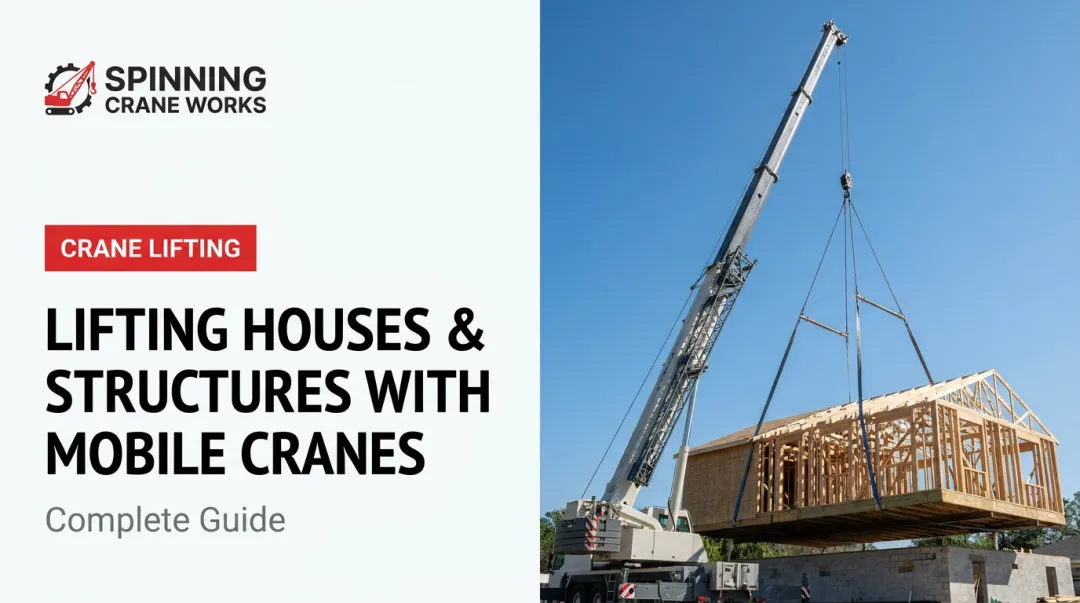
Modular homes present a different challenge. They arrive on a reusable carrier frame that must be returned to the factory, so the home must be lifted off and set precisely onto its permanent foundation. Many double-wide manufactured homes follow the same logic — two sections have to align accurately on a foundation system, and that kind of precision requires overhead control.
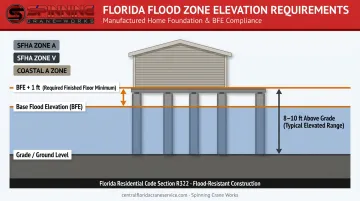
Florida's flood zone rules add another layer. Homes placed in FEMA-designated Special Flood Hazard Areas (SFHAs) must meet Base Flood Elevation standards under Florida Residential Code R322. In many cases that means elevating the home's bottom frame to BFE plus one foot — sometimes requiring the structure to sit 8–10 feet above grade. A crane can achieve that elevation and place sections with the precision that permanent foundations demand.
Crawl space and basement foundations also routinely require crane placement. The geometry of lowering a full home section onto a perimeter foundation, without dragging it across the masonry, calls for overhead control that ground-level equipment can't provide.
The Mobile Home Crane Lifting Process: What to Expect
A well-executed crane lift follows a defined sequence. Property owners who understand each phase are better prepared to coordinate with contractors and avoid delays.
Site Assessment and Lift Planning
Before any crane mobilizes to the site, a qualified crane operator and rigging team assess the specific conditions. This pre-lift evaluation covers:
- Ground conditions — load-bearing capacity determines where outriggers can be positioned
- Overhead obstacles — power lines, tree canopy, and utility wires define the available swing path
- Available swing radius — the distance from crane center to the home's final resting position
- Access points — where the crane can enter and set up without damaging existing structures or utilities
A documented lift plan is developed from this assessment. It accounts for the home's weight and dimensions, the crane's rated capacity at the required working radius, rigging attachment points, and the exact sequence of moves needed to set the home without structural damage. That document governs every decision from first hook to final placement.
Rigging, Lifting, and Placement
Once the plan is confirmed, the lift proceeds in a structured sequence:
- Rigging setup — Spreader bars and certified rigging hardware are attached to the home's frame, distributing the load evenly to prevent structural stress during the lift
- Lift off — The crane operator raises the home slowly and deliberately from the carrier or ground staging position
- Swing and clear — The home moves over obstacles along the planned arc, with continuous coordination between the operator, riggers, and ground crew via radio
- Lower and set — The home descends precisely onto the waiting foundation, piers, or blocking
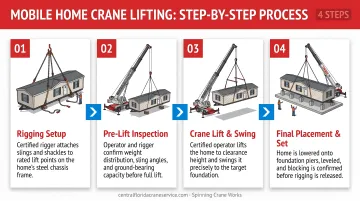
After placement, the home is leveled and anchored to its foundation — a step governed by Florida code. FAC 15C-1.0104 sets the standard for hurricane-rated tie-down installation, and Florida's wind exposure requirements make compliance non-negotiable. Crane placement allows the home to be lowered directly onto pre-installed anchor systems — a significant advantage over trying to thread anchor hardware after the home is already resting on piers.
Once anchoring is confirmed, the site is cleared and the crane demobilizes — leaving the home fully set and ready for utility reconnection and inspection.
Florida-Specific Considerations for Mobile Home Lifting
Florida isn't a typical manufactured housing market. The combination of flood exposure, hurricane wind loads, and dense utility infrastructure creates regulatory and logistical requirements that don't exist in most other states.
Flood Zone Compliance
First Street Foundation's 2020 national flood risk assessment found that 1,719,400 Florida properties fall within FEMA Special Flood Hazard Areas, with over 20% of all state properties carrying substantial flood risk. For manufactured home placements, flood zone status is a primary design driver.
Florida Residential Code R322 and FDEM's 2024 manufactured home guidance require that homes placed, replaced, or substantially improved in flood hazard areas have the bottom of their frame at or above the applicable flood elevation. In many A, V, and Coastal A zones, that means BFE plus one foot.
When that requirement pushes a home 6, 8, or 10 feet above grade, crane placement is the most efficient and precise method available.
Hurricane Anchoring Requirements
Florida's manufactured home anchoring rules, governed by FAC 15C-1.0104 and 15C-1.0105, specify ground anchors, tie-down straps, and longitudinal stabilization standards that must be inspected by local county or municipal authorities under F.S. 320.8285.
Crane placement is particularly well-suited to hurricane anchoring compliance: the anchor system can be pre-installed and inspected before the crane ever shows up, and the home is then lowered directly onto the ready foundation. No dragging, no repositioning, no interference with pre-set anchor hardware.
Power Line Proximity
That same site-prep discipline extends to overhead utilities. Florida's manufactured home parks are often threaded with distribution power lines at low clearances, and OSHA 1926.1408 requires crane operators to maintain a minimum of 20 feet of clearance from power lines up to 50 kV, or follow Table A distances for higher-voltage lines. Overhead utility mapping is mandatory before any lift plan is finalized.
Spinning Crane Works operates under OSHA 1926 Subpart CC and OSHA 1910.269 on every job. The crew has performed crane lifts adjacent to live distribution and transmission lines across Central and South Florida, including coordinating directly with utilities on minimum approach distances and scheduled outage windows when clearances require it.
Types of Cranes Used for Mobile Home Lifting
Not every crane is suited for this application. The right choice depends on the home's size, site access, required lift height, and ground conditions.
The two most common options:
| Crane Type | Best For |
|---|---|
| Mobile telescoping boom crane | Tight-access sites, road mobility, precise reach adjustment |
| Rough-terrain crane | Soft or uneven ground, post-rain Florida job sites |
Key selection factors include:
- Rated lifting capacity — a single-wide typically runs 30,000–45,000 lbs while a double-wide can exceed 70,000 lbs; the crane must be matched to the load at the required working radius
- Maximum boom radius — the crane must reach over any obstacle between its setup position and the foundation
- Outrigger footprint — in dense manufactured home communities, available pad space is often the binding constraint that determines whether a lift is even feasible from a given position
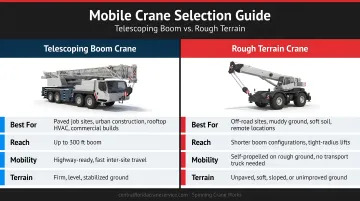
Spinning Crane Works operates a Link-Belt boom crane with 100+ ton lift capacity and 300-foot reach — enough reach to clear neighboring structures and place sections on elevated flood-zone foundations without repositioning the crane mid-job.
What Affects the Cost of Craning a Mobile Home?
No reputable crane service quotes a flat rate for manufactured home lifts — too many site-specific variables affect the scope of work. Any figure you find online is a rough reference — not an estimate for your specific job.
The primary cost drivers:
- Home size and weight — single-wide, double-wide, and triple-section homes require different crane configurations and rigging setups
- Required lift height — a ground-level set costs less than placing a home 8–10 feet above grade on an elevated flood zone pad
- Site access complexity — soft ground, overhead obstacles, and restricted swing radius all affect setup time and rigging requirements
- Mobilization distance — the further the crane travels from its operating base, the higher the transport cost; Spinning Crane Works includes mobilization in project quotes across all Florida service areas
- Crew size — more complex lifts require additional rigging personnel on the ground
- Rigging equipment needed — spreader bars, specialized hardware, and custom rigging configurations add to the equipment cost
Crane placement costs more than a standard delivery set upfront — but it often prevents far more expensive repairs. A carrier truck forced onto soft ground can sink into the lot, damage underground utilities, or compromise the foundation. Those repairs routinely exceed the cost of the crane lift several times over.
How to Choose a Mobile Home Crane Service in Florida
The qualifications you verify before hiring determine whether your lift goes smoothly or becomes a problem. Here's what matters:
Non-negotiable credentials:
- OSHA-compliant certified crane operators (verify OSHA 1926 Subpart CC compliance)
- Current crane inspection records and maintenance documentation
- Full liability and equipment insurance coverage
- Familiarity with Florida building codes, FAC 15C-1 installation standards, and local flood zone requirements
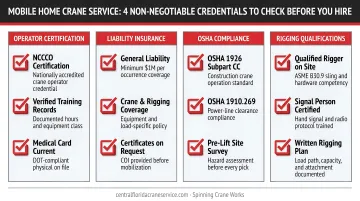
Ask about the lift planning process. A crane service that conducts documented site assessments and develops a written lift plan before mobilizing is one that has thought through the risks. Companies that skip this step or treat it as optional are the ones that encounter preventable on-site problems.
Permit coordination matters. Florida requires set-up permits for manufactured home installations, applied for through local county building departments under FLHSMV guidelines. The crane mobilization itself may also require FDOT oversize/overweight permits under Florida Statute 316.550 if the equipment exceeds road limits. An experienced crane service knows this territory.
Spinning Crane Works checks every one of these boxes. The Melbourne-based, BBB-accredited crane and rigging company serves all of Florida — including Miami, Tampa, Fort Lauderdale, and Jacksonville — with a 100+ ton Link-Belt boom crane, OSHA-compliant certified operators, and full liability coverage. The company operates 24/7 and carries documented power-line clearance experience across Florida's residential and commercial markets. For a quote or to discuss your specific site conditions, call 321-759-2263.
Frequently Asked Questions
Can a mobile home be lifted by a crane?
Yes. Mobile and manufactured homes are routinely lifted by crane when site conditions, flood elevation requirements, foundation type, or restricted access make standard placement equipment impractical. Licensed crane services across Florida use this method regularly for both new placements and repositioning work.
How much does it cost to crane a mobile home?
Costs vary significantly based on home size, required lift height, site access complexity, and mobilization distance. A site-specific quote from a licensed crane service is the only way to get an accurate number for your job.
What types of cranes are used to lift mobile homes?
Mobile telescoping boom cranes and rough-terrain cranes are the most common choices. Selection depends on the home's weight, required reach, site access, and ground conditions — rough-terrain models are particularly useful on Florida job sites after heavy rain.
How long does it take to crane set a mobile home?
The lift itself can often be completed in a few hours, but total time depends on crane setup, rigging, and any anchoring or leveling work required after placement. Complex sites or elevated flood-zone placements take longer than straightforward ground-level sets.
Do I need a permit for mobile home crane lifting in Florida?
Permit requirements vary by county. Most Florida jurisdictions require a set-up permit for the home installation, and crane mobilization may require FDOT road permits if equipment exceeds size or weight limits. A crane service with Florida-specific experience can help identify what applies to your site.
What site conditions require a crane for mobile home placement?
The most common triggers include:
- Soft or muddy ground that can't support standard transport equipment
- Restricted-access lots with limited maneuvering room
- Permanent or elevated foundations requiring precise placement height
- Flood-zone pads set significantly above grade
- Double-wide or modular homes needing exact section alignment on a foundation system