Most construction professionals know this in principle. What gets underestimated is the full operational, financial, and regulatory weight of those equipment decisions — until a project stalls, an injury occurs, or an OSHA inspector arrives.
This article breaks down the three most consequential advantages of proper lifting equipment on commercial construction sites, what happens when those standards fall short, and how to extract maximum value from every lift phase.
Key Takeaways
- Lifting equipment, including cranes, forklifts, telehandlers, hoists, and boom lifts, makes heavy commercial lifts possible
- Proper lift equipment reduces overexertion risk, which causes over 59% of construction WMSDs
- Crane optimization can save weeks; a major commercial contractor cut 24+ work days from one 17-story project
- Crane and rigging failures can trigger OSHA penalties up to $165,514 per willful or repeated violation
- Safe lifts require the right equipment, qualified operators, and a lift plan that matches the site
What Is Lifting Equipment in Commercial Construction?
Lifting equipment covers mechanized systems that move heavy materials vertically or horizontally on a commercial site, reducing the need for manual handling. Under OSHA construction standards, the main categories include:
- Cranes and derricks (OSHA 29 CFR 1926.1400): hoist, lower, and move suspended loads
- Forklifts and telehandlers: transport pallets, equipment, and materials for moderate-height placement
- Boom and aerial lifts (OSHA 1926.453): elevate personnel and lighter materials
- Scissor lifts (OSHA Subpart L): provide vertical platform access under scaffold rules
- Material hoists (OSHA 1926.552): move materials floor-to-floor within a structure
Crews use these tools across every phase of a commercial build: structural steel placement, rooftop HVAC unit setting, precast panel work, floor-to-floor material transport, and utility infrastructure work. For crane and rigging contractors such as Spinning Crane Works, the work often centers on planned picks for rooftop HVAC equipment, cell tower components, power poles, and other heavy loads.
Lifting equipment makes modern commercial construction workable: crews can set steel, place rooftop units, and move materials at the heights, speeds, and safety standards that clients and code require.
Key Advantages of Lifting Equipment in Commercial Construction
The advantages below map directly to metrics that contractors, project managers, and site owners track: injury rates, project timelines, compliance exposure, and cost control. They also compound: a weak lifting equipment decision rarely creates one isolated problem. It can affect all four dimensions at once.
Advantage 1: Reduced Worksite Injuries
Manual material handling is one of the most consistent injury drivers in construction. According to CPWR's construction injury data, overexertion (pushing, pulling, carrying, and holding) accounted for over 59% of construction work-related musculoskeletal disorders (WMSDs) in 2017.
Lifting and lowering alone accounted for another 35%. The median days away from work for construction WMSDs rose from 8 days in 1992 to 13 days by 2017.
Mechanical lifting equipment addresses this directly. Cranes and forklifts remove the need for workers to manually carry structural components, reducing the awkward body positioning that causes many of these injuries, such as twisting under load, overreaching, and sustained bending.
What this means financially:
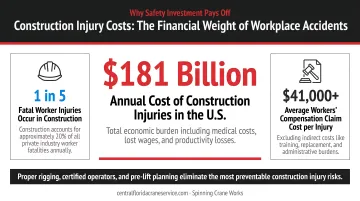
- The National Safety Council reported preventable work injuries cost $181.4 billion in 2024, including $54.9 billion in wage and productivity losses
- The average workers' compensation claim cost $47,316 for 2022–2023
- Each lost-time injury triggers replacement labor costs, schedule slippage, and downstream crew disruption
Beyond individual claims, companies with stronger safety records typically pay lower insurance premiums and qualify for more bids — particularly on regulated commercial and government projects where safety ratings are formally evaluated.
When it matters most: On multi-story commercial builds where repeated vertical material handling is required, and on projects with lean crew sizes where one injured worker creates outsized schedule risk.
Advantage 2: Faster Project Execution and Operational Efficiency
One crane operator placing structural steel or setting a rooftop HVAC unit can accomplish in a single lift cycle what a manual crew would need hours and multiple attempts to complete, assuming the load could be handled manually at all.
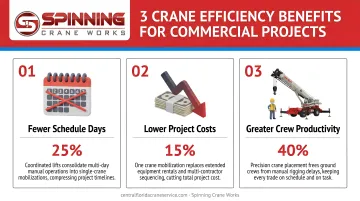
The efficiency case is measurable. ENR reported that a major commercial contractor used crane monitoring on a 17-story San Diego office project to identify an 8-minute delay per pick across 300 picks.
Addressing that inefficiency cut 17 days from panel erection and more than 24 work days from the overall schedule. The project also recorded zero under-the-hook safety incidents across 2,113 crane picks.
That kind of schedule compression matters because construction productivity has struggled for decades. An industry analysis reported global construction productivity improved only 10% from 2000 to 2022, compared to 90% in manufacturing over the same period. Equipment-driven efficiency is one of the clearest levers available to close that gap on individual projects.
Why efficiency goes beyond speed:
- Crew members freed from manual hauling can focus on skilled, value-added work — welding, MEP installation, finishing
- Resource utilization improves across the entire site, not just at the crane
- Every day of schedule compression reduces general conditions costs: site supervision, equipment rental time, and temporary utilities
When it matters most: On time-sensitive projects with fixed completion deadlines, phased occupancy requirements, or liquidated damages clauses, where each day saved has a direct dollar value written into the contract.
Advantage 3: Regulatory Compliance and Liability Risk Reduction
Commercial construction is among the most heavily regulated industries for equipment safety. OSHA's 29 CFR 1926 Subpart CC establishes specific requirements for crane operator certification, equipment inspection, load chart compliance, rigging qualifications, and power-line clearances.
Improperly operated or inadequately certified lifting equipment creates direct legal, financial, and safety exposure.
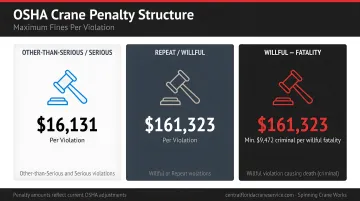
Current OSHA penalty structure (as of January 15, 2025):
- Serious violations: up to $16,550 per violation
- Willful or repeated violations: up to $165,514 per violation
- Failure to abate: up to $16,550 per day
The compliance requirements are specific. OSHA mandates pre-shift visual inspections, documented monthly inspections retained for at least 3 months, annual comprehensive inspections, and operator certification valid for 5-year periods. Power-line clearance minimums start at 10 feet for lines up to 50 kV.
Beyond fines, a single lifting-related fatality can trigger OSHA investigations, potential project shutdowns, civil litigation, and lasting reputational damage.
A 2016 ENR report noted that after a major crane accident, some New York projects raised crane operator insurance requirements from $10 million to $15–20 million. Premiums increased 30–40% for expanded coverage, and one urban crane collapse can generate damages approaching $250 million.
For Central and South Florida contractors, crane-and-rigging providers such as Spinning Crane Works fit into this risk-control process by handling lift execution, equipment operation, and rigging coordination rather than leaving those decisions to an unqualified crew.
When it matters most: On federally funded or publicly bid projects where compliance history affects bid eligibility, and on sites near power lines, occupied buildings, or public rights-of-way where a lifting incident carries compounded liability.
What Happens When Proper Lifting Equipment Is Missing or Misused
The consequences of absent, undersized, or improperly operated lifting equipment rarely stay contained.
A 2024 OSHA case out of Orlando illustrates the pattern: a crane tipped when an outrigger gave way while lifting a heavy concrete sound barrier panel. The boom struck an aerial lift and fatally injured a 37-year-old worker. Two Florida contractors faced proposed penalties for inadequate crane safety protocols.
Nationally, BLS data shows 297 crane-related deaths from 2011 to 2017, averaging 42 per year, with 43% occurring in private construction.
When lifting equipment is inadequate or mismanaged, four consequences usually follow:
- Injury rates spike: Workers attempt loads beyond safe manual limits, leading to OSHA-recordable incidents and investigations
- Schedules collapse: Work stalls without the right equipment, crews stand idle, and labor costs climb
- Compliance exposure multiplies: Improvised methods, uncertified operators, or overloaded equipment can trigger violations and stop-work orders
- Future bids are at risk: Clients and general contractors review safety records before awarding regulated work
These consequences don't arrive one at a time. A single lifting incident on a commercial site typically triggers all four simultaneously.
How to Get the Most Value from Lifting Equipment on Commercial Projects
Lifting equipment delivers value when three conditions line up:
- Match the equipment to the load weight, reach, and site access
- Use certified operators who know that equipment type
- Build the lift plan before crews arrive, instead of improvising on-site
Equipment matching is where commercial projects most often lose time or add risk. Using a forklift for a task that requires a crane, or running an undersized crane at capacity limits, increases both risk and inefficiency. For high-stakes lifts involving heavy loads, significant heights, power lines, or occupied structures, working with a professional crane and rigging service ensures the equipment matches what the lift actually requires.
Spinning Crane Works, based in Melbourne, FL and serving commercial projects throughout Central and South Florida, uses cranes of all sizes to complete your lifts safely. That capacity covers a wide range of commercial HVAC units, structural components, and heavy industrial equipment that commercial builds regularly require.
After major lift phases, review outcomes against three questions:
- Were lifts completed on schedule without improvisation?
- Were there near-misses or unplanned safety interventions?
- Does remaining scope require a different equipment configuration?
Treating lift planning as an ongoing practice, rather than a one-time setup decision, helps keep commercial projects safe, on budget, and clear of costly mid-build surprises.
Conclusion
Lifting equipment is not a background operational detail in commercial construction. It directly drives safety outcomes, schedule performance, and regulatory standing on every project, and its importance compounds across the full build lifecycle.
Injury reduction, operational efficiency, and compliance deliver the most value when equipment selection, operator expertise, and lift planning work together rather than being treated as a procurement checkbox.
For commercial teams across Central and South Florida, Spinning Crane Works supports complex picks with professional crane and rigging service. The team helps crews plan safer lifts from first pick to final placement.
Frequently Asked Questions
What is heavy lifting in construction?
Heavy lifting is the planned movement of materials too large or heavy for manual handling, such as steel beams, precast panels, rooftop HVAC units, or industrial equipment. Crews typically use cranes, forklifts, hoists, or purpose-rated rigging.
What is the heaviest lift on a construction job?
The heaviest commercial construction lifts often involve precast concrete sections, long steel trusses, or industrial machinery weighing hundreds of tons. These jobs require engineered lift plans, certified operators, and high-capacity cranes rated for heavy commercial lifts.
What types of lifting equipment are most commonly used in commercial construction?
Common equipment includes cranes for heavy high-reach lifts, forklifts or telehandlers for site transport, aerial lifts for personnel access, and material hoists for vertical movement. The right choice depends on load weight, lift height, access, and ground conditions.
What are OSHA's requirements for crane operations on commercial construction sites?
OSHA's crane rules under 29 CFR 1926 Subpart CC require certified operators, inspections, load chart compliance, qualified riggers, and power-line clearances. OSHA lists 2025 penalties up to $16,550 per serious violation and $165,514 per willful or repeated violation.
How do you choose the right lifting equipment for a commercial construction project?
Choose equipment by matching load weight, lift radius, height, ground conditions, site access, and nearby hazards. In Florida, a crane and rigging contractor such as Spinning Crane Works can review load charts and build the lift plan before mobilization.
What is rigging in construction, and why does it matter?
Rigging is the sling, chain, shackle, and hardware system that connects the load to the crane or hoist. A qualified rigger keeps the load balanced and secure, especially when workers enter the fall zone to hook, unhook, or guide it.