Choosing the wrong crane partner, though, creates real problems: delayed schedules, OSHA compliance exposure, unsafe lifts near power lines, and equipment that simply doesn't match your site conditions.
This guide profiles the top crane rental services operating in Florida in 2026, breaks down what separates them, and walks through how to evaluate the right fit for your project.
Key Takeaways
- Florida's construction boom, population growth, and storm recovery are driving unprecedented crane demand statewide
- Top providers bring NCCCO-certified operators, hurricane-season experience, and equipment matched to Florida's coastal job sites
- Always verify operator certifications, insurance, and lift planning capability before signing with any provider
- Spinning Crane Works operates 24/7 across Florida with a 100+ ton Link-Belt boom crane and specialized power line adjacency experience
- Book standard lifts 2–4 weeks out — post-storm and specialty work requires additional lead time
Overview of Crane Rental Services in Florida's Construction Market
Crane rental in construction means engaging a company to provide lifting equipment — with or without an operator — on a per-project basis. This eliminates capital outlay, maintenance burden, and fleet management for contractors and project owners. The operated model (crane plus certified crew) is by far the most common arrangement on Florida job sites. Florida's operating environment adds layers of complexity that most states don't see.
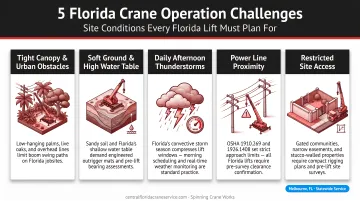
Site conditions that distinguish Florida from other states:
- Sandy, high-water-table soil requires outrigger mats, cribbing, and ground-bearing analysis before any significant lift
- Coastal wind exposure demands real-time weather monitoring and strict adherence to manufacturer wind limits
- Hurricane season (June 1–November 30) creates lift-planning complexity across six months of the calendar year
- Dense power line infrastructure throughout urban and suburban corridors requires operators with specific energized-adjacent experience
- Post-storm crane demand surges can tighten equipment availability within hours
The profiles below cover the top crane rental services actively working Florida job sites in 2026. Each was evaluated on fleet capability, operator credentials, geographic coverage, and verifiable customer trust signals.
Best Crane Rental Services for Construction Projects in Florida (2026)
Companies were evaluated on crane fleet diversity, operator certifications, service area coverage, industry experience, and verifiable customer trust signals.
Spinning Crane Works
Spinning Crane Works is a professional crane and rigging company headquartered in Melbourne, FL (Brevard County / Space Coast), serving all of Central and South Florida with 24/7 availability. The company is BBB Accredited with a 4.7-star Google rating.
They specialize in boom crane operations, rigging, and heavy lifting across HVAC, telecom, power utility, tree removal, steel erection, and heavy construction.
Their primary asset is a Link-Belt boom crane with 100+ ton lift capacity and 300-foot reach — a mid-to-heavy capacity class that handles the vast majority of Florida's commercial and industrial lifts without the mobilization cost of 200+ ton heavy-lift equipment. Every engagement includes a certified crane operator, qualified rigger, signal person, pre-lift site survey, rigging plan input, and full equipment and liability insurance.
Spinning Crane Works has extensive experience performing crane lifts adjacent to energized power lines: distribution pole sets, transformer placement, switchgear installation, and downed-tree removal coordinated with utilities. All power-line work is performed under OSHA 1910.269 clearance compliance — separating them from general-purpose crane companies in a state where power line proximity is a near-daily site condition.
| Category | Details |
|---|---|
| Service Area | Central and South Florida (Melbourne, Orlando, Miami, Fort Lauderdale, Tampa, St. Petersburg, Jacksonville, St. Augustine, and statewide) |
| Fleet & Equipment | Link-Belt 100+ ton boom crane, 300-foot reach; full rigging equipment package |
| Key Differentiators | BBB Accredited, 4.7-star rating, 24/7 availability, OSHA 1910.269 power line expertise, pre-lift site survey included, operated-only model (no bare rental) |
Sims Crane & Equipment Co.
Sims Crane has operated in Florida since 1959 — making them one of the longest-running crane companies in the state. Headquartered in Tampa, they maintain branch locations across Florida including Miami, Orlando, Jacksonville, Fort Myers, Broward, West Palm Beach, Vero Beach, and the Space Coast, giving them genuinely statewide reach.
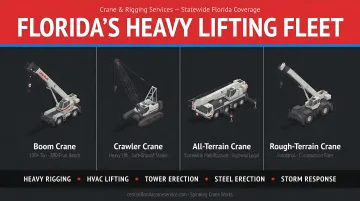
Their fleet is one of the most diverse in Florida, covering all-terrain cranes from 60 to 800 tons, crawler cranes from 90 to 600 tons, rough terrain cranes from 55 to 160 tons, and boom trucks — which means they can match equipment to nearly any load requirement or site condition. They also offer 3D lift planning and on-site consultations, which helps identify clearance conflicts and load path issues before mobilization on complex commercial and infrastructure projects.
| Category | Details |
|---|---|
| Service Area | Statewide Florida — 14+ branch locations including Tampa, Miami, Orlando, Jacksonville, Fort Myers, West Palm Beach |
| Fleet & Equipment | All-terrain (60–800 tons), crawler (90–600 tons), rough terrain (55–160 tons), boom trucks |
| Key Differentiators | 65+ years of Florida crane experience, large multi-branch statewide footprint, 3D lift planning capability, wide capacity range for heavy infrastructure and commercial projects |
Beyel Brothers, Inc.
Beyel Brothers has operated out of Cocoa, FL since 1989, building a strong presence on Florida's Space Coast and surrounding regions.
Their corporate facility spans 300,000 square feet on 92 acres and houses in-house engineering, logistics, project management, a metal shop, and dispatch. Few Florida crane companies operate at that scale under one roof.
They offer a turnkey package covering crane rental, rigging, heavy haul, and marine services, which makes them a strong option for complex industrial or marine-adjacent projects on the East Coast of Florida. Their BBB rating is A+.
| Category | Details |
|---|---|
| Service Area | Florida Space Coast and surrounding regions (Cocoa, FL headquarters) |
| Fleet & Equipment | Crane rental, all-terrain cranes, rigging equipment; specific tonnage range not publicly confirmed |
| Key Differentiators | BBB A+ rated, 37 years in business, 92-acre facility with in-house engineering and logistics, turnkey crane + rigging + heavy haul + marine package |
Maxim Crane Works
Maxim operates Florida branches in Tampa and Pompano Beach, serving both the Gulf Coast and South Florida markets. Nationally, they're one of the larger crane rental operations in the country, with a fleet that spans tower cranes, mobile cranes, crawler cranes, boom trucks, and rough terrain equipment.
They offer both bare rental and operated-and-maintained (O&M) rentals — a useful option for contractors who supply their own certified operator. Their O&M model covers setup, transportation, operation, and maintenance, which suits industrial plant turnarounds and petrochemical work where multi-crane setups and extended project windows are common. For complex industrial outages, Maxim recommends beginning planning 6 to 12 months in advance.
Note: OSHA cited Maxim for two serious violations following a 2024 Fort Lauderdale crane-collapse investigation — worth factoring into your due diligence.
| Category | Details |
|---|---|
| Service Area | Tampa and Pompano Beach branches; broader Southeast US coverage |
| Fleet & Equipment | Tower cranes, mobile cranes, crawler cranes, boom trucks, rough terrain cranes |
| Key Differentiators | Bare rental and O&M options, strong industrial/petrochemical project experience, multi-crane project capability |
Bigge Crane and Rigging Co.
Bigge's Fort Lauderdale branch at 420 W McNab Road serves South Florida including Pompano Beach, Miami, Hialeah, Hollywood, Miramar, and Coral Springs. The company positions itself as operating the largest bare rental fleet of crawler and rough terrain cranes in the U.S., giving South Florida contractors access to heavy-capacity bare-rental equipment without the lead time typical of national fleet rotations.
Their Fort Lauderdale facility specifically provides crawler cranes, telecrawlers, and rough terrain cranes — crane types well-suited to Florida's heavy infrastructure, port, and coastal construction work where soft or uneven ground conditions demand tracked undercarriages.
| Category | Details |
|---|---|
| Service Area | Fort Lauderdale, Pompano Beach, Miami, Hialeah, Hollywood, Miramar, Coral Springs |
| Fleet & Equipment | Crawler cranes, telecrawlers, rough terrain cranes, all-terrain cranes; bare rental focus |
| Key Differentiators | Claims largest U.S. bare rental fleet of crawler and rough terrain cranes, dedicated South Florida branch, strong fit for heavy infrastructure and coastal/industrial projects |
How to Choose the Best Crane Rental Service in Florida
The most common mistake contractors make is selecting a provider based on the lowest quote. Price matters, but a cheap lift that results in a compliance citation, a delayed project, or an unsafe lift near energized lines costs far more in the end.
Verify Operator Certifications and OSHA Compliance
Florida follows federal OSHA 29 CFR 1926 Subpart CC for cranes and derricks in construction. NCCCO (National Commission for the Certification of Crane Operators) certification is the recognized industry standard — operators must recertify every 5 years. Ask for documentation. Any reputable Florida crane company will provide it without hesitation.
For lifts near energized power lines — a common scenario across Florida's utility-dense urban corridors — the relevant standard is OSHA 1910.269. Not every crane company has operators trained in power-line-adjacent work. Confirm this experience before you commit — the exposure risk if something goes wrong is not recoverable.
Match the Crane Type to Your Site and Load
The right crane type depends on more than just lift capacity.
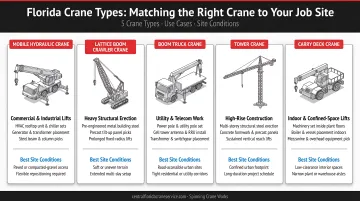
- Boom trucks: Smaller commercial work, HVAC, utility, and telecom — fast to mobilize and cost-effective for lighter lifts
- All-terrain cranes: Roadable heavy lifts, multi-location commercial projects, industrial sites
- Crawler cranes: Heavy infrastructure, soft coastal ground conditions where ground-bearing plans support a tracked undercarriage
- Rough terrain cranes: Industrial yards, uneven sites with limited prepared access
- Tower cranes: High-rise and dense urban construction, particularly in South Florida
Florida's sandy soil and high water table mean ground-bearing capacity must be confirmed before any significant lift. OSHA requires firm, drained, and graded ground conditions, using mats, blocking, or cribbing as needed. A crane company that doesn't ask about soil conditions before quoting is a red flag.
Confirm 24/7 Availability and Emergency Response
Post-hurricane rebuilding, storm-response utility work, and tight construction windows don't follow business hours. Confirm whether a provider can dispatch outside standard hours and whether they maintain a dedicated emergency response protocol for storm events. A provider worth hiring will have a clear answer — not a vague promise.
Require Insurance and Lift Planning Documentation
Before committing to any Florida crane rental provider:
- Certificate of insurance covering general liability and equipment — get this before mobilization, not after
- Lift plan input or engineered lift plans for complex picks — confirm this is included, not a paid add-on
- References from projects similar to yours in scope and trade
- Confirmed mobilization timeline so the crane arrives when your crew is ready
Conclusion
Choosing a crane service in Florida comes down to more than finding available equipment. The right partner brings a properly matched crane, certified operators, local terrain knowledge, and a documented safety record — all of which directly affect whether your project finishes on schedule and within budget.
When you evaluate providers, go beyond the quote. Ask about:
- Lift planning support and pre-lift site surveys
- Response times for both scheduled jobs and emergency dispatch
- Operator certifications and OSHA compliance history
- Demonstrated experience in your industry — HVAC, telecom, power utility, steel erection, tree removal, or post-storm cleanup
For construction and industrial projects across Florida, Spinning Crane Works provides 24/7 crane and rigging services with a 100+ ton Link-Belt boom crane, 300-foot reach, and certified operators trained for power line-adjacent lifts under OSHA 1910.269 compliance. Call 321-759-2263 to discuss your project.
Frequently Asked Questions
How much does crane rental cost per hour in Florida?
Rates vary based on crane type, lift capacity, project duration, mobilization distance, and whether you're booking a bare rental or an operated-and-maintained service. Key cost drivers include boom configuration, ground preparation, permits, and weather standby time. Most operated-and-maintained contracts price mobilization as a flat fee separate from the hourly or day rate — get itemized quotes from at least two providers before committing.
What types of cranes are most commonly used on Florida construction projects?
Florida projects draw on several crane types depending on load and site conditions:
- Boom trucks — smaller commercial, HVAC, and utility lifts
- All-terrain and rough terrain cranes — mid-to-heavy commercial and industrial work
- Crawler cranes — heavy infrastructure and soft coastal ground where outrigger-based cranes struggle
- Tower cranes — high-rise construction in dense South Florida urban markets
Do crane operators need special certifications to work in Florida?
Yes. Florida follows federal OSHA 1926 Subpart CC requirements, with NCCCO certification as the industry standard. Operators must recertify every 5 years. Licensed Florida crane companies employ certified operators as a baseline — always request operator credentials and proof of insurance before a provider mobilizes on your site.
What is the difference between a bare crane rental and an operated crane rental?
A bare rental provides equipment only — the hiring contractor supplies their own certified operator. An operated-and-maintained rental includes the crane, a certified operator, transportation, setup, and maintenance responsibility under one contract. Most Florida commercial and industrial projects use the operated model. Note that not all crane providers offer bare rental — confirm availability upfront if your crew holds their own NCCCO certifications.
How does Florida's weather affect crane operations?
Hurricane season runs June 1 through November 30, with peak activity in September. High winds, afternoon thunderstorms, and soft soil conditions require operators to monitor forecasts closely, use outrigger mats for ground stability, and follow manufacturer wind speed limits. Miami-Dade County specifically requires tower cranes to be set in weathervane position before tropical weather events.
How far in advance should I book a crane rental for a Florida construction project?
Book standard commercial lifts at least 2–4 weeks in advance. Specialized or large-capacity cranes require more lead time, particularly during hurricane season or post-storm recovery periods when demand spikes significantly. For industrial plant turnarounds involving multiple cranes, planning should begin 6 to 12 months before the outage window.